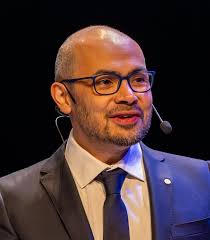
It would be great to have some sort of regulation, but I think it needs to be smart and adaptable because it needs to adapt to where the technology ends up going and what the problems end up being. If we were to talk five years ago, as we first did, it would have been very different worries people would have had about the technology compared to today. And it will be different again in two or three years time. But the most important thing is it's got to be some form of international cooperation because the technology is across all borders. It's going to get applied to all countries or jurisdictions. I sometimes talked about a kind of CERN-like international effort, like we have in physics and other subjects, where we're carefully approaching this event horizon of AGI. It's turned out the technology has gone in a different way. It became commercially applicable much more quickly, and so the capitalist engine does what it does best, and undoubtedly has driven progress much faster than it would have happened otherwise. The amount of investment going into data centers, all the hardware and other things everyone's familiar with. But I do think that we should be thinking very carefully about these next steps, and scientifically, ideally use a scientific method to try and have as much foresight as possible before these systems arrive, these AGI systems arrive and are widely deployed. But we'll see if that's possible. I still have a lot of chief executives that say, I think I understand AI, but not really. What's your AI utopia? What does it look like? Well, an AI utopia, the good versions of this that those of us who worked in it for a long time have always hoped for is if you build a general intelligence, an artificial general intelligence, you could use it to crack what I call root node problems in science. These are problems where if you unlock them, it would allow for whole new branches of discovery or applications that couldn't have been done before. I think AlphaFold was one of those that unlocks drug discovery, structural biology, many areas in biology and medicine. And I think there are a few more that are needed like that, maybe in energy, material science, and so on. And then I think what it could look like if everything goes well is a sort of radical abundance if we solve things like energy. There could be many ways: optimal batteries plus new better solar materials, or perhaps we help the fusion folks get to break-even point in fusion. So there are several different ways, I think, room temperature superconductors.
Cite this transcript
APA, MLA, BibTeX
APA
Hassabis, D. (2025, June 8). Demis Hassabis at SXSWLondon [Interview transcript]. AI Institute. CEOInterviews.AI. https://ceointerviews.ai/interview/450965/
MLA
Demis Hassabis. "Demis Hassabis at SXSWLondon." AI Institute, 8 Jun. 2025. Transcript, CEOInterviews.AI, https://ceointerviews.ai/interview/450965/.
BibTeX
@misc{hassabis2025_450965,
  author       = {Demis Hassabis},
  title        = {Demis Hassabis at SXSWLondon},
  howpublished = {Interview transcript, AI Institute. CEOInterviews.AI},
  year         = {2025},
  month        = {jun},
  url          = {https://ceointerviews.ai/interview/450965/},
  note         = {Speaker-attributed transcript with timestamps}
}