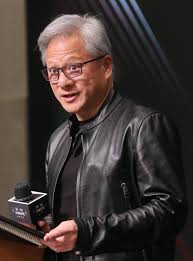
Collection of colleagues here in physical space and we're going to have an interesting conversation with Jensen Huang. I would waste your time by introducing him. You know, everybody knows Jensen, but what you may not know is that he started from fairly humble roots. Your mom was a school teacher. Your dad was a petroleum engineer. You and I share one thing in common: we both started off our first job running a dishwashing machine in a restaurant. Denny's, you? What was your restaurant? It was at Mount Rushmore, when all you... but you did better than I did. He became a bus boy and later a waiter, and then I guess led him to Nvidia. It's a remarkable story. I think it's the quintessential American story, that we welcome people who come with just energy and imagination and creativity, and they make an astounding success. Congratulations, and thank you for joining us. We're going to have a very interesting conversation today. Colleagues, Nvidia is not only a huge economic success, but it's a national security platform, and I think we want to talk about that today. I've been looking at your website, and you do talk about Nvidia as being a platform. What does that mean?
A platform is something that you build other things upon. Nvidia is the largest pure play technology company the United States has ever seen. In fact, we're the largest pure play technology company the world's ever known. We create technology out of nothing. Our final product is pure technology. And in order to use it, you have to create software and applications for various industries above it. If you look at most of the technology companies today, some of it could be in social media, some in e-commerce, some in information search. These are all amazing technology companies whose business models are something else. Our business model is purely technology. The way that AI works and our technology works is that in the final analysis, the technology platform is built in layers, and that's one of the reasons why we think of it as a platform. You're standing on top of it. An application or an industry stands on top of that platform. That platform starts with energy on the bottom. One of the reasons why this administration has made such a huge difference right away is its pro-energy growth initiative. Its attitude about energy is that if we don't have energy, we can't enable this new industry to thrive. It is absolutely true. So layer one is energy. Layer two is essentially the chips and systems, but the chips—that's where Nvidia comes in. Layer three is a whole bunch of software, and we build a whole bunch of software on top of our chips. We're well known for this piece of software called CUDA, but there are hundreds of different pieces of software that we create that enable people to do AI for different fields of science, language, images, robotics, manufacturing, etc. That third layer is called infrastructure, basically software. People historically have thought of infrastructure as cloud, but increasingly it's really important to realize that infrastructure includes land, power, shell, because this industry spawned another industry altogether. The third layer is infrastructure, and that infrastructure includes financial services because it takes an enormous amount of capital to do what we do. Historically, all of that software—the layer above that, and this is where people largely focus on when they talk about AI—is the AI models. This is the revolutionary part: of course ChatGPT, incredible work that Anthropic does with Claude, Google with Gemini, and xAI with Grok. But the important thing to realize is those are four of the one and a half million AI models in the world. AI is not just intelligence that understands English or language, but AI that understands genes, proteins, chemicals, the laws of physics. AI that understands quantum. AI that understands physical articulation, otherwise known as robotics. AI that understands patterns across long sequences of time, financial services. AI that understands longitudinally across multiple modalities, healthcare, and so on. AI has all of these different reaches and domains. We talk about this one area. We just have to be very careful to understand that AI spans basically every form of information across every field of science across every single industry. One and a half million AIs around the world. On top of that are all the applications, and we never should forget that in the final analysis, these AI models are technologies, but technologies are about enabling application and use, whether you're in healthcare, entertainment, manufacturing, self-driving cars, transportation. Each one of these industries has AIs that deeply affect them. This is the five-layer stack. Nvidia is at the lower level, the platform level. The reason why we say we're an AI company that works with every single AI company in the world is because we're the platform by which we are able to work with all of these technology companies and all these application companies across all these industries. That is a platform that we created. The mode people describe—not so much a mode, but the language by which all of these different applications and technologies speak to us—is an architecture we invented 25 years ago called CUDA. On top of that, CUDA library is a whole bunch of algorithms we invented over the years. That is basically Nvidia's platform. In the end, we don't build self-driving cars, but we work with every single self-driving car company in the world. We don't discover drugs, but we work with every single drug discovery company in the world. We're the platform by which they build their things. We're a platform company. I think half a dozen young kids came up to me today and said Nvidia gave them a better gaming experience. Before we invented the AI industry, the first industry we created is the modern gaming industry. You may not know this. I'm very proud of this: Nvidia is the world's largest gaming platform. Probably didn't know that. Most of the kids were talking to me about that today. 300 million active users. 100 million of them on Nintendo Switch. Nvidia is in that.
Okay. So, let me ask you. You said something recently that was quite provocative. You said that China was winning the AI race, the AI competition. I know that you've got a powerful competitor in Huawei, and Huawei has a lot of advantages you don't have. Why don't you describe this competition? Are we really losing?
It was a very good headline. It was a great headline. And apparently caught a lot of attention. As you know with headlines, the disclaimer part, the foundation part, was left out of the headline. But the way to think about that is let me just handicap it right now. If you look at AI, and go back to the first thing we said, AI is a five-layer cake. Let's simplify AI into five layers: energy, chips, infrastructure, models, and applications. Let's handicap it from bottom to top. At the lowest level, energy: China has twice the amount of energy we have as a nation. I want to ask about that. Twice as much energy as we have as a nation, and our economy is larger than theirs. Makes no sense to me. We also know that one of the most important initiatives, one of the most important policies of this administration, and the first thing that President Trump said to me when we met is, 'Listen, we need to reindustrialize America. We need to onshore manufacturing again. We need to help America make things again. It's going to create jobs.' That part of the economy has been offshored and completely gutted the United States. We need to bring that back, and he needs my help to do so. So that entire sector of the economy is missing. However, without energy, how do we build chip plants, computer system plants, and these AI data centers we call AI factories? We're building simultaneously three different types of factories in the United States: chip factories, supercomputer factories, and AI factories. They all require energy. Every single one of them. On the one hand, we want to reindustrialize the United States. How do you do that without energy? The fact that we vilified energy for so long, and President Trump sticking his neck out and taking it on the chin, helping the country realize that energy is necessary for our growth, is one of the greatest things he's done right off the bat. So at the energy level, back to that stack, we're 50% and they're growing straight up. We're kind of flat right now. Number two: chips. We're generations ahead. I think everybody recognizes that. Number three: infrastructure. If you want to build a data center here in the United States, from breaking ground to standing up an AI supercomputer is probably about three years. They can build a hospital in a weekend. That's a real challenge. At the infrastructure layer, their velocity of building things, because they are builders, is extraordinarily high. Now, on chips, we're several generations ahead, but don't be complacent. Remember, semiconductors is a manufacturing process. Anybody who thinks China can't manufacture is missing a big idea. But China discounts energy costs for a chip company by 50%. They provide free transportation for employees to come out to the factory. You can't do that. Our energy cost is more expensive than theirs in the first place, and then they discount 50%. So we're probably four to eight times the cost.
So tell me, how do you feel about this great competition with China? I mean, the government is putting enormous resources underneath their champion. We don't do that in this country. How do you feel about that?
Well, before I get there, don't let me not answer that question. I'm dying to answer it, but let me handicap the next two layers. The large language model layer: United States frontier models are unquestionably world class. We are probably six months ahead. However, out of the 1.4 million models, most of them are open source. China is well ahead on open source. The reason why open source is so important is because without open source, startups can't thrive. University researchers can't do research. You can't teach AI. Scientists can't use AI. Basically, all of the industry around your economy has no ability to fundamentally advance themselves unless you have open source. Without Linux, where would we be? Without Kubernetes, PyTorch, all of these technologies that made AI thrive are all open source. They are well ahead of us on open source. And then the layer above that: applications. If you were to do a poll of their society and ours, and you ask them, 'Is AI likely to do more good than harm?' They're going to say in their case, 80% would say AI will do more good than harm. In our case, it would be the other way around. That tells you something very important socially. Socially, we need to be careful not to describe AI in these science fiction movie ways, causing people so much concern. We want to be concerned, but we also want to be practical. AI is about automation. I think we need to be careful not to fall behind in the application and diffusion of AI, because in the end, whoever applies the technology first and most wins that industrial revolution. As you know, electricity was invented in the UK, but the United States applied it faster and more broadly, and as a result, look where we are. So we have to be a little mindful. So I just handicapped that stack. It's important when looking at AI not to see it as a holistic thing. It's really not about ChatGPT versus DeepSeek. You have to look at it across all of the stacks and across all of the industries. Does that make sense? It's a little more complicated than one simple answer.
But do you feel you have a level playing field up against China putting their resources under Huawei?
First of all, America's technology industry, just as our financial services industry, our military, our technology industry, we can all agree are the mightiest in the world. I am part of one of the mightiest technology industries anyone in history has ever seen. We have going toe to toe against anyone. The American technology industry has nothing to fear. We are mighty. We're fast. We're inventive. We'll take anybody on. However, we can't concede the market to them. At the moment, Nvidia has been banned from going to China. Not to mention, China has banned Nvidia going to China. So I think we're the first company in history that has been banned on both sides. So whoever banned us going to China—them and China—agree that Nvidia should not go to China. Of course, I'm being a little cute here, and I'll be a bit more nuanced in a second, but at the moment we're simply not competing in China. What's going on? We have conceded essentially the second largest AI market, the second largest technology market in the world. Someone has said to me, 'Well, okay, we're not in China, but we'll grow somewhere else.' You're not going to replace China. It's just like the world wanting to sell to America. If they don't export to America, you're not going to replace the United States. We are singular in the world. In the case of China, we shouldn't concede the entire market to them. They're formidable, but conceding that entire market—we ought to go compete for it. Having said that, we should also acknowledge that Huawei is one of the most formidable technology companies the world has ever seen. They deserve all the respect everybody ought to give them. We compete with this company. They're formidable. They're agile. They move incredibly fast. If the United States was not in China, China's AI industry would be set back. Absolutely has not happened. As a result, their semiconductor industry has doubled, doubled, doubled. The semiconductor industry in the west is growing at 20-30% per year. Compounded, versus doubling every year compounded—it doesn't take long to catch up. But you know, they're starting on second base, and we're just going up to the batter's box. They've got a real advantage, and that means we need to think about this.
Can I ask you? At the G20 summit, Li Keqiang, the premier, was there and he was offering opportunities for countries to be participants with China on AI. We didn't even send a delegation. It doesn't feel like we're in the game. They're smart about technology proliferation. If we use 5G as an example, they realize 5G is a technology that's also a platform. On top of 5G, you build all kinds of services. Well, if you get there first, just as Nvidia—I was there 25 years first. For a long time, nobody paid me any mind. So I had lots of time to build up all these ecosystems, applications, relationships, and I connected all this stuff together in all these different fields of industry. I had 25 years to do it. In the case of Huawei with 5G, they were completely isolated through policy. So they had a billion phone users all but to themselves. It gave them the opportunity to grow scale. They exported the technology to all of the belt and road countries, and now there's AI belt and road. They'll definitely diffuse Chinese technology as quickly as possible because they understand that the sooner you get there, the sooner you build the ecosystem on top, the sooner you become sticky, you become an essential part of that ecosystem. Tell me about the Chinese ecosystem they're trying to create. Obviously it's deep and robust, and it has a physical as well as a technological and economic dimension. How do you look at that?
Take a step back again. Nine out of the top 10 science and technology schools in the world are now in China. They lead in science and technology in many different fields. This has completely flipped in the last half to a decade. We used to lead most of them. Now they lead most of them. They have a large population of highly qualified students. Fifty percent of the world's AI researchers are Chinese. Seventy percent of last year's AI patents were published by China. The ecosystem of AI in China is vibrant, rich, incredibly innovative. They work incredibly hard. This is a country with enormous might. That is the ecosystem of software developers. As I just mentioned, the model and application layer—all of these scientists are sitting at the model and application layer. And now they're going to take that capability because the United States is no longer participating in China. We've left China. We've evacuated that market. We've conceded that market. So now they've got to go build their own. Using these AI researchers, all of this incredible computer science capability and richness of software capability, they're going to go build their own complete stack. Once they build that entire complete stack, they'll export it as quickly as you could imagine. This is the world. What we will find someday if we don't activate will be buyers, not sellers.
Let me ask you. You're in Washington D.C. I know you don't look forward to those opportunities, but it's my only opportunity to wear a suit and a tie. But let me ask, because we're involved in something I've not seen before in my 45 years here. We've delved into industrial policy. I always thought industrial policy was something we shouldn't be doing in this country. The Biden administration decided they would define what they would allow you to sell, and they had this thing they called diffusion that they were trying to manage. Now you get the Trump administration. They don't have that, but they want a golden chair and they want a percent of the cut on how you're doing business. Tell me how you look at this industrial policy that we have in Washington.