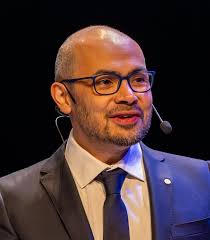
Thank you ministers and government of India and our fellow professors for inviting me here to give this keynote. It's a huge honor to be here. Very excited to see the incredible turnout from the country and the interest in AI, of course, but also from many of my colleagues from around the world in both industry and academia who've convened here. So I'm looking forward to a really amazing couple of days of discussions about the way forward for AI.
When we started DeepMind in 2010, it seems it's only 16 years ago now, but it's almost a lifetime in terms of AI. Almost nobody was working on AI back then, few people in academia but almost nobody in industry. So it's been amazing to see the progress we've made in just over a decade. But at this point, I think we're at a threshold moment where AGI, artificial general intelligence, is on the horizon, maybe in the next five to eight years.
So this summit comes at a critical moment as we start seeing more autonomous, agentic AI systems, much more capable. I think we're seeing the beginnings of what those kinds of systems can do. And of course the opportunities are incredible. My personal passion is using AI for science and to advance science and medicine with systems like AlphaFold. I think we can revolutionize drug discovery and human health, and also areas like material science and climate change with the help of AI.
But of course it also comes with many risks too. AI is a dual-purpose technology. It's going to be one of the most, if not the most, transformative technology in human history. And that's just on the horizon now. And the thing about this technology is it's going to affect the whole world, everybody in the world. It's going to cross borders. So it's very important that we have summits like this, international summits, to bring the international community together to discuss how to make sure the opportunities benefit the whole world.
And also how do we mitigate the risks? And I think in order to mitigate some of the risks, it's going to need international cooperation. And the first step for that is to have international dialogue. And I think that's what these summits, starting in the UK and then in Paris and then in Korea and now here in India, are for and have been really helpful in convening many of the important heads of state and many of the important leaders in this technology together to discuss what is on the horizon. So with that, thank you for having me and I look forward to the discussions here in the next couple of days. Thank you.
So good morning everyone. So you started talking about how amazed you are at the progress that AI has made and you started DeepMind in 2010 with a vision to solve intelligence. So are we there yet?
No, I don't think we're there yet. I have quite a high bar for if we talk about solve intelligence, meaning building artificial general intelligence. Then my measure for that is having a system that can exhibit all the cognitive capabilities humans can, including in creativity, long-term planning, things like that. And today's systems are very impressive, but as we know, they still have many flaws and things they can't do, including consistency across different tasks that you would want from a general system.
So you did mention AGI, right? So what do you think really that we can do to take where we are right now and move it towards artificial general intelligence as you define it?
Well, when I look at the current systems and what's missing from them being a kind of general intelligence, I would say things like continual learning. So learning after they've been trained and put out into the world. Today's systems, we train them, we do various different types of training on them and then they're kind of frozen and then put out into the world. But what you'd like is for those systems to continually learn online from experience, to learn from the context they're in, maybe get personalized to the situation and the task that you have for them. And today's systems don't do that.
Also, they have difficulty in things like doing long-term coherent plans. They can plan over the short term, but over the longer term, like the way that we can plan over years, they don't really have that capability at the moment. But I think probably one of the biggest issues is what I would call consistency. So, today's systems, they're kind of like jagged intelligences. They're very good at certain things but they're very poor at other things, including sometimes the same things. So for example, today's systems can get gold medals in the International Math Olympiad, really hard problems, but sometimes can still make mistakes on elementary maths if you pose the question in a certain way. A true general intelligent system shouldn't have that kind of jaggedness.
But aren't humans jagged as well?
No, not in that way. I don't think so. So, I think if you're an expert in maths, and many of you in the room are, or in physics or something like that, you're not going to sort of make a mistake on a strictly easier, more trivial problem, right? You would have some way to work through that problem. Similarly, let's take the example of games, which is very close to my heart and we've used in the early days of DeepMind to train our AI systems. Today's general foundation models are very poor at, for example, playing chess, below kind of weak amateur level, and that is not what you would expect from an AGI system.
There are other tests too that I would have, like true creativity. So AI is very useful as a scientific tool, an assistant, or for solving specialized areas like AlphaFold does with protein structures. But really what separates great scientists from good scientists is their creativity and their sort of, maybe you could call it, taste for what's the right question, what's the right hypothesis. And it's much harder to come up with the right question and the right hypothesis than it is to solve a conjecture. And I would call that the highest level of sort of creativity. And so far today's systems, they don't have that capability. One way we maybe would test that is you could imagine training a foundation model with a knowledge cutoff of something like 1911 and then see if it could come up with general relativity like Einstein did in 1950. But that would be a good test I think for AGI and I think today's systems clearly would not be capable of doing that, but I think this will be solved in time.
Okay, that's great. So you talked about scientific tools, a tool for scientific discovery, right? And so we see a lot of headlines about AI making great breakthroughs in science sometimes, but how would this become the norm, right? I mean, so do you see AI becoming the scientific tool for discoveries?
Yeah, the reason I spent my whole life and career working on AI is I saw it quite early on as if you could build these kind of general models that were good at pattern recognition, they would be incredibly useful scientific tools, maybe the ultimate tool for science. That's what I was thinking. A lot of science is about finding insights and structure in vast amounts of data, that's perfect for AI. And so I think we're going to enter in the next probably 10 years this new golden era for scientific discovery, almost a new renaissance using these incredible tools like AlphaFold, but I hope that will be the first of many that can massively speed up our research and accelerate scientific discovery across almost any subject area.
So I think that's going to be the next period is using these systems as tools and then after that we'll see as they become more autonomous, can they be kind of like co-scientists with you, like a PhD student and something like that. I think we're still quite away from that but maybe in 10 plus years that will be possible.
So just to reassure a good fraction of the audience, you still see a role for humans in that future, right?
Yes, I think the next phase is going to be incredible for human experts and scientists, the amount of work they'll be able to do. And I'm actually really excited about cross-disciplinary science, which is quite hard because you have to understand more than one subject area, maybe two, three, four subject areas and then find some interesting connections between that. I actually think that's where a lot of the really valuable advances are going to happen in the next few years, these combinations of subject areas. And I think having a tool like AI will really help scientists learn about and be able to understand and process all of that information from multiple different domains.
So in some sense science is a well-defined field if you will, I mean you can recognize success and so on so forth. So what do you think would be the role of AI in more abstract domains like policy, other kinds of public decision making?
I think things like science, but especially if you take coding and maths, are more amenable to the current systems we have today, mostly because especially coding and mathematics, but also things like games like chess, they are verifiable. So the answer that the AI system outputs can be checked for correctness. And so it's very useful for when you're training these systems, you can have databases of questions and check to see if 100% if it's right or not. I think of course when you get into the arts and the humanities, things like decision-making, policy, they're much more subjective. They're hard to run the same experiment twice. So it's difficult to get data about what is a good decision in those cases. So I think those areas will be a lot harder for AI to model.
So as a neuroscientist, what do you think we have learned about human intelligence itself with all these advances in AI that we see?
Well, I think when you're in the early days of this modern AI phase, which maybe you could say is the last 20 years with the advent of things like deep learning from Jeff Hinton. A lot when we started at DeepMind too, we took a lot of inspiration from the brain. High-level systems inspiration, not the direct mechanics of the brain, but things like episodic memory, what does the hippocampus do, which is what I studied. How obviously neural networks, reinforcement learning, your area, which we know the brain dopamine system implements. So we kind of took inspiration from the brain, which is the only general example of a general intelligence that we know of maybe in the universe, as a starting point. And so we sort of knew that it was possible in the limit, right? And I think that's why neural networks and reinforcement learning have been so successful because I think learning is the key to these modern AI systems working, not being programmed with the answer like expert systems were in the 90s, like Deep Blue, but actually allowing the systems to learn directly from data.
And I think now what I view looking back at neuroscience is how efficient the brain is, sample efficient. It doesn't need to ingest the whole of the internet to understand things. So it's a different, what we've built now today uses some of the same principles but it's been manifest in a very different type of system than probably the way the brain works.
Thank you. So, one of the things that people always talk about is the safety risk, security risk from AI and so on so forth, right? And so, what does DeepMind's stand on this and how do you approach making sure that AI is safe?
Well, we've been, when we again when we started DeepMind, we actually, you know, were planning for success. Our mission statement was solve intelligence step one and then step two, use it to solve everything else, which at the time sounded like science fiction, but I think now it's becoming clearer how that might be possible. And applying AI to almost every subject area, but we planned for success. So even though we were just starting out and the field was mostly just building up a head of steam, we understood also the implications of that if that did turn out to be the case and we thought about it as a 20-year mission and I think we're basically on track for that, you know, around 2030, then it would come with these attendant risks as well as the enormous benefits to science and medicine and all these things that I think we need as a society to help with our other challenges, many other challenges that we have around the world.
But also as these systems become more powerful, I think there's, you know, at least two risks that we've always worried about. One is bad actors, human actors, but individuals, but could be also nation states using these systems and repurposing them for harmful ends because they're dual purpose. But then also as we get closer to AGI and I think we're entering maybe a kind of agentic era, should we call it, where systems are more autonomous, I think we'll see a lot of that happening this year and next year. Then we have to make sure as well that the guardrails are in place that these systems do what we expect them to do and don't veer off into areas that we hadn't planned for. And that could also be problematic. So I think those are the two challenges. There's a very sort of societal one which I think also is going to require international dialogue and maybe ideally a minimum set of standards that is agreed internationally. And then the second one is more of a technical risk of how can we make sure these systems are robust and reliable.
So I mean setting aside all existential risk questions. So what do you think is the top two risks that we should address with AI systems today?
Well, I mean I think I mentioned the two classes of problems. I think we need to worry about things like bio and cyber risk very soon. I think that the current systems are getting pretty good at cyber and I think we need to make sure cyber defenses are more powerful than the attack vectors. And it's something that we work on quite a lot at Google and at DeepMind is sort of using AI for cyber security to make sure that of course it's a very useful tool for cyber defense too but you need to make sure that the defenses are stronger than the offenses. So I think those are kind of near-term risks. But there are many that we need to think about and do a lot more research on and some of them are to do with agreeing a sort of a set of standards which I know many people including yourself are trying to work on.
Great. Thank you. So again talking about international collaborations, right, so you said that we really have to work on that. So an audience like this or a gathering like this where we are trying to involve the global south very much in the dialogue, right, so what do you think would be the impact of such gatherings on the overall direction of AI do you think and are these going to make a big change?
I think so and I think that's why it's important we convene this summit around the world because this technology is going to affect everyone. It's a digital technology, so it can't really be contained by borders. There's things like open source, which is generally very good, but also one has to think about if you found a vulnerability or some issue with an open source piece of software, how do you recall it? How do you patch it? There's no recall. So, we need to think about that. These are new issues with something like AI where it's hard ahead of time to fully understand if there are any vulnerabilities.
And I think for the global south and countries like India, I think there's huge opportunity for the youth of today. You all have access to pretty much the most cutting edge tools in the world, right? I don't think that's ever sort of happened before, maybe only three to six months after they've been invented in the frontier labs. And I can say as someone working on the whole face of this, we barely have time to understand what are the amazing capabilities that could be supported by these models in products and applied research. So I think there's so much potential there to be explored and I think we'll see a lot of that. And hopefully many of you in the audience too, entrepreneurs here, you can do incredible things, maybe 10x of what you could do before because these tools are so capable and they're available almost instantly around the world.
So I have a question. It's more specific because you are right now in India, right? So the Indian population, like as we, one of the things that a lot of people have been remarking is that the crowd at this summit is extraordinarily young, right? So this youthful energy, right? So you think what would be the role that India can play effectively in the future given the resource constraints of India and but also the availability of this talent pool?
Well, look, I've been incredibly impressed already about the energy that's here and we heard from the minister that the youth of today and in India especially. I think when you see the polls on this are very positive about AI which I think is great. And what I'd recommend to the students of today is to really lean into becoming incredibly proficient with these new AI tools. And I think over the next 10 years that will almost kind of make them superpowered in terms of what they're able to do, whether that's business or science. And it's a little bit like the dawn of the computer age or maybe mobile or internet that we went through. The generation that grows up native with that technology will end up doing sort of incredible things that we can only dream of right now. And I think that's going to happen with AI and I think India and the youth here can be at the vanguard of that.
Since this is a research symposium, can I ask you to get a little technical on the next?
Sure. Great. So we saw the evolution of how AlphaFold started off by building on top of existing work from the Baker lab and then moving on to evolving all on its own, right? So what do you think is the next stage technically in the evolution of these kinds of co-scientist models?
Yeah, so well with AlphaFold we actually built a new completely new system but it required the PDB, the protein database. So it needed the 150,000 structures that humanity had painstakingly found over the last 50 years through experimental work, right? And that turned out to be only just enough data to actually solve the problem and build a system like AlphaFold. The interesting thing is in the debate we have at DeepMind and other places is what's the difference between the general system which you can think of like the brain and the tools that it uses. So for us as humans there's no debate about what's our minds and what are our tools because obviously it's physically separated. But if both things are digital and in some cases both things are AI, the tool and the orchestrating system, then what do you put in the main system and what do you leave as a specialized tool?
Now in my opinion I think you'll end up with, in our case with foundation models like Gemini, will use things like AlphaFold as a tool. So if Gemini wanted to or needed to fold a protein, understand the structure of a protein, I think it would be better for it to call AlphaFold as a tool, then put all of that protein information into the main system. And I think if you want to talk about it technically, I think the choice comes down to if you put that data into the main system, does it help with other tasks? Does it transfer to other tasks or does it actually degrade the performance on those other tasks? So, it's actually an empirical question. So that's why for example coding and maths we put that in the general foundation models because it turns out if you get good at coding or maths you're actually better at planning and reasoning in general. So it's a useful skill but it also generalizes. But something like folding proteins probably is a very specialized skill that wouldn't necessarily transfer to other domains. So I would be of the opinion that we should leave that as a specialized tool.
Oh that's interesting because a lot of learnings from robot path planning was used for trying to solve protein folding. So you think knowing how to protein fold will not transfer back to other domains?
It might do, but we would, I think it's, in fact we do these experiments all the time on smaller scale models where we ablate different data sets and we try and mix in certain data sets and see if they help or if they regress some benchmarks. Like it would be no use if you put all the protein data in and then it got worse at language for example, which is probably currently what would happen. So maybe over time with an AGI system, you just have everything in the one system. But I think for the foreseeable future I think it'll be more efficient to still have separate tools. Also those tools by the way might be hybrid systems in that they might not be just learning systems. They might also have built-in structures like AlphaFold did actually about physics and chemistry and chemical bonds that you could learn but would be more efficient to just tell the system or program that indirectly.
So now that I mentioned the word robots, so I'd like to ask you what's next in physical AI?
Well look, I think I'm getting increasingly excited by robotics. I probably wasn't so interested in that 10 years ago because I felt that the issue was the algorithms not the physical construction of the bodies. I thought the algorithms were the thing that was behind. Now I think algorithmically and actually we're very excited about Gemini robotics because we built our foundation model to be really good multimodally. So it could understand vision, image, the world around us. So it has a very good understanding of the physical world and that's exactly what you'd want for robotics is a kind of general system that understands the physical context the robot's in. So I think we're probably in the next two, three years we're going to see some very interesting new breakout moments for robotics. I think there's still quite a bit more research to be done. I don't think we're there yet like some robotics companies are claiming. And I think we'll have humanoid robots and also non-humanoid. I think both will be useful. But I think in the next couple of years there'll be some really breakthrough moments. So I think it's a very exciting space to watch and a good area to get into right now.
So a little tricky question. So a lot of people are, you know, I mean there is a lot of fear mongering around AI. I mean we know that most of it is unnecessary. But if you start getting humanoids that are running off foundation models, do you think the fear factor would go up?
Potentially. I mean it depends how we design those humanoids but I think some risks go up too, right? Again depends on what you deploy them for and I think increasingly especially if the humanoids are pretty capable and they're heavy, you know, there are dangers and risks with that. So I think we need to have those guardrails that we were discussing earlier in place by the time there's a lot of robots roaming around.
Great. Thank you. So now we've talked enough about risk so let's talk a little bit more about the positivity of things. So you know a lot of the benefits of all this cutting edge AI right now still seems to accrue to the countries that have more resources, right, that have GPUs that can run their models there and so on so forth. So what kind of initiatives should we be looking at to reach the global south, benefit a larger fraction of the population?
Well, look, I think we kind of touched on it earlier, but the leading foundation models, maybe there's three or four of them and perhaps they're pretty much available very cost-effectively, you know, a few months behind, also open source. I mean we work on our own open source models, Gemma, which we'll be releasing a new version of soon which are very powerful for edge devices. So I think that's very interesting areas, really efficient models for computing on the edge, whether that's your phone or a single laptop or eventually robotics. I think there's huge opportunities there for optimizing what those kinds of models do and the types of products or applications you can build on top of that. So I think there's a lot of potential there for those types of work to happen.