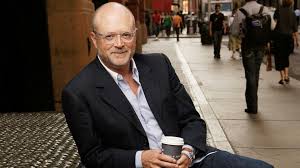
I'm Laura Vinritpool of Capital and this is what we wore. I love a brilliant merchant and there's no one more legendary than Mickey Drexler. Mickey is the former CEO of Ann Taylor, The Gap, J. Crew, and the founder of spin-off brands Old Navy and Madewell. He's currently the chairman of Alex Mill, the New York-based women's and men's fashion brand, where he works with his son, Alex. This episode is a true retail masterclass and a lot of fun, too.
The first time that I heard of you was in the late 80s. I was probably 16 years old, maybe 17, and I was at Andover, and I don't know if I was in a dorm room, a common room, or it was a classroom. Somebody came in and said, you know, we're talking about Gap going out of business. And somebody in the conversation said, don't worry about it because they have the smartest person who's ever been involved in retail at the helm. He's going to save their asses.
Wow. So, this is late. I mean, this is a really I'm 51 years old. This is a really long time ago, but I remember it specifically. And they said, "It's Mickey Drexler." And I was like, I don't know who that is, but noted. How did he know about me?
It was somebody who turns out to be our mutual family friend.
Okay. Anyway, thank him for that. You know, compliment early on.
Isn't that funny though? 1988 probably.
You know, it's funny. I remember things like whatever struck me the same way on issues that happened 30, 40 years ago, both good and not so good, but I can repeat so many things, but I'm happy to hear that.
Well it's true. Where are you from?
Well, I grew up in the Bronx, New York.
You know, I didn't know any better about what existed outside the Bronx. And my mother was ill when I was born and she survived for 16 years with breast cancer and she died of esophageal cancer because she was a chain smoker. And my father, he wanted desperately to be successful and he was not. He worked in the shipping room of a garment coat company. You know, my mother had three sisters. It was like a kibbutz. They lived down the street. Two of the three of them in a home, a two-story house that my grandparents lived in. They came from Poland, first generation. I used to escape to their house because my cousins were all there. And one of the things I think I got out of all this was living in my imagination. It wasn't easy at all. So I went to Science High School which changed my life a lot. I don't know if you know of it here in New York.
Well, it's considered you're automatically smart, but I got in. I didn't know, you know, I just took a one single test, so you don't have to bribe anyone. You don't have to write essays. You take a test. So, the whole grade at PS76 took the test. And I was one of five who got in. I was really surprised. I never it just surprised me. I was always good in mathematics. I didn't know how to spell science. But that was so it changed my life because all of a sudden I was with people who got always better grades than me and I used to get intimidated by their high grades. I went there for four years. But I'll tell you how it changed my life. No one of my seven cousins went to college. And when I went to Bronx Science, it was automatic that you went to college. Everyone went to college.
Your mother died when you were 16.
I was 16. Yeah. I was a sophomore in high school and she died then. And I was waiting for her every day. I knew she was dying. I knew she had a mastectomy but they never told you in those days. But I knew, I saw it, and it was something I carried around with me mentally always.
That you were going to miss that moment or school and not being successful.
Well, not I didn't worry about not being successful because that wasn't a category. I was too young. I worried about everything because the environment, the way I got out of town was the only way. I applied to Buffalo and the University of Pennsylvania. Why? I would never have gotten in anyway. Buffalo's a state school. Thank God I got in. The reason I picked it is some guy I knew went there. I didn't know from colleges. Thank God I got in. And then I went off to school that September. You know, I was on my own, which is okay. I knew the one kid. So, I graduated, you know, two years later. I was definitely afraid of going into the army, the Vietnam War. So, I had a little ploy and I probably I started seeing a psychiatrist.
Because I knew section. On the other hand, I needed to see one that I didn't know. It was a ploy, a total ploy. And so I was seeing and then when I moved back to New York, I continued seeing someone. And then when they sent me the letter, you know, plus every night, you know, I got married young and I'm sleeping, I'm nervous every night that I get the letter. So the letter finally comes and I have my psychiatrist letter, section eight it's called. And you know this is it was just a nightmare. Gentleman, you know, you think you're cold now, just wait, you know, whatever the [__] out of me. So I get to the desk, I hand the letter, and I wasn't eligible, which by the way he didn't say, you know, you wouldn't be eligible anyway. That full hair with you know, it just so I didn't go and I loved my job at Bloomingdale's then.
You started at Bloomingdale's then?
Yeah, right after I went to well I also worked in retail. I worked at A&S which is I don't know if you remember it was a crap house.
What are some of the most important lessons you learned in those early years of Bloomingdale's or Macy's, A&S?
Now Macy's wasn't so early. I six years Bloomingdale's and a year and a half at Macy's, which forget about it. And then a bigger mistake at A&S. I mean, and I never met someone who I could really admire. I, you know, you don't say that, but the one person who was the most important in those early years was a woman named Katie Murphy. She was the fashion director at Bloomingdale's. You know, she could out merchandise anyone there, but she was this I don't know, they had her be my I don't like the word mentor because then they never used that word. But Katie and I, we took few trips to Europe a year. I bought sweaters and swimwear. So, we'd go to the sweater factories and we had tremendous compatibility with each other. She was Irish and I was 25, she was maybe 45 or whatever. Wonderful woman. I miss her. That was the first person who got me. I went on and at Bloomingdale's and then I quit after six years. So I left after six years at Bloomingdale's because I saw people getting promoted around me, age, service.
I didn't know that I had no respect for but inside knew Ed Finkelstein did one thing, he recruited me with I'll never forget this. I learned my lesson, that was a big lesson because I went to work for him. I was in the branches at Bloomingdale's, those are the days you, you know, training whatever and then to the branches. And he called me and said, "Hi, this is Ed Finkelstein. I just want to welcome you aboard." Now, Ed was a huge name. I was so happy about that. I do that all the time, but that's how I do anyway, but never forgot that. But I didn't realize the rest of it. So, so I quit, about a month. I got a job at A&S. This the owners of then Bloomingdale's and A&S, Federated. They were, they recruited me back. I said yes. Four and a half horrible years working for Allan Gilman who was he didn't know a thing about anything. But, you know, in him, I kind of had a sense. I was miserable. I didn't know what I would do. I really didn't. I was in New York. Well, you know, you can't afford to live in New York what I was making. And someone called me said Ann Taylor's looking for a CEO, whatever. Ann Taylor, 25 million, 25 stores. I said no. And then I said no again. And these are moments in your life. So, I had dinner with a guy who was older, richer, and then we don't talk to each other. And he always hung out with much younger people, which I was. We're having dinner with him one night. And he said, "What are you doing? What are you up to?" I told him the story that I turned it down because I was worried about, you know, I made a salary and.
And he said, "Take the job. You're better off running a $25 million company than being a vice president of a 500 million." So next morning I was praying they didn't fill the job. They didn't fill the job. I called the president of the corporation said Manny is that position filled? He said no way. I said I'm taking or whatever I said and I took the job.
That's when they started to call you the turnaround king, right?
Okay. Turnaround is to me not what I do or what anyone does who has a long-term view of building a business. You don't turn it around in those days. Yeah. Turn around. That was the only term they used. And for a public company, which Ann Taylor wasn't, you know, turnaround people, oh, they get the stock up in a year or two, the turnaround this, turn around that. You can't build a company in a year or two. I was 18 years at GAP and building and at J. Crew, I built the Old Navy. I founded that. I think you know, I named it after a store. I don't know if you know after in Paris. And that was with lots of resistance from the board. I don't know if you don't have a board, but if you have them, you know, there's very few people who get it.
Yeah. But at Ann Taylor, could like right when you got in there, was it clear what needed to be done?
You know, it's funny. People ask me and I say I guess yeah, I did. I learned very quickly from my experience at the department stores and from Brooks Brothers who was owned by the same company parenthetically. I could see the CEO was bringing it down, taking quality out, doing this that other thing and it became what it is.
My prom dress was Ann Taylor. It really was. I mean, it used to be really, really beautiful.
Well, the company was a nightmare as I thought it was Gap and J. Crew, but I liked famous companies. Well, Ann Taylor 57th and Fifth and it had Soho Shakerie there and Joan David Shoes, you know, but I was I whatever. But I liked that it was well known and I liked that it was 50 the headquarters store in our offices. I didn't have I guess I did have a vision.
From there you went to the Gap.
Well, I spent four years there. Six months when I was there we were bought by Allied stores. I was very unhappy about that. I just had a sense, you know, this was a cozy little company. The bureaucrats. They're all bureaucrats. They were in Washington DC. They didn't do a thing. I was on my own at Bloomingdale's as a buyer. I was on my own at A&S because then there was no merchants around who taught or you would follow their examples. I did that for four years and they were trying to bring down the company, put a unit of Allied stores on every shopping bag. I never did it. Of course, they don't know because they never followed up on anything. Then I get a call after four years and I wasn't I never negotiated good deals. I still couldn't afford to upscale my tiny apartment in 35 years old. I was on the board of my building, a fancy building, but I had to cut up a Palm Park Avenue on the back. But so I get a call from a woman named Rose Wells who was a grand I don't want to say old person but Rose was kind of a legend. Everyone knew Rose. She calls me she said you know and she's a consultant for GAP. She says I want you to meet Don Fisher at GAP. I said I'm not moving but of course I'll meet him. So I come in. I was so depressed for the first my wife and I were living in San Francisco. I'm working in San Bruno, California. And I'm thinking I can't stand it here. It's depressing. And the culture, holy [__].
I mean, you'd never lived out of New York.
Well, I No. Yeah. I never lived out but I never worked in an office park ever because I like New York City and the creative energy but the least of it the people there nightmare. And you know you have to do that's the first thing are the people and the most important thing. So I and then I'd sit there and they would know there's a 12:00 flight to Hong Kong. I mean, who gives a [__] because they live, you know, the airport and they would think, "Oh, there's a 1:00 flight for whatever." And then everything was a discount on sale shelf.
Business was going like this. I'll never forget I visited Houston Galleria, parked the car, I get out and I see all these flyers on the windshield. I look at one today only. Gap 30 off.
My god. Like they knew you were coming.
So I went to see Hector who was the district manager. He was in the store and I said, "Hector, what's going on here?" He said, "Oh, we have we do that every once in a while." And I didn't intellectualize. I felt what kind of schllock because I always wanted to I always knew what I guess I knew what other what taste or style I don't know. So that was the beginning first year and a half a nightmare as Peggy said. Obviously not going to say this. She goes I don't understand how you could run a public company and come home every night so depressed.
It's like all you've ever wanted, right? Yeah.
Yeah. Yeah. Well, yeah. The depression. No, I Well, I didn't want to live in San Francisco.
But you were there for 18 years, Mickey. How did you make it work?
Oh, God. How long story short I made? Well, the second day or the third day, what I do in all these jobs, I went through the complete assortment. I said, "Bring all the anything we own, bring and also bring anything on order." I always do that and I went with a fine tooth comb with every stock. The biggest ownership and on order, well, let's see. You were quite, you were a child then, was those backstitched pocket jeans.
And I said to them, I got to mark them down. Levis was one-third of the company. Don invented it by not being able to get his size in Levis's and you know he was so he did Levis's only for six years it was booming and then by 1975 it started going this way. So anyway I looked through the whole law and order I went to visit one-third the company. I went to visit Levis's who I never liked a bunch another bunch of boring San Francisco and I went to visit them among other things I was taking markdowns left and right huge you got to liquidate it before I say Levis so Don it was January early January my officers were across he said you're killing the quarter. What are you taking all these markdowns for? So that hits my emotional butt there things. So I said, "Don, if we don't take these markdowns, we're going to have because you have to have a bad quarter the first year when you're liquidating all your inventory." I said, "If we don't convert this to cash, this will be an albatross for the next few years." So the stock and this is that's public company dropped 50%. It was dropping anyway. So the stock when I joined was 24 I think it ended up in 12 to the and I you know something I never let anything I worry but if I get knocked down I get right back up always. That's what I do because my life was about being knocked down. I didn't plan getting back up always. So, I hired two Ann Taylor people, one to do all the product and Maggie to do all the marketing. Now, Maggie at Ann Taylor, she was an accessory buyer. I said, "Let's start a catalog." And I picked her to do it. Who cares? She had great style and taste and she was creative.
And that's what I do. I take shots. Not that to me they're well-thought-out risks. And she was a big hitter. And by the way, both of our relationships ended like this. They both walked out and they never spoke to me again.
San Francisco was socially tough. The people you didn't love. That's a good way to put it. But one person I know that was really important to you that you really you really respected and loved was Steve Jobs.
Loved and respect. I met him in Napa Valley at a birthday party. Of course I knew who he was. And I guess he knew who I was. So he starts to schmooze with me. And you know in those days you know it was late 90s. I never really felt I guess I was you know not young. And maybe I was in my early 40s or whatever and I still I was always well he was a god and a famous and not even that and I so he said to me he started he said a little bit later can you join the board of Apple computer and I said no I don't like boards public. He is the most seductive person. Doesn't stop and look what he did with the record industry. And he went at we chatted two or three times and then he said to me the following the last chat he says if you join the Apple board I will join the Gap.
I said he why because Steve is a he's a he's what's the word I use for Steve I he's a he's a rabble rouser but He he just says whatever he thinks he could be. Like he's kind of other people would consider him maybe rude. I never did. I loved what he did. I loved his brain. But he was irreverent.
And was he helpful with the Gap? I mean, did he have interesting things to contribute?
What he contributed was people who did not like him because he would take no prisoners. He said whatever he thought. And Steve is was being Steve.
Sounds sounds a little like you.
Well, but you know, but he was that's what he was. You know, I'm very difficult, I guess. But Steve had a vision always. He was there so that I could help him design the first good store, you know, be, you know, be and also I guess I had really pretty good judgment, I think, in those days. And, you know, I never realized because he was a bit intimidating, but to me, he was could do no wrong. And by the way, I didn't understand a damn thing about technology. In fact, one thing that annoyed him, I was still on my Blackberry because I was intimidated about a new device. Finally, I got an iPad and I did the Blackberry under the desk. Then I then when I finally switched, what the hell? This is such a great product. So, I was on the board for 16 years. I just watched him and I didn't really, you know, when you do something you look back. I looked at what an experience to watch him.
Yeah. And he actually had a nice relationship.
Although his widow Laurene said he loved me once and I said I knew that when he was alive because he is intimidating and he's so smart and he is the smartest guy in the room. And then the other thing, he had cancer for his last I'm guessing five or six years and he didn't want surgery or whatever. And then when he I don't think I'm saying anything that's private. when he had his liver transplant, I think it was in Kansas City, wherever, just some publicity. We got a call saying he was maybe had a few days to live.