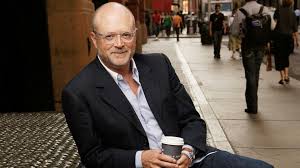
This week on Generating Alpha, in an episode unlike most, I'm joined by Mickey Drexler. One of the most legendary figures in modern retail and brand building. Known as the merchant prince, Mickey transformed Gap into a global powerhouse, turned J. Crew into a cultural icon, and has advised some of today's most influential consumer companies, including Apple. Few leaders have had as profound an impact as he has on how we think about brands, style, and the consumer experience. Now, you might be wondering why feature Mickey Drexler on an investing podcast. While he doesn't come from Wall Street, Mickey offers invaluable lessons on leadership, culture, and the art of building enduring brands. His insights cut across industries and speak directly to anyone who's trying to create something that lasts. That's why this is part of my first two-part series with him. In this episode, we explore Mickey's early life and what shaped his relentless curiosity, the rise of Gap during its golden years and how he developed his instinct for spotting and shaping cultural trends before anyone else. More importantly, we dig into his philosophy of leadership. How to hire, how to inspire, and how to build organizations that stand the test of time. The second part of this two-part series is coming out in two weeks. If you enjoy this conversation, please follow the podcast and rate it a five-star on Spotify. Subscribe to the YouTube channel and share it with anyone who would find Mickey's story as inspiring as I do. Thank you and I really appreciate it. Thank you for coming on. I really appreciate it.
Well, it's my pleasure, Amir. I've been looking forward to this since you called me the eighth time to come on. So, but you have pretty good credentials and, you know, I'm excited to do this.
I'm very excited to do this as well. And I want to start from the beginning. So tell me about your childhood. How did kind of growing up in the Bronx and the relationship you had with your father shape kind of your perspective?
Yeah. And you probably heard my comments about him, right? And I grew up in the 40s and 50s. Well, I lived there in the Bronx through high school. And I lived very, you know, now it's not the way you say a lot of people live, but then the Bronx, Barnes Avenue was a very kind of I don't want to call it a working-class family neighborhood, but it was mostly Jews and Italians. It was near Allerton Avenue, which was our main shopping street. One elevated stop north of Pelham Parkway, which most people know because of the Bronx Zoo, a hospital. I had one aunt who lived there. Anyway, we lived in a ground floor apartment on a, it's kind of noisy because everyone used to play handball or ball in the courtyard which I lived on. And I wouldn't trade it now, you know, when you connect dots backwards. You always see what the miserable times might have been good for, how they helped. But my father was not a nice person. Took me many years to admit that. I was a Jewish family. I went to temple on the high holidays. The shul was exactly across the street from my building. And now it's a mosque, but that's been for years. And of course the neighborhood's changed. So my mom was ill from when I was born. She got breast cancer and so she had a very depressing early life and she passed away. It took 16 years. But my three aunts, it was like a kibbutz down the street. My three aunts and seven cousins lived one in Pelham Park and the other two in my grandparents' house, two floors. One of my aunts lived with grandparents and her family and the other on the ground floor of the house. So that was my family in a sense. I hated being at home because now this, a lot of this is hindsight. I didn't like being at home because it was very hard dealing with my mom and because she was very depressed. She always worked. She was a secretary to the head of the YMCA in the South Bronx. And my dad was a wannabe big shot, but he was not successful. He worked in the garment business in the shipping room. He bought buttons and piece goods, and he acted like a big shot. He really, he was probably on the spectrum, but I didn't know what that meant, nor did anyone in those days. And he wasn't kind, he wasn't warm. He was a big shot in his own mind but I saw through that. But he forced me to work which was okay on the weekends in the garment business for his boss. So I always had a working discipline. And when I went to, as a kid, well I worked when I was in grade school storing towels. My uncle delivered towels. I don't know if you read that or not. And then I went to Bronx Science. Thank God I got in and made a big difference in my life because I was the first one and the only one of eight Jewish cousins in the 60s who went to college, which is kind of rare in those days. And I delivered the New York Times at Bronx Science Annex. I lost my job six months later because we moved to a new building right next door to DeWitt Clinton. So I went there. I was really, as I said to the, I spoke at graduation two years ago and I didn't tell the students, mostly first generation, that because the parents would have booed me out of the auditorium if I said well I didn't like science. I was intimidated. I didn't have confidence as a kid. And I told them that I didn't tell them I didn't like, I certainly didn't tell the graduating class that I didn't learn anything in college and I don't, this is true. I don't care where people go to college. They don't learn to do most things in college. And I was very, I lived in my fantasies mostly, imagination, because I wanted to escape my early life. And that lasts, you know, you don't escape easily. But I never kind of felt like a victim. At Bronx Science I felt not smart because, you know, Phil Heler who sat next to me every test was an A+. I stopped asking him and he wasn't the most exciting warm guy but you know, A+ whatever. And then I ended up because my mom had passed, my father really didn't pay attention so I went to City College for two years and I did that because I didn't know where else to apply. I didn't do very well my board scores which disappointed me but I took them again and I did very well. I was very pleased about that. I didn't have a lot of self-esteem, but then, you know, I really whatever. But I got into science on a test, so that was something. People think everyone that goes to a good college or Bronx Science is extra smart. Sometimes you're school smart, you're street smart. I didn't have the patience to listen in school. Oh, the other thing with my father, big shot that he was, I used to work in the shipping room there. And one day they ask me, whoever they is, to take the payroll to the bank. So I'm thinking, wow. They give me the payroll. Everyone's pay is in there. I take the freight elevator down to 37th and 8th where it was. I tuck into the freight elevator next door. I go through the payroll. And it's, I'll never forget this. My dad, who was a big shot, quote unquote, was one of the lowest paid people at Jill Jr., which was the women's coat company. And I was devastated but it was good because then my fantasy was punctured completely. He is what he is. And I always hoped that he could be a boss. He could be this, and then I wouldn't have to worry in my life. But it is what it is. And you know, all these little setbacks you have, it's all part of growing up. It's part of the game. And so I went to City College for two years. I had an escape because my father remarried. I don't want to go too much into this, but let's say it was not a description of what I'd want a step family to be like, you know, like whatever. And so I moved to a suburb of New York. I'm disguising where it is. They had a ranch house on the railroad tracks. And the family was whatever. Anyway, my second, I was I guess 19 when he remarried. I was a sophomore at City College. I was commuting, you know, subway. It didn't matter. I mean, who knew from whatever? And I felt I had to escape and I needed to leave, get out, do what I have to do because I was extremely unhappy there. And I'll tell you some off-the-record crazy stories. Anyway, so I applied. I didn't know where to apply to college. Some guy I knew's son went to Buffalo State School. So I applied. Thank God I got in and I escaped. Thank God. And that was another, there's all these turning points in your life. From science, escaping having a miserable childhood. I like adversity. I look today to people who have had adversity, unlike most of the people I kind of know. And you know, but I interview everyone. I've always interviewed tons of people and you can interrupt me anytime you want, by the way. And I look, you know, I used to be very impressed with fancy schools. I didn't know any rich kids growing up until I went to overnight camp. Now rich in those days in the 50s or 60s could have been a Cadillac convertible but I hadn't been out. I used to go to the Catskills every summer, bungalow colonies and I never knew that there was a better life out there until I knew, you know, I visited a friend in Riverdale I said oh my god this is fancy. So but I always had this inner drive I guess and I got hit down on whatever I bounced up in hindsight because when you're going through all this I mean the what I lived through in my early life. I kind of thank in my second half of my life. But, you know, I was pretty scarred as a kid, but I got by. And I, you know, in school, I just wanted to pass. That's all I cared about. I didn't have patience. There's a Yiddish term called spilcus. It's ants. Are you in the tribal, are you a tribal member or not?
I'm a tribal member. I'm...
Okay. I was thinking I have a friend named Amir but in any case so I was not a student. I did go, so I moved to this suburb, miserable, I did that, lived there for well one year and then I had to get out of town so I went to Buffalo and I really enjoyed it. I lived in a kind of a little student apartment behind the optician store parking lot was Kentucky Fried Chicken, but I was away and that was a great escape for me. And but I always had the depressive tendencies, no more, but in those days, you know, I guess I had a right to have them. So, two years at Buffalo and then I moved back into the place I was living. Needless to say, I wasn't happy. And my dad was just not, I could tell you stories, but those are off the record. They're really big tales. I met my wife Peggy in Boston. I went to Boston University business school. I didn't learn anything because I didn't really, I wasn't a student, but I avoided the trap. My friends either became teachers, National Guard or they kept their education going. So I did that and when I graduated, my first job was Bloomingdale's. And I don't know if you want to continue but that made a big difference in my life. You know, there's so many things that you look at that played a role again connecting dots back where you say, 'Gee, if I would have had that job, I would have been miserable. I'm glad they underpaid me in a company I worked a summer.' And you know, you just go through it. And I think that's true of everyone. Everyone today, I don't know about you, but they're trying to figure out their life.
Yeah, I agree. When they're your age, the pressure's crazy and the kids, you know, my grandchild that died, they have to experience everything on the experiential list, you know, but my first time on an airplane, it's fine. I used to go to Bungalow Colony in the Catskills in the summers or overnight camp and I wasn't on an airplane until I guess 20 years old going to Miami with my dad who then met his future wife there. And so I got a job at Bloomingdale's.
Yeah. I met Peggy. I was young, but in those days you kind of married youngish. Yes. And now it's oldish. And you know, she was my family and we married a couple of years later and she still is my family and my kids and my close friends. So and my three aunts I was very close to but I thank them a lot for the support, the love and they built me up in a nice way. So anyway, go ahead.
And I'm interested in that concept of connecting dots backwards. So if you were to kind of connect the main dots of what made Mickey Drexler what he is today over your entire career, whether that be Gap, Old Navy, J. Crew, Alex Mill, take me through a couple of those dots that you think were most pivotal to who you are today.
Yeah. By the way, you know, that's famous in Steve Jobs.
Steve Jobs, Stanford speech. Yes.
And I loved Steve for the 16 years I was with him. Enormous respect and he didn't have a fairy tale ending and whatever and he knew that by the way. Any of course he knew. Anyway, tell me the question again.