The idea that we're digitizing money with some of these contracts, it's already done. It's massively done.
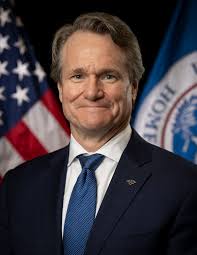
Good evening members and welcome to this evening's talk. We have a very special guest tonight who is Brian Moynihan, the Chairman, President and CEO of Bank of America. He has led the bank since 2010, steering it through post-financial crisis reforms, digital transformation, and shifting global economic trends. Please join me in welcoming Brian to the Oxford Union.
Brian, thank you so much for joining us here this evening. You are in a very significant position at one of the most significant banks. There's quite a few things to discuss and I want to go straight to it. I think post-financial crisis, the global banking landscape shifted significantly since the 2008 financial crisis, and you have also been part of this journey especially with Bank of America. How has Bank of America evolved in response to especially new regulatory frameworks, and do you really believe that these measures truly made the financial system safer to prevent another crisis like we saw in 2008?
So one, it's great to be here. Thank you for inviting me and thank all of you for coming. So if you think about the financial crisis, there's a little bit of a misnomer in that people believe it was the banking system. It was actually much broader than that in that a lot of the enterprises that we now call banks weren't banks before the financial crisis. So Merrill Lynch was an independent company not governed by the banking rules. Morgan Stanley, Goldman Sachs, Bear Stearns, etc. in the US and then likewise around the world. So one of the first regulations that came out was to pull everybody under the tent and that was a good thing. And then the second major piece that came out was a thing called stress testing. And what stress testing does is assume the financial crisis happens tomorrow without any warning. Do you have capital, liquidity, and can you withstand it? And that's important. Second part was a stress test liquidity regime. So all that did make the industry safer, but also I think by putting a large part under the tent, we're able to get an understanding of what's going on. So each day we file a report that has 10 million cells in it with all the liquidity of the company and we and all our peers do. So start to think about how much of that goes out. And so there's a lot more monitoring of the system and I think it's successful because of that. Let me try to pull this out here. Okay, and so that helps monitor all the activities going on. So I think if you think about it, yes, the banking system, the financial system on a global basis didn't help during the financial crisis, but yes there are a lot of other enterprises which are now part of it. Yes, the response was appropriate to the regulation on liquidity and capital, but what we're in the debate now is when do you stop 20 years later? Because a lot of people think the financial crisis is 2008. It actually started in 2001, 2, 3, 4, 5 when you had the over-lending buildup. And so 20 years later you're sort of saying have we got this balance right? Because the more capital required, the less lending we can do, less economic activity we can promote. The more liquidity required, the less money can be put to use to help the economies grow. And so that's the debate. And so it's not a debate about a level of regulation. It's a debate about at the end of the trail, have you gone too far?
And what do you see as the biggest risk to the global financial system over the next decade? And how do you think Bank of America is preparing for it?
Well, the risk in finance is leverage and borrowing. So, if you think about it, in your personal life, you know, you have assets, your bank account, your money in it, your investments, you have liabilities, the money you borrow. What a bank is giving you is the ability to borrow more than your assets. Typically, you borrow a home, you don't have that much assets built up. If you take that through the commercial banking, it's all the same thing. So, in the hedge funds and the leverage, and so leverage is the one that we monitor carefully. And how do we monitor that? The credit risk standards, the maintenance of margin requirements in the trading business. But it's going to be leverage. That's usually what gets it done because what does leverage say? The inverse of leverage is the margin for error is low. So if an enterprise has 10 times leverage or 9 to 1 debt to equity, the margin for error if they make a little bit less money is eight into their equity pretty fast and then they have financial distress. So that's the question. So as you look across industry, the household leverage in the consumer side generally across the world and particularly in the United States which has, you know, the biggest economy, the biggest amount of consumer debt is in pretty good shape. The corporate debt's been pretty well managed. There's concerns about private capital and whether it has more leverage and things like that. So, we'll see.
I also want to touch on that, especially we have seen a shift in geopolitics. There is a lot of tension which also, and any political tension translates to economic tension as well with Donald Trump coming into power. There's also a trade and tariff war. You've seen Ukraine, Russia, so many things happening. How do these influence decisions on a daily basis in the banking sector? When you wake up as a CEO, you're like, 'Okay, Ukraine, Russia is happening. The war in the Middle East, Trump just imposing tariffs.' How do you navigate through those things? And how does the bank's policy evolve on a daily basis when these situations arise?
The banking sector will basically reflect the economy around it. Our job is to transmit the economy from one set of clients to the other set of clients. So we take deposits in from a set of clients and we lend the money out to another set of clients. We have a buyer of a security that comes to us and we get it and we have a seller of a security that we're taking away from. So we're transmitting economy. So when you think about all the debates about tariffs and tax policy, regulatory policy, at the end of the day, if the economy is growing, banks are generally going to be okay unless the economy gets overheated and they may be setting up tomorrow's problem, but typically they'll be okay till the economy falls. And so if you said this is hard to describe because we do all this risk analysis and all this stress testing and all this scenario playing and what could go wrong and what could happen and generally it all comes down to okay what's the effect of that activity to the economy in terms of jobs, wage growth, job growth, employment levels, credit formation etc. and that'll affect it. There are unique other things right, cyber security is a unique risk now. It may not affect the economy but it could affect you unilaterally and it could affect your company not other companies. A particular position that you might take in a trading book could affect your company not other companies. And so you have to think about two different things. One is the general risk of the economy and how you risk manage around that. And the other is the issue of idiosyncratic risk so-called and how do you make sure you manage around that and you manage around that by not getting yourself too over your skis in any particular day. So we monitor the amount of idiosyncratic risk we can take in the trading is monitored very carefully and measured all the time and stressed all the time to say it could be a bad afternoon, it could be a bad day, it could be a bad week but it's not going to be a bad quarter. And if we have a trade that goes bad and then in the operational side you just have to maintain your operational discipline.
And talking about risk, as we evolve through technology with the increase in digital banking, one of the biggest growing risks I think we have seen time and again in this country and I suppose in the United States as well is data privacy and cyber security. How are big banks dealing with such threats and critical threats because we now see with AI innovation and more access to digital information. Is this the biggest challenge do you think currently as you face?
So how do we deal with it? We have a team of 3,000 people working nothing but cyber security in the company. And by the way, cyber security is everybody's responsibility. So what we call personal hygiene of people in our companies clicking on links. We send them things to try to trick them into phishing. We have phishing. We have attack teams. We all do that to test our defenses. So we have 3,000 people. They build network protectivity. We get cyber attacks all the time, DDoS attacks, all that stuff. And they do a great job of managing. So, you put that, the other thing is you rely on your partners and providers to help you manage that whether it's the mainframe or the main software providers, you know, Salesforce etc. So, you try to rely on them to in their defenses and we work with the government closely. Honestly, we do a lot of work at the government to monitor the activity of bad people out there in the government. We have people that work inside the government with all security clearances for our industry in cooperation with them to disseminate that information so we can be responsive to it. So, it's something we worry about. It's something we spend a lot of money. It's gone up 10-fold in the last 15 years, the amount we spend. But you just got to have good people and we got a great team and we are one of the, we get the best people in the business to come work for us in this because it's kind of an interesting platform to do it on. So you might think those of you get, you know, tech companies but we get this, this is an area where our risk is as high as anybody. So we get some of the best people and so they're a lot of fun and they do a lot of great work.
And one of the other sectors I think which is also within the area of cyber security, we are also seeing a technological innovation in the banking sector in the fintech, especially the future of banking with the rise of decentralized finance and blockchain-based banking models. How does a big bank like Bank of America plan to compete in an industry that is increasingly moving towards decentralization?
There's different concepts there. One is the sort of decentralized DeFi and things like that versus digital movement of money. And at the end of the day tomorrow over the next 24 hours $3 trillion will go out of Bank of America and all be digital. And so all the commercial side of the house, institutional trading, all that stuff is all digitized and most of the consumer stuff is. And so the idea that we're digitizing money with some of these contracts, it's already done. It's massively done. And so then the question comes down into the distributed ledger technology and what that provides. And we have, I don't know, several hundred blockchain patents already. We have more patents than anybody, any other financial institution in the world. We have more, we're like the top five patented companies in the United States. We haven't really figured out how, we use it in some places. We're still trying to figure out how applicable it is because a lot of places people would say we want to use blockchain to do something. There's already a system of record that is irrefutable that exists. So in security settlement that's all done electronically and there's a system of record and the bank account system, the money moves and there's a system of record at our bank and the Fed and another bank. We're trying to figure out where it seems to have the applicability. We've used it is where there is a lot of data and information that has to move with money together and across border and so that happens. In terms of DeFi and stable coins and things, you know, as we think about that in the future, we will be in that business if it becomes okay to do so. It's not, there's a lot of laws and rules and regulations, a lot of argument about what it does and doesn't allow us to do. It just doesn't allow you to do it. Now, they're trying to change that, but until there's a law enabling, you got to be careful, but once there is, it'll be equivalent to another currency for our company. So, when the euro came on, we had to adopt the euro and put the euro in. So I don't see that as a major obstacle for us. And so we as a company or we as the industry will figure out a way to actually participate in that. But it won't, the amount of money that moves in that type of stuff or the amount of money that moves is really small compared to the amount of money moves. So our customers, our consumers move about four and a half trillion dollars through their accounts every year. And so these amounts are not big but we will have a competency because consumers on vacation in Pakistan and they get dinner and you can pay with a credit card. It's a pretty good system. You can take that piece of plastic anywhere in the world and hand it to people and people give you stuff. But sometimes the tariff to the merchant, the restaurant's high so they don't want to take, they want cash. People aren't carrying cash so you okay hit this QR code and pay. We can support that. We support it in the United States already. So the idea is that doing that cross-border, there might be an application there. We're not sure how big it is but if it gets legal we can do it. Until it is we can't.
And what about cryptocurrencies? I mean they were initially dismissed by many traditional banks but now are being integrated into the financial system. Does Bank of America see crypto as a legitimate financial asset or are you still very skeptical of it and is there a future for it in the banking system?
If there's any future for us it'll be, we sell the ETFs that have crypto in them to very sophisticated investors because the volatility around them is much different. That say I want to buy it and we don't solicit the trade so to speak. We trade derivatives on crypto for our institutional clients, but it's still, it's really going to be for us around stable coin in the near term. The other types of currency, it's still not clear what role they have. When you divorce the stable currency transaction part away from it, it'll be interesting to see. So, there's a variety of opinions on that every day. And we'll see where it plays out but it's probably not something that we're focused on.