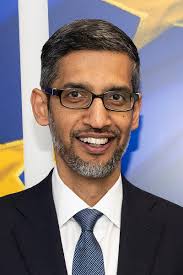
All right, Ohio gozaimasu and good morning everybody. Did anybody like Metallica last night? What about Benson Boone? Did you see him? Great. Yeah, Metallica. They were really on. I'm tired. Yeah, I really slept with one eye open last night. Um okay, we have a great morning for you. Are you all excited to meet Sundar? All right, Sundar, where are you? We need you, Sundar. Come on out, Sundar. Here he comes. Sundar, everybody. Good to see you. All right, man. Well. Great. All right, we're so thrilled to have Sundar this morning. And it is going to be a great interview we're going to do here. We're going to spend 38 minutes, uh 40 minutes, as much time as you want.
Well, as much time as I want. So, it's true. It is as much time as I want. Okay. Very, very excited to be here. It's a beautiful theater. It is a beautiful. You know, we're talking backstage. This was a famous theater for me because all of the Apple product launches that I loved were all here. Yeah. And Steve Jobs was here and I kind of feel like he left a little bit of his magic behind on the stage and it's just a great place to be. Good karma.
Absolutely. So, anyway, Sundar, you know, we know each other very well and we have been to many, many different kind of programs together and also a lot of personal events, some wonderful happy situations, some sad situations. We've had every possible situation together. And I think, you know, when I was thinking about this interview on the way in, what occurred to me was, um, you know, does everybody really know you? And I would really like just to take a few minutes and try to let people know who you are because, as I was saying backstage, you're from my very favorite part of India, from the south. Um, everybody knows I like a good masala dosa. And one thing I love about the south is, you know, the women are in charge of the household, the mothers are in charge, and, um, and the gurus are the women. Um, I met an incredible guru in Trivandrum, you know, in Kerala, in the backwaters of the Arabian Sea, named Amachi. It was amazing, had a huge impact on my life. But that idea of growing up in South India and the values of South India, the mystique and the energy and the matriarchy. Tell us about that and then, you know, let's get you all the way from that point when you were there in IIT and Stanford, but first let's go back to South India and then just give everyone a flavor for Sundar.
Wow, I didn't expect it to stop there, but, uh, definitely a trip down nostalgia. I mean, you're right, it's a special place, obviously, and you know, my mom had, uh, you know, I learned my love of reading from my granddad, her father, and my mother. Uh, you know, she used to be a voracious reader. Uh, she, you know, with the financial circumstances never went past high school, but she used to read a lot. And so, that's where my love of learning and knowledge kind of, uh, you know, came. I think growing up there, you know, obviously strong family values, extraordinary focus on learning and knowledge and acquiring, uh, wisdom over the years and it's not an accident. I think it kind of led me to Google over time given what our mission is and so on. But I, you know, yeah, I had to wait for every piece of technology for a long time in my life. Waited 5 years to get a rotary phone and when the phone came, 5 years for a rotary phone. It was a government made it at that time and there was a long waiting list. But the minute the phone came to the house we were one of the first in the neighborhood. People would come to the house, call their families. It kind of like created a community around it. So for me it was, you know, incredible to see how getting access to technology can have this profound shift in your life. I had to wait for a long time to get access to a computer. So that's what led me to this journey.
How old were you when you first had access to a computer?
You know, I'd seen and had like, you know, you could get an hour of use maybe like once every two to three months. But when I came to Stanford is when I could walk down to a lab and there were workstations and like I could open Emacs and I was, you know, it was a whole world.
That's where access was opportunity.
Yeah, that's right and that's what always reinforced to me that, you know, all of us are in this world of trying to give people access to technology and you see that step change that comes with it. And it's a journey and with AI I think we have a chance to do a step even more. You mentioned South India. I called the Prime Minister of India this on Sunday night. You know, I used to take this train through the south of India and there's this town called Visakhapatnam. It's a beautiful coastal town growing up and we announced our largest ever AI investment outside the US. A $15 billion, 1 gigawatt plus data center, 80% powered by clean energy with subsea cables going in. That chance to transform a region like that with that kind of investment, it really meant a lot to be able to call the Prime Minister who really cares about developing the country. And this has been his vision. I know you know him well, too. And so anyway, it's extraordinary to see the impact of all this.
Very exciting. And it's a great way to give back. So you really see that this kind of technology giving access to even to be developed in this, I nod to South India there. Yeah. Very good. It sounded like there's a lot of folks here from India or in Visakhapatnam. Stand up if you're from India, actually. Would you well be welcomed? Wow, look at that. Thank you, everybody. Welcome. So okay, well, let's talk about that. So here we are. I think I've started the conversation in the right way. Would you agree? That we have to connect to India to understand you. And here you are. You're growing up in South India. You're getting a vision for technology, the idea that access is opportunity. Um you're now in pursuit of IIT, probably one of the finest institutes in India for technology. You know, when did you make that decision that technology was going to be your passion?
Look, I mean, I was very interested in physics. I was fascinated with semiconductors and computers. And so to me it was literal, and I literally wanted to be. This place was called Silicon Valley, so it's the best advertising ever, right? You know, as a kid growing up, you know, you're interested in semiconductors. It's wonder that you could turn sand into this thing which is the substrate of the digital age. And so for me, I literally wanted to be in Silicon Valley because that's what I was interested in. And you know, I was very inspired by the One Laptop Per Child project from MIT. What Negroponte was working on. This is the One Laptop Per Child where they're going to try to put this kind of low-cost computer in the hands of every child in the world that would especially targeting India. Yeah. And it was going to be a very, very low-cost computer. It was Nicholas was really the visionary behind it. That's right. And I, you know, I have to, you know, in some ways I can directly link that to my work on Chromebooks many years later. Right. So, the fact that... That must have been now, I mean, One Laptop Per Child, that was in the mid-90s, I think. Right? 94, 95, 96. I don't remember the exact dates. You were right and around the time I came to the US, but what's extraordinary is his vision of making that possible. Uh, I think made a lot of progress, quite couldn't get there. But you know, for me it always, you know, it later played out not just in Chromebooks, but we eventually ended up giving pretty much everyone a mobile phone, which is a computer in their hands with Android, too. You know, now you have all around the world, be it in the US, be it in Brazil, be it in Indonesia, be it in India, Africa. Was there also a browser on that Android phone? That's right. What's that word I was saying? There's a browser on that phone. There's a browser called Chrome there. We're going to get there. Yeah. Looking forward to it. I'm going there. Oh, I'm looking forward to it. Uh, look, but I think that inspired me. And so in some ways, uh, you know, the chance and the thing that attracted me to Google was literally the mission statement. And I'm very serious about it. The phrase to make information universally accessible and useful. That phrase is why I joined Google. Cuz it resonated so much with me. Right? This is about giving access to information, knowledge to everyone in the world. And that journey continues across all of us. I think AI is the ultimate expression of that, right? It's really giving a true knowledge, a collaborator, a companion, however you want to think about it. The access to everyone in the world regardless of where you're from. Uh and so it's a great equalizer, I think.
Well, it's an amazing vision now and you're in pursuit of IIT with this inspiration. You go sail through IIT. It's amazing. And then somehow you know you want to go to Stanford. Was that when did that occur?
I mean, you know, it's a fortunate opportunity and for me, I had the chance to go to a few places. Stanford happened to be in Silicon Valley, so it was straightforward. The only thing I felt maybe misled was the professor who emailed me said it's really nice and warm and beautiful weather. But I think kind of coming from South India when people say warm, I remember the first time I went to the ocean and I was so excited and I went into the water and I was like, 'No, this is not warm. This is not the backwaters of the Arabian Sea.' No, okay. It's a bit different. Having said that, you know, it is the birthplace of semiconductors and the story surround, you know, Fairchild and National. I mean, you see the history back and so it's a real special place. So, I felt home when I came here.
Well, you're helping me remember all of my great times in South India, too, and the warmth and the energy and the mysticism and all that. And remember a lot of times being there and spending time, you know, with Amachi and also a friend of mine there, Amrita Swarup Ananda as well. And it's just an incredible place, and it feels a long way from here. Yeah. But I guess it's actually much closer because here we are together right now. And so now here you are, you've kind of gone through that whole experience. You're all the way to IIT, and now you're on your way to Stanford. What is your family thinking at this point?
Uh look, I mean, now you step back, you know, I just became an empty nester this year, and you have this incredible access to your kids, and it's still very very hard. I can't believe in those days when I came here, it was probably $2.30 per minute to call back home. Yes. Right? And so, you know, if you ever think the curve of how technology makes things more accessible, yeah, it was, you know, used to write letters back then because it was so expensive to call. Now, you know, I'm fortunate enough, you know, I see my parents regularly, and I'm staying close touch with them. But, you know, they talk about, you know, just like you kind of disappear from their life. But so I'm glad we're working all, you know, I look at there's a product we're working on called Google Beam, and which really when two people talk, you feel like physically they are in the same place. Part of the reason I'm motivated by all that is like, you know, you realize people today, you know, imagine veterans being deployed and being away from their families or something like that. So, I think it's important to connect people.
All right. So, here we are. Now we're at Stanford. The favorite son has left the home. There's a distance. Yeah. Um you're lonely it sounds like at Stanford. Uh, you're missing the masala dosa. You're in Palo Alto. You know, freezing.
I was missing my girlfriend then my wife now.
Girlfriend now your wife, very nice.