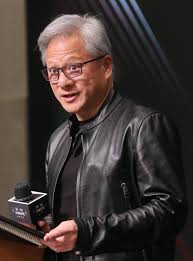
Jensen Huang was born in Taiwan, grew up partly in Thailand, and moved to the US when he was nine. He's a poster boy of a successful American immigration story. He is the co-founder and CEO of Nvidia, the world's most valuable company worth more than 5 trillion US and counting. He identifies pretty much as an American. He speaks Taiwanese Hokkien and Mandarin, wears a now famous black leather jacket like a uniform and draws rockstar crowds everywhere from Silicon Valley to Taipei night markets. To the US, he's the face of the AI boom. To Taiwan, he's a legend and a hero. But behind the mythology is a man who says Nvidia nearly died several times before changing the world. I'm Genevie Wu and our senior correspondent Victoria Jen scored a rare long and wide ranging interview with Mr. Huang. Let's start with your opinion about this larger than life personality. Was there a moment off camera, a comment or an observation that impressed you or stayed with you?
Well, to the media, Jensen is almost like a Santa Claus in a black leather jacket. He has that signature look, but more importantly, he answers everything and he's incredibly media savvy. You actually see many reporters staking out his hotel just to catch a glimpse of him. And when they do, he doesn't just wave and walk off. He chats, he engages, sometimes even hands out small snacks. He's also often seen at night markets here in Taiwan just casually talking to vendors, taking photos, signing autographs. That's why people here call it the Renong phenomenon or Jensen Mania. Wherever he goes, there is this buzz and this excitement. Everyone wants to see him.
Well, sounds like he's a very grounded kind of superhero, isn't he?
Yeah. Well, of course, we have a million questions for a superhero like Jensen. And I'm thinking one of the biggest insights we want to hear from him is what he thinks about AI and job cuts, job losses, and that's creating a lot of anxiety and insecurities for workers globally. How did he address that?
He was actually quite direct on this. He pushed back strongly against the idea that AI is already causing job losses. He said that the narrative is lazy. I quote, 'Because AI has only just become useful recently, so it doesn't make sense to blame layoffs on AI.' He thinks companies are using AI as an easy excuse, but at the same time, he didn't dismiss people's fears. His advice was very clear. Learn AI. Let's listen to what he has to say.
And I think the narrative that connects AI to job loss for many of the CEOs that are doing it, it is just too lazy. It's just too lazy. AI has just arrived. How is it possible they're already losing jobs? You know, how is it possible that AI became productive and useful only six months ago and they were somehow laying people off two years ago because of AI. It doesn't make any sense. It was just a way for them to sound smart and I really hate that. I think we're scaring people and that's irresponsible. I think we should tell a balanced story, a balanced narrative about the potential of this technology, the importance of advancing it safely, securely, with necessary social, political, government, industrial policies to ensure that it advances safely.
What do you say to people who are afraid of losing their jobs to AI?
I would say to the people who are worried about losing their jobs to AI to learn AI. You're not going to lose your jobs to AI. You're going to lose your job to somebody who learned AI better than you. My point is it's more likely that AI will elevate your job, elevate the purpose of your job if you became expert at it. Try to engage it. Don't be afraid of it. Of course, the industry has to be really thoughtful about building AI in a safe way and a guardrail way and make sure that it's deployed in a proper way and that the end applications whether it's in healthcare or transportation or manufacturing or air travel or whatever it is that applies AI, those industries have lots of regulations already and they should re-evaluate the regulations to be AI ready, to be AI prepared. So everybody has to be part of this.
You had an interesting question for Jensen. You asked him if AI is making or will make humans lazy in their thinking. Did he have a good response?
Yes, he did. What stood out to me is that he put AI into a much bigger historical context. He said that every major technology from the personal computer to the internet raised the same concern. People thought we'd become lazier, but instead we became more ambitious. He made a very simple point. We are actually busier than ever. Because when technology makes things easier, we don't stop working. We just aim higher. Here's what he says.
Well, I think you could use history as a guide. When the personal computer came along, I think that everybody said, is that going to make people lazier as a result because so much of work is going to be, so many tasks will be automated. And then when the internet came along, are people going to stop being smart because all the information is at their fingertips. And then before you know it mobile cloud came along so it's actually in our pocket so we don't have to remember anything anymore. And we have so many automation capabilities, the performance of a computer increased by a million times during this time. Do we find ourselves busier or less busy? And I think the answer is we found ourselves busier. And the reason for that is because we became more ambitious. The type of things that we could do is greater than ever. Our students today that are graduating, they're a hundred times smarter than when I graduated. What they know, what they can do, their exposure to the world, the knowledge they have, the wisdom that they've somehow imbued. All of that capability was made possible because of information technology, but it hasn't made them any less busy. I think you and I would admit that we're busier than ever.
Okay. Now, let me talk about AI, right? China is definitely part of the picture as well. So that came up in your conversation naturally. What did Jensen share about China and the AI story on China?
He was very candid. He said US export controls created a gap that allowed Chinese companies like Huawei to grow very quickly. So in a way restrictions may have accelerated China's self-reliance. He also made a broader point that China will be a major competitor for everyone simply because of its huge domestic market. But he doesn't see it as a zero sum game. He still believes Nvidia can add value in China even as the country develops its own technology. Let's listen.
But reports suggest that China hasn't purchased any of Nvidia's H200 chips despite US export approval.
We're not stepping back from China. I would say that the Chinese government, when we were banned from going to China through export controls, it left a vacuum that the Chinese companies were able to fill and as a result Huawei and many of the startup companies in China had record years. They are now growing at an incredible pace and in our absence, even though Nvidia's technology is better, in our absence, available technology is the best you can get and it's plenty good. The Chinese government is understandably, as every government would and should, encourage and want to have conditions for their local companies to be successful. However, I also believe that Nvidia could add an enormous amount of value to the Chinese market.
As it pushes for its own chips, could that actually eventually make China your greatest rival?
Well, China is going to be everybody's greatest rival. I mean that goes without saying because they have such an extraordinary local market that is completely uniform just like the United States. For China's technology, it competes with one layer of the five layer cake. We compete with one layer of the five layer cake but don't forget AI is a five layer cake. And so when Nvidia is participating in China and serving the Chinese market as we have in the past, it supports the expansion of the other five layers. And so when you look at the market in a more holistic way, and I surely believe that the leaders and the local markets will, when you look at it in the holistic way, Nvidia could be of great service to that industry and we could add a lot of value to the China market as well.