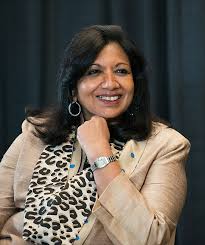
About Kiran Mazumdar-shaw
Kiran Mazumdar-Shaw, Executive Chairperson of Biocon, has been discussing the company’s growth strategy and the broader challenges facing women entrepreneurs and the Indian biotech sector. In a July 2026 interview with NDTV Profit, she stated that Biocon expects to double its business over the next five fiscals and aims to become a $20 billion company by market capitalization. She attributed this potential growth to the company’s differentiated portfolio of biosimilars, insulins, and GLP-1s, as well as its end-to-end manufacturing capabilities. In a separate conversation at the Future Female Forward event, Mazumdar-Shaw said that 50% of Biocon’s research employees are women. She also commented that women entrepreneurs face greater difficulty than men in raising capital, saying that "banks and financial institutions and venture funds are very reluctant to really invest in women."
Mazumdar-Shaw has also spoken about the need for regulatory reforms in India to foster innovation. At the India Global Forum in London in June 2026, she said that "the world doesn't wait for us" and called for "very rapid regulatory reforms" to help India compete globally. She noted that India is often perceived as a generics-focused country and argued that the country needs to emulate the US ecosystem to retain intellectual property and grow company value. In a BBC StoryWorks documentary on cancer care, she stated that Biocon’s mission is to make life-saving medicines accessible through biosimilars, which she described as having the power to bridge the gap between access and affordability for patients worldwide.
Source: AI-verified profile updated from Kiran Mazumdar-shaw's recent appearances.
Browse all interviews →
Transcript (99 segments)
H
Host0:00
Biocon in focus of course, as it embarks a new journey of reaping returns on past years of investments. And founder and executive chairperson at Biocon, Kiran Mazumdar-Shaw, says that the global presence will help in bolstering all segments of the business, particularly GLP-1. Here's an exclusive conversation that she had with my colleague, Nisha Poddar.
N
Nisha Poddar0:37
So, Kiran, there is a roadmap that the market also expects to know. The world, as well as the pharma industry, also is looking at. When we talk about Biocon, what is required to now make it a $20 billion company?
K
Kiran Mazumdar-Shaw0:54
You mean market cap?
K
Kiran Mazumdar-Shaw0:56
So, I think we have all that it takes to get there.
K
Kiran Mazumdar-Shaw1:00
First and foremost, we are now on a high-growth trajectory.
K
Kiran Mazumdar-Shaw1:05
We expect to double our business over the next five fiscals.
K
Kiran Mazumdar-Shaw1:09
We believe that we have a very, very well-differentiated portfolio of products because, as you just rightly said, we are the only biosimilars company out of India.
K
Kiran Mazumdar-Shaw1:21
But in that, we also have the very unique combination of insulins and GLP-1s.
K
Kiran Mazumdar-Shaw1:31
Of the cancer drugs, both generics and biosimilars.
K
Kiran Mazumdar-Shaw1:36
And of course, we have many new launches
K
Kiran Mazumdar-Shaw1:40
Waiting to happen.
K
Kiran Mazumdar-Shaw1:41
And many new products under development in both generics and biosimilars.
K
Kiran Mazumdar-Shaw1:47
And then of course, when you talk about Syngene, I think we are really doubling down on the CDMO business.
K
Kiran Mazumdar-Shaw1:54
So, I think we have high-growth opportunities in every one of our businesses.
N
Nisha Poddar1:59
Mhm. And now, of course, I don't even want to talk about generics and biosimilars as a separate business. This is a combined business. So, if you look at it, it's a products and services company which both have got very exciting growth opportunities. So, the way I look at it is that our EBITDA is growing. Our profitability is growing because, you know, we've retired a lot of these structured debt. We raised almost a billion dollars through our two QIPs. And that has actually taken away the overhang of the huge interest provisioning that used to go on. And the overhang of the debt that was payable at any given point in time.
So, finance charges, yes, reduction of that, but what the expectation is also that you are in a phase of deleveraging momentum. What is your road map and vision towards that? What is the timeline that we are looking at in terms of debt reduction?
K
Kiran Mazumdar-Shaw3:04
I think debt reduction has already started, Nisha. So, it's not like we have to wait for anything to happen. The beauty of our business, you know, inflection point right now is the fact that CAPEX is behind us. Right? R&D spends are reduced because of the new regulatory pathways. And of course, the deleveraging that has already happened. Okay? And we continue to retire debt every quarter. But, I think that actually now makes for a very profitable business, a growing EBITDA, and obviously free cash flow is going to start showing up from this fiscal.
N
Nisha Poddar3:44
All right. When we talk about the GLP-1 opportunity, Kiran, everybody in the pharma space is now really looking at that particular pie and a share in that pie. What's your vision? Of course, your company has been at the top of the line when it comes to GLP-1 opportunity. What's in store and what is the outlook towards that even globally? That's a big opportunity for Biocon coming in for GLP-1.
K
Kiran Mazumdar-Shaw4:15
So, for us GLP-1s have always been about a global opportunity.
K
Kiran Mazumdar-Shaw4:21
And I think we already have the foot in the door because we have a liraglutide which is both in the US and in Europe.
K
Kiran Mazumdar-Shaw4:30
And a very interesting aspect of even liraglutide
K
Kiran Mazumdar-Shaw4:35
Fact that the other competitors who were in the US
K
Kiran Mazumdar-Shaw4:40
Have indicated certain manufacturing difficulties.
K
Kiran Mazumdar-Shaw4:46
Okay, so I think Biocon's capability in peptides and insulins
K
Kiran Mazumdar-Shaw4:51
Have made them very, very strong when it comes to GLP-1s as well.
K
Kiran Mazumdar-Shaw4:57
Okay. And I think that we see ourselves as a fully end-to-end company
K
Kiran Mazumdar-Shaw5:03
Manufacturing GLP-1s. Many of our competitors rely very much on key starting materials from China.
K
Kiran Mazumdar-Shaw5:11
We don't.
K
Kiran Mazumdar-Shaw5:12
So, I think that kind of sets us apart and ultimately, I think the two competitor advantages that we look at is the ability to make many of these through recombinant DNA technology.
N
Nisha Poddar5:26
All right, so that's one challenge in the GLP-1 journey of Indian pharma that you really pointed out where you have created the end-to-end bouquet in-house. But, when we talk about the peptide opportunity and the commercialization of that, you've always passionately spoken about that chemistry and that formulation. But, how do you read benefits of when it comes to the commercial aspect even at a greater pace?
K
Kiran Mazumdar-Shaw5:53
Well, you know, the fact is we now have a global presence. We have a global field force because of our biosimilars and we can now leverage that capability to drive every part of our business and that's what makes us very excited and, you know, sort of aspirational and very confident
K
Kiran Mazumdar-Shaw6:15
That we can actually drive that kind of growth because of the fact that we made a big success of our biosimilars and the same workforce can be leveraged in many parts of the world for these other products.
N
Nisha Poddar6:28
Right. And when we talk about insulin again Kiran, you have been very, very focused and optimistic about the insulin business. And you've doubled down on this particular aspect. It is a low margin business. What is the
K
Kiran Mazumdar-Shaw6:42
Says who?
N
Nisha Poddar6:43
All right. So there is competitiveness in the market. There are new products which have come in. Of course, but supply is much lower than the global demand is. So putting both these aspects together, how do you see the 300 million plus business now that you've created scaling up to 1 billion dollars?
K
Kiran Mazumdar-Shaw7:04
So first and foremost, you know that we've just recently doubled our manufacturing, yes, right? And if you were just to double the 300 million because of that, you can see where the business is heading in the near term.
K
Kiran Mazumdar-Shaw7:18
But I think we will get to that billion dollar mark in a fairly predictable way because of two reasons. One is that the insulin companies have decided to focus their resources and their capacities on GLP-1s.
K
Kiran Mazumdar-Shaw7:37
Okay? And there are very few insulin companies at scale
K
Kiran Mazumdar-Shaw7:44
To take on the responsibility of insulins.
K
Kiran Mazumdar-Shaw7:47
And insulins will never go away.
K
Kiran Mazumdar-Shaw7:50
So, I believe that we have a very exciting opportunity.
K
Kiran Mazumdar-Shaw7:54
I think that we will get to our billion-dollar target as we aspire to do.
K
Kiran Mazumdar-Shaw8:01
And I think the fact that we put in place the kind of manufacturing capacities that can help us get there gives me that confidence.
K
Kiran Mazumdar-Shaw8:10
Apart from that, of course, we know what the demand is. We can't even meet all the demand. So, I think we know what that whole opportunity is going to be all about.
K
Kiran Mazumdar-Shaw8:21
The other aspect is that insulin is a very fungible manufacturing base.
K
Kiran Mazumdar-Shaw8:30
You can use your drug product facility to make both insulins and GLP-1s.
K
Kiran Mazumdar-Shaw8:38
And you can use some of your recombinant DNA technologies to make both GLP-1s and insulins.
K
Kiran Mazumdar-Shaw8:45
So, that's what is very exciting for us. This whole segment is going to be a very, very important segment for us over the foreseeable future.
N
Nisha Poddar8:56
All right. So, this is another growth engine that you're looking at, but the pain point for the entire Biocon group, Kiran, is Syngene. The revival plan for that, and what are the key factors which will really revive this particular business which has been struggling with many challenges?
K
Kiran Mazumdar-Shaw9:16
So, let me put it this way. I think Syngene lost its way by not doubling down on CDMO.
K
Kiran Mazumdar-Shaw9:24
And now we realize that CDMO is a very low-hanging fruit for Syngene.
K
Kiran Mazumdar-Shaw9:29
And given the new leadership change that we've made,
K
Kiran Mazumdar-Shaw9:33
We are now going to really focus on biomanufacturing and generally in CDMO.
K
Kiran Mazumdar-Shaw9:39
Which I think is our forte. Is Biocon's forte.
And the new CEO of Syngene
K
Kiran Mazumdar-Shaw9:48
Who is an old-timer knows this business very well. So, I think given the new focus, I think you will see a turnaround by the end of this
N
Nisha Poddar10:00
Think the management needs to be bolstered? There have been some teething problems in the overall setup as well.
K
Kiran Mazumdar-Shaw10:06
I don't think so. We made a lot of key management changes because I think we were staffed with people who were trying to offer services which were not really required. And so, we made many, many of those changes. I think I've always believed in offering differentiated services. And they had lost track of that. They started getting into commodity services. Which according to me is not where we should be.
K
Kiran Mazumdar-Shaw10:40
So, you're going to see a lot of changes in the way Syngene is going to rebuild itself. And I'm very, very confident that by the end of this fiscal, you will not only start seeing green shoots, but you will see a strong turnaround next fiscal.