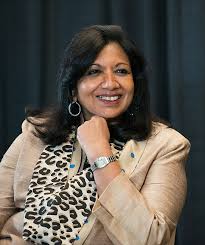
Ladies and gentlemen, it is my pleasure and privilege to have Kiran back here with us on Future Female Forward. I have had multiple occasions to have conversations with her, and every conversation I always walk away having learned something. So Kiran, it's great to have you join us. Your Future Female Forward, but I want to start by asking you, you know, every time you are called out to a stage like this, there is a long litany of things that people attribute to you, all the milestones, all the success that you've achieved. What are you, Kiran Mazumdar-Shaw, the proudest of today?
Well, I think I am just proud to have pioneered biotech in India. That really to me has been something I have really, really been very proud of, and I think to see so many women entrepreneurs in the biotech sector is also something that makes me very inspired.
But you know, I want to talk about that, Kiran, because one of the objectives I remember when you started Biocon was that you wanted to create an environment. You wanted to create a space where women scientists would flourish. As you look at what Biocon has been able to achieve and what you've been able to do to create that environment, how do you feel about that today, and how do we replicate that success across other organizations?
So, one thing that I am very proud of in Biocon is that 50% of our research employees are women. Big round of applause, ladies and gentlemen, that is true equity. And that's one division where we have gender parity, which tells you the role women can play. And this is not about, you know, having an affirmative action. These are smart women. These are women who have made it by merit. And I can tell you, every time I meet these women, I just feel so good about the fact that what I had aspired for, what I wanted this company to represent, is happening right before me. And I think what we need to ensure is that we create a boundless world for women to enter, because I think there are too many boundaries even today. I mean, when I look at just the shop floors, it's still not very apparent that there is gender parity, and I know that it was the shop floor that turned me away from those brewing jobs, because they felt that this is not the right environment for women. And I think that psyche still exists even today. Because I know that even in Biocon, we have been able to get that gender parity on the shop floor. So I think there is a lot to be done there. Of course, it started with the fact that you know women were not allowed to function in second and third shifts. That's changed. I think many states have changed that policy, but it still becomes very onerous on companies to have women in night shifts because of the kind of security measures that you have to provide women. But I think this is the boundless world that we need to create so that women can participate in every aspect of corporate India and startups or anything.
Hmm. Another thing that really excites me today, Kiran, is the fact that when I look at startups, especially in Bangalore, I see so many smart women as co-founders, as team members, and they are all, you know, pursuing very exciting new ideas. That's, I think, something which we need to celebrate and build.
We do need to celebrate, and we've got many such founders here with us in this room, and we will be celebrating their stories in just a second. But you know, Kiran, you often spoken about the fact that there is a credibility challenge, which gets exacerbated if you are a woman and you face that. Of course, as you grow and as you encounter success, the credibility challenge also starts to diminish. Has it changed? Do you, when you are talking to young women founders, you are talking to young female entrepreneurs who are looking at starting up? Does the credibility challenge still get in the way? How much deterrent is it today?
I think unfortunately there still is that credibility challenge. I mean, I constantly have to mentor young women who are starting companies to basically help them through their challenge of raising capital. You know, for some reason, I think banks and financial institutions and venture funds are very reluctant to really invest in women. I mean, that is something which I have found. Hmm. I think men have it easier. I think maybe they hustle their way through. Women don't hustle their way through. So I think it is unfair, and I think women have created some wonderful companies, but they are just not able to access the capital the way men can. So I think there still is that sort of old boys' club, because unfortunately the money is still in the hands of men. There are very few women who are investing as venture funds into women, and even the women who are, you know, investing in businesses often have teams that are sort of populated by men, and so they end up, they might be leading the fund, but unfortunately their team is not very, you know, gender equalized. And so I think again, when they take this decision, I think women get a raw deal. Women get a raw deal, and we will address this issue with women here in the room as well as investors and former investors here in the room.
But Kiran, you know what I want to talk about now is the overall environment that we are seeing here in India. There is a lot of focus on the fact that as we move faster and faster into this AI world, it's going to be about IP. It's going to be about innovation. You don't hold back. You basically have been on this tirade for several years now saying that regulation needs to make way for innovation. Regulators need to make way for innovation. Have we moved on that? How are we doing on that front? Are we ready for innovation and for IP?
You know, the world doesn't wait for us, and we are moving too slowly. I think we need very rapid regulatory reforms, and I think we need to understand that if we want to play in the world and if we want to catch up with others who are sort of beating us to that game, we should do it fast. And the reason I say this is that we don't lack talent. Hmm. We don't lack resources very often, because let's face it, the government is also investing in innovation in a big way. I think there is enough money coming into the space for backing innovation. But I think the regulatory reforms that I am seeing to really leverage that innovation, and I mean leverage that, you know, the incentives to really translate into big successes, is not there. So I feel we need regulatory reforms. I mean, I think you and I had a chat that if you look at the kind of the virtuous cycle of investment, you know, an idea needs risk capital, seed capital, to go to proof of concept, and the government is doing its bit to do that. But then you need follow-on capital to scale that idea, and that has to come from venture capital. And once you take that idea to the market, you know, when VC exits into the capital markets, they reinvest, and that's how you create the virtuous cycle. Today we are very good at taking it up to proof of concept, but the follow-on venture capital is not coming through because of the poor exits that venture funds have into the capital markets. And then investors are not backing innovation the way they should, because they are risk-averse. So I think the risk appetite of the country has to really grow. We are too comfortable, and you know, we are too used to low risk, predictable returns on our investment. We are not willing to back new ideas. We are not willing to basically get excited about, you know, blue sky ideas. Like SpaceX, it would have never done well in India. You know, you don't think we could do a SpaceX in India, because we don't have the risk appetite to be able to value it the way.
But that's what is, is that your frustration, Kiran, as far as the stock markets particularly concern? And do you believe that the kind of pressure on delivering quarter on quarter has that stymied, stifled innovation? Does that continue to stifle innovation, you think?
See, we have created an investment climate where investors are very happy with getting dividends and getting share buybacks. I don't think investors are getting excited about denying themselves with either dividends or share buybacks and investing that money into creating new technologies. So I think that's what I mean by saying that we have to change the way we think about investing. If you invest in, you know, in new ideas, innovation, your share value should go up and should be your return. That's the way I look at it. You have to invest in, you know, companies that think ahead of the curve. You have to invest in companies that come up with new ideas. And I can tell you, I am mentoring a number of startups today who have the coolest ideas, but will they be valued? Will they be able to grow their, you know, ideas into very, very large impactful global businesses? Big question mark. Big question mark.
But you also firmly believe, Kiran, that biology is the future. You are willing to make big bets as far as biology is concerned. But biological intelligence in the world of artificial intelligence, where does biological intelligence come in and what is the plan for that?
So, if you look at it, you know, biology holds the answers to many of the challenges we have in artificial intelligence itself. So if you look at all the, you know, the neural network models that have helped build AI, I think we are just scratching at the surface, because if you look at the way the human mind actually generates information, stores information, and retrieves information, that itself is so efficient compared to what we are doing in data centers. With 20 watts, we are able to do much more than what a data center can do, consuming huge amounts of energy and rare minerals on top of that. Think about a data center based on DNA chips. Okay, that's going to be very energy efficient and no rare minerals. Now that's blue sky thinking. But we have to start seeing how we can build those models. And that's where I think we need to have innovation that is sort of invested in a big way. Because we have to think differently. And you know, when I think about the, you know, even if you think about DeepSeek and the way it sort of created a language model that completely disrupted…
The LLM and the cost of developing LLMs, I think we have to think that way. Because today innovation is about disrupting the status quo. Hmm.
And that's what I believed in. You know, I believed in basically looking at the pharmaceutical market and seeing how to disrupt any expensive space. I did that with, of course, biosimilars. I did that with cell therapies. And I will keep doing that. Because you have to keep questioning that status quo, that wrong economic model which denies access to many of the patients who need it. So, the same thing holds true for AI and for any of these new technologies. Because everyone, like a herd mentality, is pursuing one model. Is there a way of disrupting that model? I am sure there are many ways of disrupting that model. And biology is one area which you can leverage to see if you can do something smarter. And I will tell you why, because as a biologist, I know that before AI came into existence, before data science came into existence, it was an iterative science, it was a very primitive science, we did not know enough about biology. And when you just look at the immune system, we hardly understood the immune system. Today, thanks to technology, you have got deeper insights into biology, right? DNA. How does genomics work? How does gene signaling and regulation work? How do chemical signals, electrical signals, enzymatic signals, how do they all work? I mean, that's the beauty of biology, which is so multifaceted and interconnected, that it gives you a quantum view of what information technology should look like.
You know, so Kiran, you talk about being a disruptor. Would it be fair to say that if I would ask you what the Kiran Mazumdar-Shaw legacy would be, it would be 'Kiran Mazumdar-Shaw the disruptor'? [Laughter] But you know, I want, for the benefit of everybody who is watching here in this room but also people who are watching online and on TV, you know, take me through what you believe today on the back of the lessons and your own experience are crucial to an entrepreneur's success. How do you deal with failure? How do you manage failure? How do you learn from failure? Because that's equally important. Learning from success is important, but learning from failure also important. And I know it was your late husband, I think, who said that Biocon's story has a lot to do with aggressive scientific bets but also with frugal financial discipline. And that's what I want you to talk to us about as well.
Yeah. So, that was John's great line, because every time I used to get excited about a new scientific idea, he says, 'Go for it. But remember, don't spend too much money.' [Laughter] But anyway, you know, apart from that, I would say that yes, I think every entrepreneur has to go through failure. If you don't make mistakes, if you don't learn from your failures, you will never be resilient. So that's why I think you need to be resourceful and resilient from learning from failures. In addition to that, I think I want every entrepreneur to start with an idea. Translating that idea is the most important part of entrepreneurship. So it's not about having a great idea, but have you translated it into a commercial success. That's the way you judge yourself. And if your idea remains small, you have failed. If you can scale up your idea, that success.
Is the ultimate sign of success. So I think I have always tried to build Biocon as a leading biopharmaceutical company from India for the world. And that is about making that global impact. You know, that's why I wanted to be a global company where I understood how I could actually make a difference to global healthcare. So I think that's just in my case. But I think every young entrepreneur today has to think about the big picture. What, how, you know, how big can I take this idea? That's what it's about. And I find that a lot of entrepreneurs get stunted because they get frustrated. They don't have access to capital. They don't have people who believe in what they are doing. And it's a hard struggle. And therefore a lot of great ideas get destroyed. And I will give you a very good example in our own city of Bengaluru. The Simputer, which was the idea of a handful of scientists at IISc, was a great invention. I mean, it was an idea ahead of its time, because it was a multilingual handheld computer. Hmm. Right? Which actually could connect with GPRS, and the whole objective was to make it into a teaching tablet. It was ahead of Palm Pilot, it was ahead of iPad. And what happened? There were no takers, there were no backers, there was no investment, and ultimately it died. And yet that could have been India's story. That could have been India's tablet for the world. We never did that. So there are many such examples where we had these kinds of failures because we didn't invest enough. We didn't have the risk appetite. We didn't have confidence. We didn't believe in our own technology. That's another problem, Sharin. We don't believe in our own technologies, in our own capabilities. And we have plenty of it. When you speak to young people in Bangalore.
And I am just thinking to myself, I would have never got that idea, so I am just saying there is so much AI talent here, there is so much energy, but it needs to be backed with venture capital, with capital period. You know, and I think we need to allow these ideas to translate into commercial successes. Ah, that's what I am hoping for.
Where we are all hoping for that. But Kiran, as a woman entrepreneur, and there is a difference, and that's what I want to address with you now. As a woman entrepreneur, what advice would you leave young female founders with? Kiran Mazumdar-Shaw has been pretty fearless if you have seen her on Twitter. She is one of the very few people who still tweets away, you know, calling out all kinds of bad behavior. But you know, self-belief, that is something that often gets in the way. We have spoken about the impostor syndrome and so on and so forth. To women entrepreneurs, what would you say on the back of what you have learned to do over the years?