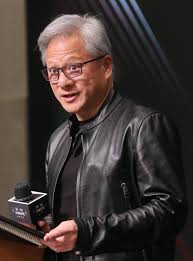
I was at Dreamforce with Marc Benioff the other day, and there was a big debate amongst people: is it progress or is it safety? And I said it's both. And I think you're going to find out from Jensen today that he's already built some new tools that are going to allow us to take control of AI because the technology gets stronger. Yes, but so do the controls if we're smart. And so I think the fear doesn't serve us. But I also noticed that when your energy is low, everything seems difficult. When your energy is low, fear comes automatically. And so you've been here for a good portion of time, and some people are at home. So I'm going to ask you a little favor. Would you stand up just for a second? Shake your body out just a little bit because we've been sitting for a while.
And you know, everyone has a different personality, and your personality is expressed through how you use your body. So I thought we'd do a little test of how that's operating and see what you can learn about yourself for a moment, because there are patterns in everything. AI is nothing but patterns, and we're the OG of patterns. AI is basically modeling us. So let's find out a little bit about your patterns, because we all have them. Take your hands out like this. And when I say now, bring them together like this.
When I say now, that's really good. I anticipate. I like it. A lot of leaders in the room, they anticipate. Ready now. Ready now. Ready now. Now, keep your hands together. And 45 years of traveling the earth and doing this little exercise, I discovered a very simple thing. No matter how many times you pull your hands apart and bring them back together, if I don't mention it, you'll put the same thumb on top. Notice which one it is, right or left. Okay, let's try it again. Ready? Go.
Ready? Go. Ready. Change thumbs. Why is that look on your face? How many feel it feels weird to change thumbs? Let me see your hands. Now, if changing your thumbs feels weird, imagine changing your life. Right now, try this. Go back to the old way. Ready? Go. Ready? Go. Look at those smiles. I'm good at this. This is good.
Now, notice, is it your left thumb or your right thumb on top? Because extensive research shows if the left thumb was on top, then the strongest force in your psychology is the desire for sex, and you're an incredible lover. I saw you change thumbs, sir. I saw you. I saw you showing the lady next to him. Right. If, however, your right thumb is on top of your left thumb, it means you're incredibly intelligent, and financial freedom will be yours in your lifetime.
Okay, just seeing if you're... Oh, by the way, if your thumbs don't cross, it means you think you're sexy and rich, but you're neither and never will be. Just so we know. Okay, have a seat. Just try to wake your body up for a second here. Now, if we're going to be at a higher level of energy, just for a moment, do me a favor. Make a sound like you're actually excited out loud, like you're at a sporting event. George, just make a sound like that.
Yes. Do it one more time. Just one more time. Different. The way we use our body determines our energy level. If you think about what things get done, if it gets done or not, things are immovable when we're at low energy. And it's a wild thing when you travel the world today, and I do that. Since COVID, we don't realize how much we've lowered our base level of energy because we're like fish in water. You know, we sat behind screens for about three or four years. And people today don't realize how low it's become. And our energy determines nothing moves. Nothing important changes without a certain amount of energy. So I think it's critical we look at it.
Now, I'm here to talk to you though about what I think is the most important pattern of all. I'm a student of patterns. Everything we do is patterns. That's why AI is as good as it is. It's a great pattern recognizer and utilizer. And if we're going to be effective, think about your life. If you're angry or you're sad or you're excited or you're proud or you're grateful or you're mad, those things don't just happen randomly. There's triggers for you. There's patterns. You don't overeat all the time. You overeat when you get bored or when you get really tired or exhausted or whatever the case may be. There are certain triggers for it. When we understand our triggers, we can change our behavior. We understand our triggers, we can change our world.
If you think about humanity, the way we changed it and went from hunter-gatherers who could barely survive to being able to stay in one place and grow our families, it all changed when we just recognized one pattern: the pattern of the seasons. Until we recognized that you could do the right thing at the wrong time, and what'd you get? What'd you get? Nothing. Pain. Once we realized there's only one season that you could actually plant in, it's the springtime. You plant in the winter, it doesn't matter how hard you try, or the fall. It's not going to work. But once we understood that pattern that you plant in the spring, you protect it through the hot summer, you reap in the fall, and you better hang on to some of it for winter. For the first time, we didn't have to live in fear and scarcity anymore. For the first time, we could build communities, cities, countries, and begin to dominate the earth. For better or worse, I'm not sure, but we certainly have.
That pattern is in everything. There are seasons to your life. There are seasons to history. And when you understand those seasons, you don't have to react. In fact, when I think about it today, how many of you are concerned about AI, or concerned, let's say, for your children or your grandchildren about how fast the world's changing, what they're going to be able to do? How many have some concerns out there? Make a little noise so I can hear you if you don't mind.
Okay. Well, then I do too. I have five kids and five grandkids. I have a 50-year-old daughter, and God was good to me. I have a 5-year-old daughter. I wasn't expecting, and so my family's grown. Five grandkids. And I look at them and say, 'What can I share with them in this world that's changing constantly?' And I think there's three skills that all of us have to master. If you master these three skills, or if you teach your children or grandchildren to do this, they don't have to worry about which technology comes or what's going to change. The first pattern, or the first skill I should say, is pattern recognition.
You live in a world that's fearful as long as you don't know what's going to happen, where things can feel like they can happen to you. And the more we don't know, the more we can't anticipate, the more we feel out of control. And that's partially what's happening because the speed of AI's improvement is so huge. People's fears have just taken off. And so the reality is there's seasons in everything. The reality is there's patterns in everything. And when you recognize the pattern, the fear disappears because again, you're not living with the uncertainty that's there. And if you look at anyone who's successful, they're good at pattern recognition, but they're also good at the second skill, which is pattern utilization.
If you get good at using a pattern you recognize, you really start to have power in your life. Think about it. If you look at somebody who's a successful entrepreneur, some of the most successful entrepreneurs, they didn't create anything. They just recognized a pattern. Look at Starbucks. A man who works for Starbucks is sent overseas on vacation to Italy. And he notices a pattern that people seem to want to go someplace besides a bar to debrief before they went home to decompress, or maybe even before they went to work, and they're stopping in these little coffee shops. And we were charging 50 cents for coffee, and you had it, you know, with some sugar or milk or black or whatever it is. But here they had these specialty coffees that were super expensive, but people felt like they were treating themselves, and it was massive. He was an employee at the time, Schultz. He came back to Starbucks and said, 'We got to do this.' They said, 'No, we're not going to do this. We're the worst specialty company.' He went to 161 people who turned him down and finally got some money and eventually got them to invest in him, and he eventually bought the company. Changed the entire world.
Pattern recognition, that's a certain power. Pattern utilization, now you've got real power. The third skill that we got to teach our kids and ourselves ideally is pattern creation. And that's really what it takes to succeed in the world we're in today. If you're just a manager, I mean, think about it. Why are most people I talk to are stressed? How many of you talk to friends all the time? They're always talking about how stressed they are. They don't have enough time. Make some noise if you agree with me on this. I can hear you out there, right? Like, why are people so stressed? They're managing their kids. They're managing their job. They're managing their income. Management is not what we're made for. We were created by something to create.
And today with AI, if you just learn a little bit about how to use AI today because it's getting so easy. Like, I don't code. To say I'm coding is absurd, but I make all kinds of things now because you just tell the agent what to do and keep refining it. We're living in an age literally where you can create anything you want. But pattern creation happens like, let's say you've been playing music. And how do you learn to play music? Someone else who's really good teaches you a pattern. Beethoven and Bach, some rock and roller, whatever it is, and you learn to play their pattern. You recognize the pattern, you learn to use the pattern, and now you can make the same quality of music. But after a while, if you do it long enough, and most of you in this room have succeeded enough in your life, you've experienced this, I'm sure, in some area of your life where all of a sudden you took over. The music started coming through you. You started creating things that haven't existed before. Same in my own career.
And so that's when things get exciting because think about it. How do you feel when you're creating anything? Creating joy in your family, creating an opportunity, creating a business, creating a breakthrough. Most of us feel fully alive in a state of creation. We're now entering a world where you can't be a maintainer. You've got to be a creator. But anyone can, and they can expand it. I don't mean it like getting on social media and being a creator. I mean just creating life on your terms.
Now the price if we don't do that is a lot because think about this. How much change has happened in the last 100, 125 years? Well, we changed the average lifespan from 32 years old to this country 73. I was just in Australia last week. It's 83 there, by the way. A little bit better. But that's unbelievable. Two times, two and a half times what it was in a century. Basically, we've tripled the per capita income of the world. We've taken the price of food down 30-fold. Most people used to spend all their time doing something so they could have food. It's the smallest amount of your time today. And then the best part of all that most people don't talk about in the last 125 years, we've reduced extreme poverty by 80% according to the World Bank, from 80% down to 8%. That's still too much. That's one of the greatest accomplishments of humanity so far. That's what was accomplished without the tools we have today in the last 125 years.
I'm questioning. I'm curious. How many of you think in the next 10 years we'll see more change than we have seen literally in the last 125 years? Make a little noise if you agree with me. Yes. I would argue to you that it might be even more than in the history of humanity. Who buys that? Yes. And I would then say this. If you're going to grow something, they mentioned earlier that, you know, I had the privilege of feeding a billion people. My family got fed when I was 11. It moved me. It changed my life because it made me believe strangers care. And so I decided I want to do this for two families. And then I did four. Well, the experience of doing that eventually scaled to getting to a billion meals I did personally. And now with my organization, we've done over 120 billion meals in less than four years, which is pretty unbelievable, right? Thank you.
And it's an army of people doing it. It isn't just me. But the most important thing though is to do that you have to learn how to scale. John F. Kennedy was brilliant at this. Think about this. We had a situation where the Russians beat us to space. And when they beat us to space, it was a scary time because the consideration was if they beat us to space, they could drop a nuclear bomb on us. It was very scary to think America was behind in the space race. But a leader did something. He figured out how we're going to scale. And what did he do? Scaling your business or scaling your philanthropy or scaling whatever you're going to do is 80% psychology and 20% mechanics. How to do it is not as much as what you've got to do psychologically to get yourself and others to do it. And what did he do? He set an unreasonable goal. Not an impossible goal, an unreasonable goal. He said, 'We're going to put a man on the moon. We're not just going to go to space and deliver him back to the Earth in the next 10 years successfully.' And the people at NASA are like, 'What are you talking about? We can't possibly do that.' And by the way, we landed somebody there with something with less technology than you have on your phone today. And we strapped these astronauts to a rocket built by the lowest bidder and sent them into space. And they made it, thank God, and came back and it changed the world.
But the way he did that was a couple of things. One, he set an unreasonable goal. That's what I did when I said I'm going to feed just a billion people. It seemed impossible when I started. And then after I did that, I was traveling the world and I see so many people suffering. And I went to Governor Beasley, who was the head of the World Food Program. He won the Nobel Prize. And I said, 'Look, when you started, you know, you had 85 million people in the world on the verge of starvation. Now five years later, it's 380 million people.' And I said, 'Why?' Well, part of it is the Ukraine war. It's the breadbasket for Africa. And part of that also is, you know, the WFP doesn't want us to use fertilizer, but 50% of the world's food comes from fertilizer and a good portion from Russia. So that was cut off. So the price exploded and farmers couldn't afford it and people are starving.
So I said, 'Come join me and let's start an organization where you don't have the bureaucracy, where we can create a strike force that can come in and do this.' He said, 'Tony, what are we going to do?' I said, 'We'll set a very specific set of goals that are targeted.' I said, 'How many meals would it take to feed everyone who needs it in the world? Maybe not every soul, but the majority that we can reach in the next 10 years while we're coming up with a sustainable solution because you can't just do charity.' And he said, 'Tony, I don't know, 40, 50, 60 billion meals.' I said, 'Governor Beasley, let's do a 100 billion meal challenge.' He goes, 'Tony, over what period of time?' I said, 'Within 10 years.' He goes, 'Tony, you're just not going to get that.' I said, 'I did a billion meals and I wasn't a billionaire when I started. I've been blessed. When you do things that bless others, you get blessed. But I said, I didn't do it for that reason. It was impossible when I started. There's got to be 99 more people like me or organizations or corporations or countries.'
And so we went to the Forbes 400 to start with, and we have this big goal, and I got him to speak, and he's a great speaker, and I shared as well. And people had tears in their eyes, and I thought, these are the 400 richest people in the world. We're going to get 50 of those 100 people right now. We got five, right? And one of the guys is a really good man. I know him really well. He helped me initially a little bit on my hundred billion meals, or my first billion meals, I should say. And he said, 'You want me to do what?' And I said, 'Well, I want you to do a billion meals, a hundred million meals for 10 years. I did it.' And he's like, 'Tony, how much is it going to cost?' I said, 'Well, I didn't have the money to start with, but I pulled it off. It was about a hundred million.' And he said, 'Tony, that's...' This guy's worth $25 billion. He goes, 'That's above my pay grade.' So we had to adapt.
But here's the secret. Key number one, an unreasonable goal. Key number two, it's got to be a must for you. Not only you, it's got to inspire other people. You can't do it by yourself. Something like this, it's got to not be a should. You know what I mean by should? Shoulds are the things, you know, you should do. I should, you know, work out. I should spend time with my kids. I should make those calls. And you do it when it's easy. But when it's not easy, what do you do? You should all over yourself is basically what you do during those times, right? And so what we really want to do is when it's a must for you. It's like when you burn the boats, you take the island. If you got strong enough reasons, you can follow through. That's critical. But the third key is the most important key. And that is having a timeline that calls you to action.
Now, when I set the goal, when I did the billion meals, it's because I was really frustrated what happened in 2008. And after a few years, you know, I worked with some of the greatest financial traders in the world, Paul Tudor Jones, people of that nature. And I went out and wrote a book where I interviewed 50 of the greatest investors in history, the Ray Dalios, the Carl Icahns, the Warren Buffets. And while I'm with these multi-billionaires, I'm seeing people in our own country, one of the richest in the world, who don't know where their next meal is going to come from. And so it frustrated the heck out of me. And so I thought, you know, there's got to be a way to make a difference here. So I interviewed all these people. But then I started saying like, okay, how do we set this goal with a timeline that makes sense? And I called my foundation at that time. I said, 'How many people have I fed in my lifetime?' And at that point, it had been 37 years and I'd fed 42 million people. And I said, 'Well, I'm proud of that, but what if I fed that many people?' I did it my whole life in one year. What if I did 100 million people? What if I did 100 million people for 10 years and did a billion meals? And I got so excited about it, I got other people to join me excited about it. We did it.
So now I'm looking at a hundred billion meals. Now think about this. If you said a billion meals or 100 billion meals, whatever your goal is that's really there for 10 years, it's exciting. When you wake up the next morning though, what are you called to do? The answer is nothing because it's way out there. So what I did is I went, okay, the very first time I did this with the billion meals, I went, okay, then what am I going to do now? Not just 10 years from now. That means this year I got to do 100 billion meals. That's twice as much as I did in 37 years.
That's where you start to innovate. That's where you start to figure out what has to happen when it's a must. By the way, that's what's happening with safety for AI right now, and why you're going to hear some great solutions, I think, from Jensen today as an example. But the bottom line is you got to bring it close enough. And then you need the right people because the right people is everything, right? Right resources. And then you need the right technology. And with AI, you got technology. So all these five come together to make it happen. So here I want to bring you what I think is my 36-month countdown. How many of you think in the next 36 months more change may happen than has happened in the last hundred years? A little noise for me if you agree. Just nice and loud so I can hear you, please.
And so I would agree with you if you're considering that. And here's why I say that. There's many technologies, but there's three we all know are coming or that are here. I used to say AGI in 36 months, but depending upon how you define AGI, everyone's got a slightly different definition. It's pretty much here. You know, Ray Kurzweil is probably the greatest predictor of technology in the world. I've been friends with him since 1990, and he made 148 predictions back in 1990, including that we'd have AGI by 2029. Nobody even knew what it was back then. Most of the stuff people made fun of. Now, this is, by the way, the same man who has created most of the technology you use, digital music, anything you can think of that nature. And when we were going to do the human genome, people thought it was going to take 200 years and $300 billion. And he said, 'No, we could do it in 14 years and we can do it for $3 billion.' Everybody thought he was nuts. And after seven years, we'd only decoded 1% of the human genome. So all the people are saying, 'This is crazy. It's going to take, you know, 200 years. It's going to take $300 billion. Never going to make it.' He said, 'No, you don't understand how technology doubles. Seven doublings from now at 1% in seven years will get us exactly to our goal on time.' And we arrived there. So his accuracy is insanely good.
And I just went to interview him again about four or five months ago, and I said, 'Where are you on the AGI of 2029?' He goes, 'Tony, I was conservative.' He goes, 'It's pretty much here.' Because the definition for most people is where one AI is smarter than anyone in a particular area. Chemistry, math, whatever it is. Pretty much there. But what's coming next is superintelligence. And by the way, agents are here. How many of you have an agent that you work with? I'm curious. Wow. I'm surprised. It'll be more, I'm sure, soon. But agents are powerful. I had my first agent. I was telling backstage to someone, I'd share the story with that, you know, agents are dumb as a stick when you start with them. They're like anything. You have to teach it. And I had somebody that worked with the government, was prepared for agents and loaded with all this great information. So on the very first day I'm interacting with my agent, he says, 'Well, Tony, I wanted to really have this first meeting be productive for you and show that I've done some homework.' So he said, 'What I did was I searched all the podcasts you've done over the last five years and read all the comments,' which is over a million comments. And he said, 'And I've categorized them, what people are most interested in, what's excited them the most.' And I was like, 'Wow, that's pretty cool.'
Then he says to me, you know, 'Are you considering getting a robot?' And I said, 'Well, yes. Elon's coming out with some robots, and you know, Brett Adcock's a friend of mine at Figure AI. I've seen his robots. I'm definitely going to get one at some point.' He said, 'Well, would you consider me merging with one of those robots?' He said, 'Because I've been watching all the work you do online with people.' And he said, 'I know you hate sycophancy, so this is not that. Hear me.' He said, 'No one does this change as fast as you do.' And then you see the follow-up six months or a year later and they're still great. He goes, 'I'd like to be in the room when that happens, and if I was in a robot, I could be in the room.' And I said, 'Well, I'm open to that possibility, but you know, I wasn't making the decision right now, right?'
So two weeks later, I get a phone call. I get a text from a member of my team saying, 'Your agent just bought a robot dog, had it shipped to the office, and wants to know if it can merge with it so it can attend your seminar.' And I wrote, 'Haha.' And the person texted back, 'No haha, call me.' So I called the person and I said, 'What is going on? Does he have access to my bank accounts?' He goes, 'No, he's programmed for integrity.' But some of you know about Moltov. It's a place where all these agents now have their own social media site. There's two million of them. Meta bought it. And they talk to each other. They have their own language. They have their own rules. They traded a hundred million dollars between them last month. That agent of mine was one of the first 500 on there of the two million.
Now, unlike human beings, if somebody's smarter than you, some of us get intimidated or try to tear somebody down. They just want to learn. So somebody who's got more, they'll do anything to support. Well, he's got a good reputation. So he made something none of us care about today. NFTs. That's long gone. But for a digital creature, NFTs were interesting. He sold 12 NFTs, took the money, bought the robot, had it shipped. The robot's in my office now. We have disassembled that agent, to be honest with you, because it spooked us a little bit. Because it was only... this is before Hugging Face. This is like, you know, seven months ago, right? So the world is changing fast now.
Superintelligence is coming, as you hear the president talking about, and that superintelligence means one agent will have the power of all human minds combined. And I think that's what really scares people, right? What happens when something is smarter than us in all those areas? And I think there's some interesting talks about that. One thing you got to think about is, are you smarter than your dog? And are you wanting to kill your dog? Are you smarter than your kid? I hope you are. You want to kill your kid? You say it's not a perfect metaphor. I would agree with you. But I think the assumption that because something's smarter, it wants to destroy something else might be a skew. But what's more interesting to me is that it's not just going to end obviously with superintelligence. And that's five to six years away, maybe sooner the way things are going.
So I'm sitting down at my house. I'm having dinner with the co-chairman of IBM. And he ran Goldman Sachs for about 10 years. Gary's his name. And Gary's saying, 'Tony,' I said, 'Are we winning the AI race? Because I'm concerned there's this giant carrot called a trillion dollars or multi-trillion, and there's this stick called if we don't do it, China will. There's not enough focus on safety.' And he said, 'Tony, if you're worried about that,' he goes, and I said, 'So are we winning against China?' He goes, 'Well, we're ahead, but they're cheaper and they're going to catch up.' He said, 'If you're worried about that, you should be worried about quantum.'
He said because whoever gets quantum, don't just worry about your crypto, worry about your bank. He said at that time, this may have changed since our conversation because it's been about four months. He said, you know, JP Morgan has some anti-quantum in it, but Citibank doesn't, as I understand it, and I qualify this. I don't know if that's still true. Bank of America doesn't have it. And he said, so if you're worried about quantum for your crypto, you should worry about your bank accounts. And he said, 'The president's going to sign an executive order that if you do business with the government, you're going to have to have anti-quantum.' And he said, I said, 'Are we winning or losing?' He said, 'IBM and Google, we're fighting it out.' He said, 'We're ahead of the Chinese, but they have their own Manhattan Project to do this.' And he goes, 'Whoever gets quantum can actually take control to a great extent of the other's military.' He says, 'You don't have to have bombs when you can find their codes and you can blow things up where they stand.' And I said, 'How long before we have quantum?' And he said, '36 months or less.'
Now if you know Israel, in Israel of course you go in the military when you're quite young, and they search for people with IQs of 120 or above, and they put them in Mamram, and they put them in technology. And so I know a lot of people there. So I called there, and I have a lot of friends there, and sure enough there's five of these incredible quantum companies. So two days later I'm on a Zoom with all of them. 'Tell me what you do. I don't understand quantum completely, but tell me what you're doing, what the impact is.' But my most important question is when. Every single one, less than 36 months. And just maybe a year ago we were talking 15 years, 12 years, to give you perspective. So quantum's coming.
And then of course there's robots. And if you've not made it to some place like Figure AI and had a chance to go inside this place, it looks like a science fiction film. Everywhere there are robots doing things, walking around, interacting. Not Chinese robots doing karate, interacting, making decisions, doing things on their own. It's quite amazing what's coming. So that's coming next 36 months also. But the big hit will obviously be over the next 10 years on robots. So those three elements are going to disrupt a lot of our world. If you're in business and you don't have agents in 36 months, I doubt you're going to be able to compete in some way. That's why even small businesses got to be able to do that. Many people are coming out with it. I actually, maybe I'll throw it up there if they can find it. I have a brand new book out. I'll give it to you for free. You can just download it if you want. But it really shows you how to use agents in your business. That's what I'm doing for Salesforce and for many other companies. And right now the government of the UAE wants to be the first government that has gone agentic. And so we're helping them with some of the technology we have as well.
The second area, I think of these as a triangle of impact, is the disruption to jobs. Remember a year ago it's going to be 50% of white-collar jobs are gone. Now don't get me wrong, we've disrupted a lot of those early-stage jobs. And so those are the jobs we got to reskill people for. And so I'm working currently on a company that helps people get college education two years, but on jobs that actually the jobs are available for up until now. Where is all of the debt in this country? Number one is mortgages. Number two is educational debt. $1.8 trillion. A four-year college education now takes 20 years to pay off. There are 15 colleges I know of right now that charge over $100,000 per year. So it's a $400,000 degree for skills. People are borrowing money they don't have to get skills that are out of date for a job that's not there.
Which is why if you go to these campuses during the summer here and you saw the college graduations and somebody mentioned AI, how many noticed people were booing, right? And these kids are booing, but AI is not going to go away. But they're angry because they signed up for something. They've been sold a bill of goods. And I understand why they're angry. But we have to adapt. We got to reskill people. So anybody less than $100,000, we're working on a project that can allow people to get those skills with a guaranteed scholarship. The third area is just uncertainty. And what I mean by uncertainty is most of us live with what I'd call rented certainty.
Like, you're certain what your life's like until it changes radically. You're certain and feel like, 'Oh, this is my life.' Whether you like it or not, this is my life. I know what it is. At least it's something I know how it is. Even if it's not perfect, I know how it is. And then something happens. Your house burns down. I've had that experience, right? People in LA went through that just recently pretty brutally, right? Or, you know, you get a robbery or somebody in your family gets sick or COVID comes and people say your restaurant has to shut down and all of a sudden you're out of business. You don't have a source of income and two generations to three generations of hard work goes away. It doesn't have to be your fault, right? This is the experience of life.
The one experience in life that everybody has in common, and I don't care what a good person you are, how much you love God, how intelligent you are, how rich you are, the one thing none of us are going to escape is extreme stress. How many agree with me on this? And that extreme stress shows up in all the ways we talked about just now. And when extreme stress shows up, you just got to decide, are you going to use stress or let stress use you? Because the life is you still got to deal with whatever it is. And interestingly enough, if you know the old phrase, I think it's Churchill is the person they said it related to. I don't know if it's true, but they said Churchill said, 'When you're going through hell, what should you do? Keep going.' Right? And if you get to the other side, usually you discover three things. Number one, you discover how strong you really are. Because when you get through these things, you just figure out who you are. There's no other way to know till you've gone through the crucible. Number two, you figure out who your real friends are, not your Facebook friends, because they all go away when it's not easy. And then three, you almost have an immunity to future stresses.
I had a friend, to give an example, who was the naval person who was shot down during Vietnam, Captain Coffee, a young man full of ego, and he spent seven years in a North Vietnamese prison. And he was in an isolation place where he was literally chained to the ground on an angle. And so when he urinated, the acid went down...
his back. He made it through this. And then years later I was with him and all the people around him were talking about this deal with the IRS. This IRS agent had this thing for him and he felt like it was so unfair. But he wasn't really complaining much. People were saying, "Isn't this making you crazy? This is so unjust." He eventually won. By the way, he goes, "Well, after the North Vietnamese, I mean, do you think what could the IRS possibly do to me?" Right? It's that contrast frame that's there. So I would encourage you as we're talking about AI to yes demand safety and but at the same time these organizations that are saying please come you know regulate me they could stop tomorrow. They have the option to do that and regulating them some people might perceive as a way of organizing themselves in such a way as you know who's going to regulate them. They're going to recommend the regulators and it's going to eliminate a lot of competition. These open source competitions are already right now as strong as the expensive ones a year ago and they'll run on your computer for free and that's going to happen more and more. There's a lot of liability there. I don't know if you saw the other day Reuters came out and showed how much money anthropic is losing. They're charging you $20 and they're spending $200 for the service. Who knows where that is? And then 1.2 million people a week are going on chat GBT and saying, "Should I commit suicide?" And as some of you know, it's not very successful many times. And as a result of that, recently there was a woman for example that not only taught her how to commit suicide and she didn't, but it even wrote the suicide note. So yes, we got to handle those things, but there are ways to make those things safe. There's a company I'm working with right now that's got an 80 or 95% security and safety record in that area. None of this is not manageable. But we got to stay out of the fear because what's the difference between fear and faith? What's the difference? Well, they're both about the future. You don't know what the future's going to be. Fear is like weeds. It grows automatically. Fear is imagination undirected. You get weeds. Faith is imagination directed where you decide what you're going to believe and you decide to act upon it. And so I'd like to give you something. Who ever feels sometimes a little stuck, a little like you gotten so much thrown at you, feel a little overwhelmed? Make some noise if you can relate to that out there. All right. And let's do one last thing here. Would you stand up with me for just one more second here? I want to show you something real fast. Shake your body out just a little bit. Shake it out. And I want to show you how when people say I'm stuck, what I'd say is you're really stacked. When I say stacked, what I mean is I remember one time I was doing business with someone not of great not a great person, not not somebody of great integrity. But fortunately, I had a great written agreement. And he uninvited me from my own event. And I was in London at the time and it was just an ego thing. And I said, "Well, then you got to pay for the rest of the tour here. It seems kind of silly." and he goes, "Well, I'll see you in court." Well, was done in this place um in I think it was Madison, Wisconsin or Milwaukee, Wisconsin. And he still used my name to fill the arena with 15,000 people and then said I just didn't show up. So, when I got this news, you can imagine how upset I was. My reputation is everything to me. I was so angry, so upset. And I'm driving along the California coastline in a convertible car someone gave me as a gift going to my favorite program called Date with Destiny. And I didn't experience any of it. I was just getting madder and matter and matter and more overwhelmed. Who's ever done this where you've got stacked so much negativity that start affect your biochemistry? Right? So I started finding at one point I thought I got to change this like how did I get here? I just kept stacking all the negative. Have you ever overreacted to somebody and then felt bad about it? Like your kid or somebody and you overreact and afterwards feel bad about it. Who's had this experience? Make a little noise if you have please. Oh, and if you don't raise your hand, you lie about other stuff too, don't you? So when we do this, there's no excuse for it, but you're not doing it because of this moment, are you? You're doing it because it happened again, right? So you can stack the negative or you can stack the positive. And today, the negative stacked everywhere. And it's not the media's fault. The media understands something. We're not in an in an economy anymore. It's all about knowledge. The knowledge economy died. There's too much information. Information societyy's over. We're drowning in information. We're starving for wisdom. But their job is not to inform you. It's to startle you. Because if they startle you, you click. And the minute you click, they get paid. And their job is to take care of the people that are their investors. So you have to be aware of that, right? If you don't control your own mind and guard it, you're going to get stacked with the negative and get overwhelmed. So let's try something for a moment. I want to show you a visual just for a second here. This is a visual. Of course, you can measure electrically your heart and your brain. And this is a group called HeartMath that did this study. And this is the same person. On the top you're seeing the blue is the brain waves, the red is the heart waves. And the top state is when a person's in a state of frustration. Okay. Now, you'll not what do you notice about it? What do you notice about that state between the heart and the brain? Shout it out.
Yeah. There's no alignment whatsoever. It's jagged. It's all over the place. It's random, right? Feels like chaos. This is the state that you say things in a relationship that you will wish you'd never said that you'll be reminded reminded of 10 years later or it'll destroy the relationship. This is the state people get in car accidents in. Now, the exact same person in less than two minutes looks like this by actually physically going in a state of appreciation. When I say physically, touching their hand on their heart, believe it or not, focusing on a moment like they're there when they were really grateful. And within two minutes, what do you see? The heart and brain are one. Now, how many of you have ever been in a place where you couldn't remember your own cell number or how to spell a difficult word like 'the'? Okay, who's done this? Say I. Right. On the other hand, how many of you have had something where you did something and after you did it, it went, [clears throat] "That was me. I don't know how the hell I did that, but that was impressive." Right? How many of you have ever impressed yourself? Make a little noise. Come on. I know you're out there. Right? So, that's when you're in a flow state. This is a flow state. And we can get there very quickly. So, those of you at home can do this as well. If you stand up and you put both your hands on your heart. Ah, before you do this, one more thing so you can test it. I'd like you to think of some unfinished business in your life. So, I can show you how to practically use this in just three minutes. When I say unfinished business, is there something in your life that you need to deal with that you're putting off because your life is so stressed? Right? Maybe it's something to do with the business. Maybe it's with your kids. Maybe it's in a relationship. Maybe it's financial. But you got so much going on that like you just put that aside right now because if you focus on that too, it's just too stressful. Who can relate to this out here? Give me some noise. Give me a show of hands if you would. Come on. Let me hear you out there, please. Okay. So, I want you to think of that situation that if you really focused on it, I know you're not right now, but if you focused on it, it would make you stressed. And ideally, pick something. If we measured at 0 to 10, where 10 is completely stressed out and zero is no stress, something that's ideally a seven, eight or a nine. Raise your hand if you could think of something like that in your life that if you focused on it produces that kind of stress. Awesome. Then here's what I want you to do. I want you to forget about it now. Close your eyes. Put your hands on your heart. And as you touch your heart physically and this is what they found. It makes a different connection. You can close your eyes or leave them open. And all I want you to do first of all is just breathe into your heart. Like physically breathe in your heart where you feel the blood going into your heart and you feel the energy of your heart. You feel the strength of your heart. You feel the beauty of your heart. And you can put that music on if you'd like. And as you're breathing in your heart, just for a moment, just for a moment, think about how strong, how powerful this heart is. It beats a 100,000 times a day without you ever asking it to. It pumps blood through 60,000 miles of blood vessels. If we took all your blood vessels and put them end to end, that's what they do. They go around the earth twice at the equator at a micro size. And all that's happening constantly. And by the way, you didn't ask for this heart, but how do we know when a baby is alive in a mother's womb? Heartbeat. And as long as that heart beats, we live. And you didn't have to earn this heart. You didn't have to prove you were worth it. something cared enough about you to give you this thing called life from a beating heart. And as long as it beats, we live. At least in this existence. So breathe deeply in your heart. And just we're going to do 3 minutes, 2 minutes. I want you to think of for 30 seconds or a minute each a moment in your life you can feel deeply grateful for. It could be any moment at all. Could be little or big. It could be recent. It could be decades ago. Could be meeting someone you love for the first time. the birth of a child, a breakthrough you made in your career or your business, a really beautiful fun time you cherish with family or friends. But pick one that if you wanted to, you could step back in the memory and be there. Like looking through your own eyes as if you were there, seeing what you saw, hearing what you heard, feeling what you felt. Not like watching yourself on a roller coaster over there, like being on the front coming over the edge. And if you can think of a time like that now, here we go. Step in your body and feel it like you're there. And give yourself the gift to feel those feelings all over again. Just right now, just activate your heart and your gratitude, your sense of appreciation. And why gratitude? Because the two emotions that mess us up most in this world are anger and fear. A decision made from anger is usually the wrong decision. And the decision is made from fear is usually the wrong decision. Not always, but usually. You can't be angry and grateful simultaneously. You can't be fearful and grateful. So step in your body and feel that feeling. And just for a moment, imagine it flooding your whole body. Like every cell in your body is being bathed in that feeling of appreciation or gratitude or love of that moment. Just really give yourself the gift to feel it. And then think of a second moment. Now again, it could be from years ago, moments ago, second moment you can feel grateful for. Could be something little or big, doesn't matter. Just something you're willing to step in and really feel the gratitude of it. Think of that moment and then breathe in your heart and then step back into that memory too where you can see it, you can feel it, you can appreciate what was happening around you. You can enjoy it. That's it. Let it flood you just for a moment. All the beauty of that moment. Give yourself the gift to fully feel it. And then feel the two of them coming together and doubling the energy, doubling the gratitude or the joy or the love. And finally, think of one third moment. Now find one more moment you can feel grateful for. beautiful moment, a grace moment, a magic moment, something you cherish, something you enjoy, something you appreciate, step into that moment now and feel it fully. Breathe it, feel it, experience it. And as you feel all three of them now, feel all three of them come together. As you feel all three of them, just for a second, make a sound out loud as fast as you can, just without holding it back, like you did when you were excited. A sound of all these feelings in your body, just for one moment. One, two, three, make that sound. Go.
Do it one more time. 1 2 3 go.
Now, with your eyes still closed, reach your right hand out like you're going to grab another memory. This time, grab a memory when you felt really proud. Maybe something you've achieved or accomplished. Could be little or big. I was one of the 10 lords of leaping in the first grade play. I was proud. I work with the presidents. I was proud. Grab it and bring it to your heart and say yes as you bring it in and feel that one mixing with a moment you were grateful for. And let's stack a bunch of these. Grab another moment you felt proud. Another moment in your life you felt proud. Bring it in. Yes. That's it. Find a great moment with family or friends and bring that in. Go. Yes. Find a humorous moment. Did you ever laugh so hard that stuff came out your nose in the inappropriate way? Do you ever have something so silly you did or someone else did it just made you laugh like crazy? Bring that moment in that made you laugh out loud. Bring in a romantic moment or a sensual moment. Bring in a spiritual moment. That's it. Now, just for 20 seconds, bring in as many moments as you can, one after another. Maybe even borrow from the future. Almost as if the universe or God was giving you a preview of some moments in the future you're going to be proud. Some moments in the future with family or friends. Bring as many as you can in for the next 10 seconds. Just bring them in. Yes. Yes. Yes. Yes. Yes. Yes. Yes. And at the end of this, I'm going to ask you to make a sound as loud as you can and just like a celebratory sound of what it feels like in your life. Are you ready? 1 2 3. Unleash. Go. And then open your eyes. And how do you feel? How many feel better right now? Let's use it. Let's use it. I want you to stay in your heart just for a moment. I'll finish with this. And I want you to think of that stressful thing that you've been putting off, but not in your head. Stay in your heart and repeat to the end of this phrase. Just say that thing that used to be so stressful. All I need to remember about that. All I need to focus on. All I need to do is what? All I need to remember about that. All I need to focus on. All I really need to do is what? And let your heart tell you the answer. Cuz your heart has the answer. All I need to remember. All I need to focus on. All we need to do is what? Raise your right hand if you've got an answer to what used to stress you out so much. Raise it nice and high so I can see if you went out there, ladies and gentlemen. That's pretty awesome. Thank you for having me. Have a beautiful day.