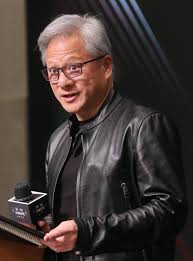
Thank you. I'm deeply honored. I'm deeply honored. How can I take some questions?
Sure. Yes. Hi, Jensen. Stella from Nikkei Asia. I have two questions if that's okay. One, you were at dinner with Xi, and last week you were at the main table with President Xi. Can you share what you guys discussed? Did President Xi ask you about AI or anything you can share? Any politics?
The overall — I was there to support the president and to welcome President Xi to America, and that's really the vast majority of the time that we spent together. Of course, I congratulated him for the great advances that they've made in their industry and in artificial intelligence. They've made a huge advance. They were just — they were so gracious, so elegant. Madame Peng was very elegant, and I was quite impressed by her as well. And so it was a very nice evening.
I'm a reporter from South Korea. I have two questions. What is next for Nvidia's partnership with Korea? How do you plan to expand Nvidia's partnership with Korean companies? And what role will Korea play in Nvidia's future AI strategy?
Well, we're at the beginning of the largest industrial infrastructure buildout in human history. And the amount of computing that we have to build so that we could provide AI for every country, every company, every society — we're still at the beginning of that. So we have a lot of work to do. Korea, as you know, is one of the leading semiconductor industries in the world and the leading memory technology provider in the world. And memory technology plays a critical role in computers, and we need more memory than ever in history. Korea also has a rich manufacturing industry and manufacturing capacity, and that's going to be revolutionized by artificial intelligence and robotics and physical AI. And so Korea will play a very big role in not just producing the technology for AI, but also using AI to revolutionize its own industries. I'm also just really impressed by how Korean society embraces technology. In my generation, in my time with Korea, it was the beginning of the PC revolution. It was the beginning of internet, beginning of mobile cloud. And in each one of these phases of technology, Korea was very enthusiastic in adopting the technology. And look at Korea now — the energy, the positive energy, the industrial success — it's just so incredible to see all of that happening in Korea.
Hi, I'm a reporter from Yonhap of South Korea. First, congratulations. With the transition to the Rubin architecture and HBM4, Nvidia's reliance on SK Hynix and Samsung Electronics is higher than ever. Do you view this heavy reliance on Korean memory makers as a potential supply chain risk or a strategic advantage?
Korea's manufacturing is world class, and nothing — oh, thank you. I haven't had anything to eat today. And so, Korea's manufacturing capability and capacity is absolutely world class. And so if I had to rely on anyone, relying on SK and Samsung and Korea to manufacture the essential ingredient for Nvidia's growth, I can't be more confident. And so I think you should also be incredibly confident and proud of the technology industry in Korea and the manufacturing capacity and capability.
May I ask some questions? You call Korean partners in building factories of intelligence by supplying knowledge chips. What role do you see Korean companies playing in Nvidia's AI infrastructure investment in the USA? And are you discussing any specific new projects with Samsung or SK? I think the second question is more important to journalists.
We have multiple years of product development already with Samsung and SK. We need to, because of course when we're building hundreds of billions of dollars of AI factory infrastructure, it's not something you can plan just months in advance. You have to plan it years in advance. And so our technology development together is quite long duration. We work with Samsung and SK and LG and Hyundai and these companies on so many different areas. We're developing a Korean sovereign AI language model. We have a Korea AI lab that we're starting, and I'm very confident that Korea, with the number of AI researchers that are growing in Korea, that Korea will build your own AI technology and your own foundation models. We're working with the companies in manufacturing of semiconductors and pushing it to the limits. We're also working with the companies in robotics. We're working around power generation with LG. We're building self-driving cars with Hyundai. Nvidia's technology is used in Samsung's fabs, SK's fab. Even though they manufacture for me, they use my technology for their fabs. And so our collaboration with Korea is both as a provider of technology as well as, of course, a grateful user of the technology. And so the collaboration is really broad and really deep and very long term. We're going to be working with Korean companies for the next 33 years. I've been working with Korea for 33 years. I'll be working with Korea for 33 more.
Mr. Huang, can you talk for a minute about global standards? We just had the summit last week between Xi Jinping and Donald Trump, and AI was big on the agenda. But you had talked also tonight about the need for control and supervision, and it took something like a year for the two of them just to decide on one sentence that they were going to try to keep a human in the military decision chain. So how do we get there by talking?
First of all, before we can have any collaboration, first of all, we should recognize that we're competitors. And competitors are still able to collaborate. And I think this is such an important and consequential technology, it has the incredible opportunity to do good, and we have to keep it from doing harm. And so we have to do that by collaborating, by talking. It is absolutely possible for all of the AI companies, AI labs, and ourselves across the world to expect some level of minimum levels of expectations of safety and functionality and quality and reliability, not unlike what we expect out of airplanes and cars and other products that we expect, consumer electronics products. And so I think that the industry is fully able to come up with standards that we can expect out of each other. I think that the idea of external auditors and testers and an industry of benchmarkers and reviewers would be really welcome for the industry. But that doesn't change the fact that we need to embrace and we need to accelerate the development of AI technology for safety. It's not just — when you think about AI, it's not just capability, but it's also AI technology for safety. They go hand in hand. The two are not conflicts. And so safety, trust, and innovation all should be thought of together, and we should be able to accelerate all of it at the same time.
Does government have a role for that, or is that just industry in your mind?
I think it's terrific that — first of all, the industry understands the technology best, and I think the industry ought to put forth some ideas about industry standards and ways that we can share and elevate the industry together, and then invite the government to codify — welcome them to codify this so that we could be a global standard.
Mr. Huang, Alex Turquy on Foreign Policy. I'm based at the United Nations. So I want to do somewhat of a follow-up, but of course, Sam Altman and Dario Amodei recently briefed just in the last week the Security Council talking about regulation. Now, you've said you're not a doomer. You think that some of these concerns are overblown or it's non-scientific. Do we need regulation, which you just talked about, but at what level? Is it at the level of an individual government within that state? Is it a science-based tech industry council, or is there a need for the United Nations in this, a body similar to the IAEA?
This is obviously one of the most consequential technologies ever created, and I think all of the bodies that you mentioned, all the institutions you mentioned, ought to be involved. You ought to have a voice. You've got to participate in how to advance this technology safely. The first part, of course, is that we have to make the technology work. You know, until just recently, the technology barely even worked and did anything useful. And so I'm delighted that the first thing that the industry has done is made the technology useful. Now that the technology is useful, we can kind of see the trajectory of how this technology could diffuse into industry. Now is a good time for everybody to get more involved and think about how can we continue to advance this technology quickly in the concept of safety. Don't forget automatic braking systems, autopilot with software redundancy and computing system redundancy and diversity, radars, camera systems that are in cars, lane-keeping technology, airbags from 360 degrees, airbag systems. All of that is technology that was created. So the concept that AI is somehow orthogonal to safety doesn't make any sense. AI and safety go hand in hand, just like a car's advancement in its performance as well as the safety go hand in hand. And so I think that one, we need to advance the technology in a capable and safe way, and so that we could build trust for people that use it. And I think we ought to invite the industry to work together to establish standards, and then invite the world to be part of helping to codify that.
I have a little question. Can I ask a quick question? There has been a media report that the Chinese government is considering allowing some Chinese companies like Baidu and Alibaba to purchase the new Nvidia chips, RTX chips. Are you aware of that situation, and do you have any comment on that?
The simplest way to think about the situation today is that on the one hand, I think the Chinese government has an interest in providing an opportunity for the Chinese companies to flourish without competition from Nvidia. And so that's an understandable situation. On the other hand, it is also important to realize that in the world of AI, compute is revenues. And the reason for that is, of course, compute generates the tokens, which drives services, which drive revenues. And so without compute capacity, the digital economy will be suppressed in China. So the tension between wanting more compute capacity in China on the one hand, wanting to provide a space for the Chinese companies to flourish on the other hand — that's where the tension is. I don't know how it's going to work out, but I think over time, the important thing for our industry is this: we would like to be able to compete globally. And I think the US administration, President Trump, would like us to be able to compete globally so that the American companies could deserve its growth. And so we have to go compete for it.
What about the US export controls? How does that factor into —
Well, Nvidia is licensed to export the Hopper generation, and the Hopper generation, of course, is still quite extraordinary, and so we're licensed to do so.
Just a quick follow-up on the AI safety. So this morning you listed the tools. OpenAI, Anthropic, and Google are not on the list, right?
Anthropic was on the list.
Okay. One of them. Yeah. But then it shows that these companies, they don't have a willingness to be accountable, at least from the executive.
Oh, no. No. It's not anything that complicated. First of all, OpenShell is a containment system for AI. It's kind of like a force field, a sandbox. And it keeps the AI from doing things and entering file systems or accessing networks that it's not supposed to. Okay. And so OpenShell is developed with a lot of different companies. Nvidia was the leader of OpenShell, and it's now been adopted by a whole lot of different companies. Every company can use it. You don't have to have your logo. You don't have to support OpenShell. There's just the companies that came out to support it. We really welcome IBM and Red Hat and Microsoft and SpaceX, and you mentioned Anthropic, Hugging Face, of course, they were attacked, and so there's CrowdStrike and Palantir and let's see, Palo Alto Networks. And so you saw companies from all these different spaces supporting OpenShell, but it's open. It's not a membership or anything. Don't read any more into it than that.
There's no certainty that they will use it, right? So if anything goes wrong —
Well, they're welcome to use it, and I encourage them. They surely are advancing and building more secure sandboxes than they previously had. And so I have every confidence that OpenAI is going to do a fabulous job in the future. This is an extraordinary technology company, and the leadership, the management of OpenAI cares deeply about safety and security. And so I have every confidence they're going to advance the capabilities.
Yes. As a shareholder, you're happy to share your views. So what is your target price for Nvidia stock in one year?
Well, you know, Nvidia is a strange company because Nvidia is already the largest company in the world. We're also still one of the fastest growing companies in the world. And so it's unnatural for a company of our size to grow as fast as we are growing. And so it's a little uncomfortable for the market, but I think they will get used to it. And you know, I think Nvidia's prosperity is ahead of us. And as a shareholder, I would encourage you to hang on to your stock and buy some more. Buy some more. Nvidia is quite inexpensive right now, quite affordable. Yes, sir.
Hi Jensen, from Tech Context. There's a lot of excitement over the past week about digital personal AI agents from Meta, Mistral to —
MetaMuse. Grokbot. Yeah. Grokbot. Yeah. Instinct, right? Astra is a great — by the way, Astra is a great agent.
Personal AI agents as a driver of demand over the next year.
Well, we're all going to have our own personal agents. It's going to help us shop and help us find things and all the things that you imagine somebody could help you digitally to do. And so we're all going to grow old with our personal bots and we're going to grow up with our personal bots. It's our own C-3PO or R2-D2, whichever one you choose. And so I think that's a foregone conclusion. Yeah.