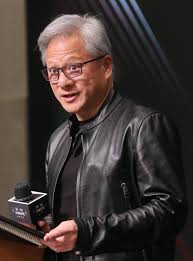
First of all, I am thrilled that your daughter is here two days after getting married. I can think of no better way to spend your honeymoon.
This is our honey—this is her honeymoon.
Than here at the Korea Society. We are honored by you being here.
And by the way, this is a very Korean honeymoon.
Um, I first of all, when we have a busy day, we take a few meetings, you know, we maybe have a lunch. You start your morning on CNBC and then you grab global headlines in the Wall Street Journal that you've made an historic stock buyback, $150 billion, um, to the total of 235 billion. That's kind of an easy morning for you, and obviously Wall Street is now looking to see you going on a spending spree. And you have talked about, you know, you've recently partnered with many of the people who are probably in this room, with Apollo, with Blackstone, with BlackRock, Goldman Sachs, KKR, and you also talk about...
I'm your largest customer, all of you.
To the tune of about a half a trillion dollars of investment. You've talked about AI infrastructure as being a five-layer cake, and you're getting invested in other layers of that cake. So share with us what the vision is and what you plan to do as you're investing in the other layers of the cake.
Yeah. So, um, we are going through probably the most consequential computing platform shift in history since the year of my birth. The year after my birth, 1964, uh, the computer industry was really created by the IBM, the announcement of the IBM System/360. Pretty much the specification of today's computer industry, or until just recently, uh, really, really resembled everything that was described by IBM. It was shaped all during that time: the central processing unit, the I/O subsystem, virtual memory, the separation of operating system software and hardware, multigenerational compatibility. All of that was largely described, um, by IBM in 1964. Well, we've reinvented computing for the very first time—a computer that's not programmed and software written by human, a computer that learns from experience and information around it, a computer that is taught, not programmed. And so this reinvention made possible, of course, what we now know as artificial intelligence, and we're at the meaning of that. Well, when you reinvent computing, which is probably the—I think it's arguably the most important instrument humanity's ever created, and it's at the foundation of literally every single industry. There's not one human, not one company, not one industry, not one country where computing is not its most important instrument, where it's not the fabric, if you will, of modern society. It is already part of infrastructure while we're reinventing it all together. And we're reinventing—when you reinvent a computing, uh, system, when you reinvent the way that people think about computer, you take a step back and you ask yourself, you know, what does it mean at every single stage of computing and every single layer of computing? This is the first time in history that a computer is going to be generating information, not just retrieving information. The reason why it's called a data center, Julie, is because it's a center that holds data. It stores information. The reason why we call it an AI factory is because we're now producing intelligence. Well, storing things has value, but manufacturing something valuable has incredible value, which is the reason why our industry has now scaled to extraordinary levels. The five-layer cake. The way that I reason through it is: how do we reinvent every aspect of industry to be preparing to prepare the future for AI.
Let me break down the five layers and then bring into it how Korea's role, right? So you've written about this, you've talked about it extensively. You mentioned the data center layer, which is infrastructure, energy being another layer, chips being another component, models, which is I guess the intelligence layer, the core of large language models, and of course applications, which is the computer software. Now, the South Korean industry maintains extraordinary, extraordinary competencies through all five layers of that AI cake. We saw it in your video, and you have doubled down on these alliances, right, with Samsung, with SK, with Hyundai, with Naver most recently. You signed a big package, LG, Tusan, and of course the entire startups, um, class that's out there. How do you see—what do you see as Korea's sort of most valuable contribution now? And what sectors can they lean into moving forward to help shape the future of AI?
Korea is unique, um, fairly, fairly singular in your ability to both consume and export AI. Very, you know, one of the things that's really extraordinary about Korea is that there's a, there's a social love of technology. There's a social love of technology. It matters a great deal. If you go back...
If you go back to the last industrial revolution, as you know, all of the names of the people who invented the modern—the last industrial revolution—there are people like Maxwell and Aier and Volta and companies names like that. None of them were American. And yet, even though it was invented in Europe, it was, if you will, exploited in the United States, exploited in a good way. Meaning that we took advantage of the technology, we applied it to industry, we permeated all of economy, and as a result, the technology was invented in Europe but diffused in the United States. Korea has a real advantage in the sense that you could invent the technology and have the technology diffuse through your society in a way that's welcome because you embrace technology. You also realize this: Korea's aspirations is greater than your human capital. It's still a small country in terms of overall number of citizens. With AI and automation, you could punch well above your weight. You could achieve your aspiration without the limitations of a smaller population. And so, for the very first time, you have the necessary technology if your society is optimistic about it, enthusiastic about embracing it, which Korea is. Korea also has the industrial capacity to consume it. As you know, Korea is extraordinary in three different areas. It's more—um, I understand—I share—Do—is it true that I share this award with BTS? Is it—is it true? Okay. I, you know, you are a rock star in Seoul. I went to Seoul this summer, and every restaurant I went to had a picture of you eating in that restaurant. You are a rock star in Seoul.
Or I just really love eating.
You're a rock star anywhere you go. Actually, you're a global rock star.
If you love eating, going to Korea is the perfect place. Not to mention drinking. And, uh, you know, I'll just say this one inappropriate thing. Um, I've only been kissed in the mouth by a man in Korea. Lori's like, 'Where is this going?' I don't know. It is a straight—and it was a Samsung employee, Jay.
Wow. This is getting really good. Okay.
But we have some serious things I got to say. But, but I just—what is that drink called where, where soju go into the, into the beer?
And then, and then you drink about 10 of those, and you have no trouble kissing a man in the mouth.
No wonder you're so popular in Seoul.
Well, I have a lot of fans. Many of them supply chain of Samsung.
Wait, I want to keep it light for one second. One more second, which is I, I.
I want to tell you something very serious.
Okay, tell me something serious.
I'm just kidding. I'm just kidding. Go ahead.
I looked up your LinkedIn profile, and it says Jensen Huang, CEO, founder, Nvidia, 1993, present. And the only other listing you have is Denny's. Dishwasher, bus boy, waiter. That's a choice on your part.
It was a good job. It was a good job. I love that job.
And that's obviously the origin story of Nvidia. It was at that Denny's.
Because I love Denny's. That's America's Diner. How could you not?
American. But tell me, what is it about your DNA and your upbringing and your road through Denny's that allowed you to make the decisions as CEO and founder that kept your company coming back from the brink and becoming this global juggernaut?
There's, there's a little bit of Korean in me. Um, resilience, stubbornness, determination, uh, the ability to suffer. No, nobody suffers better than I can, you know. Only Koreans could suffer better than I can. But, but the ability to suffer.
What do you mean by that? Seriously, what, what does that mean?
Suffering. Suffering. In order to do something incredible, you have to suffer. It's not a walk in the park. If it's a walk in the park, anybody could do it.
What were the slings and arrows for you?