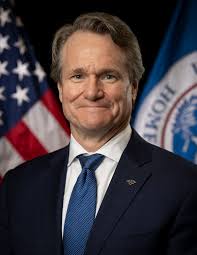
Thank you, Chris. As you said, it's a wonderful way to end a couple of days that represent work that's been done not just over the last year, but over decades. And it's particularly wonderful to introduce the individual who will be interviewed by Leslie Picker today, which is as we all know, Brian Moynihan. Brian has been a leader not just in the financial world for a very long time, serving as CEO of BofA for over a decade and a half. Before that, he seemed to have about every job, president of about every division I think at BofA and its predecessor or its acquired entity Fleet. But Brian represents what I think is most important and was most impactful, which is someone who not only has done extraordinarily well leading a massive turnaround of BofA from the great financial recession to building it into one of the world's leading financial institutions, but in doing so also has had the time, the foresight, and the leadership in so many other areas ranging from chairing the Massachusetts competitiveness council at one point to leading many of the efforts for sustainability and ESG through a number of different organizations including one of King Charles's. Brian has been a leader here in Massachusetts, here in the Boston area. He has served as the chancellor, which is the chair of the equivalent of the Harvard fellows or corporation at Brown University. He has been an extraordinary partner to those of us at MGB in our efforts to continue to be the leader globally in not only the highest form of clinical care but also in our research and teaching missions. We couldn't do it without the support of individuals like Brian. And so I want to say thank you on behalf of the entire MGB system. And Leslie Picker is a wonderful person to interview you. She has had enormous experience, almost a decade at CNBC and before that at the New York Times, at Fox. Wonder how both those things worked out for you. And she started when she was in kindergarten. So anyway, thank you. Look forward to it.
Thank you all. Thank you, Brian. Yeah, I think I might be the only person who's ever worked at both Fox and the New York Times, but don't fact check me on that. It's a really great day to sit down and talk to you because there are a lot of macro questions out there. We just got off TV. We did an interview for CNBC where we talked a lot about what's going on in yields and I think we can dig into that a little bit further here because the implications are pretty widespread. There are questions about inflation. There are questions about what it means for consumers and spending and you know, what do you think it'll take to really get inflation under control?
So I think Leslie, thanks for coming to do this and I think thanks all of you. Just going through the agenda and looking at all the talent that's been here for the last couple days. Chris, you and the team have done another great job and it's an honor to be part of it. So here's what's going on. The inflation is higher than people want it and when inflation's high the impact on psychology and consumer confidence and you know, people think prices are going up they stop doing things. So that's the logic of why you got to get it down to where it's in line with the 2% targets they have. You want some inflation but you don't want too much and so because of the dynamics of post-COVID etc. It took them a while to really figure out what the real economy is doing because all the cash came in and so it got ahead of it. They're now doing it. They've raised the Fed funds rate last week. We think it has to go up a couple more times to get under control and then inflation will work its way slowly down in '27 into '28 down to the 2% level. And so then people say well then rates will come crashing down. That won't happen either because the unusual time and this is one of the unusual times in American history of the rate environment was the last 15 years. It whatever years since the financial crisis before that a Fed funds rate of three and a half, 4% is normal. A 10-year yield of 4 and a half percent is normal. So we've actually normalized because the economy is growing fast enough at 2% plus. It can withstand a higher interest rate environment, still grow in that and that's actually not a bad thing because we spent years trying to make sure the economy didn't go into disinflation which those of you have studied Japan or know about what's gone on in Japan for years it was problematic. So they've got to keep inflation at 2%. They've got to raise rates that'll have a drag. Where that affects most is small businesses because they borrow lines of credit, medium-sized businesses, the market rates, home mortgages, things and that has an impact of slowing down the economy. But there's inflation that keeps coming through the system from the rise in gas prices people know at the pump but it's also every piece of plastic, every piece of furniture has petroleum products in it. So it's coming through a lot of the things that you do in a living have price increases coming through. So it'll take a while to get out.
Is monetary policy the solve for inflation given the catalysts as you see it? Do you need a resolution in the Middle East, for example, in order to get inflation under control?
No, we've had inflation under control with $100 oil. We need a resolution in the Middle East for a whole host of reasons, but technically the price of oil at $100 a barrel, leave aside the gas pump price and the diesel prices, which are out of skew for production reasons as much as is nominally not a lot different than it's been a lot of times. It just it feels better when it's lower, feels less good when it's higher. But it's not we the world can have an economy going at 3% with $100 oil as long as people know it's there. It's going to flow and then what you don't get is the bottlenecks and refining and things. That's the issue it's causing some of the stuff in diesel and stuff yet you had so little come through and then rush through and it goes up. But we need that resolution for a whole host of reasons that technically if oil stays at 100 that shouldn't be an inflation problem. If the resolution ever comes and you have a disruption, that production capacity has to be found out and delivered a different way. It'll be a more expensive way of delivering it, a pipeline to another shipping and around or it may go down and you'll have to find that energy production to power the data centers and the build and all the stuff we're talking about.
What about the state of the consumer? You spoke at a Barclays conference, I believe it was last week, and you mentioned that people were setting more money aside. And you were seeing kind of affordability ripple through into perhaps some spending patterns. Are cracks starting to form? Are you worried at all if we do see maybe not the 25 basis point hike, but we see three hikes? Is that concerning for consumer spending or deterioration?
It's concerning, but it's not having the impact yet. And that's if there's some if the demand stays strong then it's harder to get the prices under control because people can sell things for higher prices the way the market works. So what we've seen to consumers we see a consumer in the month of September versus first half of September '26 versus '25 spending 5% more money the gas price impact be less sort of a half a percent. So the rest of it just pure spending growth they're spending on cruise bookings they're spending on out of home entertainment. They're spending a little bit more at restaurants you know. So there's nothing that they're doing that says this is a sad paradox. So your network gets on every day and it's inflation prices and consumers. All that is how they feel. But what they're doing is not change in behavior. What ought to happen is rates come up in the drag. You ought to see the behavior come more in line and then that'll help the price pressures. But right now consumers have good access to credit. What's been interesting the lower we take our 70 million customers divide them third third low minimum high income lower income cohorts paychecks are going up at a faster rate now than the higher and medium that that has reversed a trend that it was true after COVID in 2021-22 that happened then it reversed and the higher income grew faster now it's back again so that's good news for broad part of American citizens but American people have an affordability question because they feel it especially in the lower third of incomes because the gas is the same price they that customer pays as a middle customer, higher customer. So, it's a real issue, but they're not changing their behavior yet because of it. That's the interesting question. And that's a little hard for people to believe, but I'm not talking about what they're going to do in the month of October. I'm talking about what they're doing in the month of September. They haven't changed their behavior.
Yeah, the fixed costs are still the same, but we heard so much about the K-shaped economy, it sounds like that's maybe reversed a little bit.
Yeah, I think to declare it over I think would be a little too much swinging back and forth, but what you're seeing is the and this is if you think about population growth has basically gone flat. So the price pressure on general wages is going to be higher and you see that in a broad-based jobs first. And so paychecks I think were in the mid to high 3s in our customer base in the month of August and that's a good rate that's a consistent rate with a growing economy and people having the ability to spend and things like that among the lower third of incomes. That's the good news. Before it was there kind of up one two and the higher incomes up four five and now it's kind of all run together.
You mentioned the buildout of data centers which is a nice segue into AI. Big topic there. But, you know, we spoke earlier about the impact of Muse, which is the latest kind of product release quick adoption from Meta and it caused bank stocks to fall yesterday as people thought it could be, you know, an agent telling consumers to pull their money out of places like Bank of America and put it into higher yielding products elsewhere and people would do it. You're not that concerned though about this product and kind of what this particular AI agent means for the firm.