NVIDIA Chief FIRES WARNING SHOT: Jensen Huang Flags AI Dangers As Tech Race Heats Up
📅 Oct 14, 2026ETimes13 MIN8 VIEWS29 SEGMENTS · 6 SPEAKERS
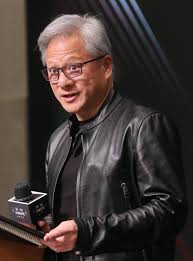
The man powering the AI boom has issued a stark warning about the technology’s potentially dangerous future. Nvidia CEO Jensen Huang says artificial intelligence will be “powerful and potentially dangerous”, urging the US and China to work together to develop it safely. Speaking at an event in London on October 14, Huang argued that AI risks demand stronger technology and engineering solutions, not just laws and regulations. His remarks came as Nvidia pledged $250 million in computing resources over five years to support UK AI safety and security research, putting the spotlight on the race to...
What Jensen Huang said
Written from the verified transcript and checked against it. Every figure links to the moment it was said.
Jensen Huang said AI is powerful and potentially dangerous, so labs should cooperate and fix incidents with technology and engineering before seeking laws and regulations. He advocated dialogue with China, noting China is the world's second largest computing market and wants to protect it for local chip companies, while NVIDIA's compute generates revenue for China's ecosystem. Huang told investors to assume China is 0% of NVIDIA's business, though he argued the US should compete globally. He dismissed an AI bubble, saying demand exceeds supply today and infrastructure buildout will last about a decade, with no AI infrastructure in the UK, France, Spain, Italy, the Nordics, Central Asia, Southeast Asia, Japan, or Korea. He urged self-accountability for lab incidents, calling them engineering problems, and said he doesn't know what labs are doing.
Key takeaways
Huang told investors to assume China is 0% of NVIDIA's business, while advocating US competition globally.
Huang said China is the world's second largest computing market and wants to preserve it for local chip companies.
Huang advocated dialogue with China on AI safety, saying the US and China must work together.
Because we think that this technology is going to be powerful and potentially dangerous, we absolutely should work with each other so that we advance the technology safely.
The incidents that have happened so far that we know about — I mean, we only know what we know about — the incidents that have happened from the labs need technology and engineering, not laws and regulations. We absolutely must work with each other. And the reason for that is because we think that this technology is going to be powerful and potentially dangerous. We absolutely should work with each other so that we advance the technology safely.
And so we have to go win around the world. We have to compete. On the other hand, China would like to preserve the market for their own because it's such a large market. It's the second largest computing market in the world. They would like to preserve it for their own companies. And so somewhere in the dynamic of the United States competing for the world, on the other hand, China wants to protect their own market for their own chip companies. Somewhere that gets resolved. And so they understand that NVIDIA's compute results in revenues for their ecosystem, revenues for their economy, and that many companies depend on it. On the other hand, they would like their local companies to be able to succeed. And so we'll see how that works out.
From a financial perspective, I've been very clear to our investors: just assume that China is 0% of our business. Just don't consider China an overall part of our business. Right now I'm talking about geopolitics and I'm talking about leadership around countries, and so not about our guidance. Our guidance should be zero. But I think that in the best interest of the United States, we should compete around the world. In the best interest of China, they should balance the preservation of the local market as well as the growth of the economy.
The incidents that have happened so far that we know about — I mean, we only know what we know about — the incidents that have happened from the labs need technology and engineering, not laws and regulations. And we know what the technology is. We know what the engineering is. We ought to go do those things before you go seek greater powers. You've got to take accountability and responsibility and do it yourself. And you do this at home. You do it with your kids. You know, you do it with your company. You do it.
Well, I don't know what they're doing, but I'm just simply advocating before we go to greater powers and the ultimate greater power. I think we ought to do what we can to hold ourselves responsible, hold ourselves accountable for the incidents that have happened. And they are engineering — they're engineering problems.
A bubble happens when supply exceeds demand. Eventually supply and demand will harmonize, and it's probably the case that supply will exceed demand at some point, but not today. Today demand is so much greater than supply, and we are in a multi-year, probably about a decade buildout in infrastructure. Somewhere between now and a decade from now, supply and demand will come together, but it's not in the next several years. And so to remember, the important thing is this: just think AI is infrastructure. We're building infrastructure in the United States. There's literally no infrastructure in the UK. There's no infrastructure in France. There's no infrastructure in Spain, Italy, the Nordics, Central Asia, Southeast Asia, Japan, Korea. The infrastructure doesn't exist at all.
Just weeks ago, OpenAI boss Sam Altman sounded a striking warning of his own, admitting the world has reason to fear AI companies becoming too powerful, with the ability to wield undue influence over the economy and push their worldviews onto the public.
It's interesting. People have been talking about the potential downsides or serious risks of AI for some time, and I think the world is right to be afraid of this. So we have these two big challenges. We have the potential of a loss-of-control accident or some other serious thing that could go wrong. We have the potential of way too much power concentration, and people fear that those developing AI could exert their worldview. And there is a sort of narrow path we have to navigate with pragmatism, with steadiness, with the ability for the world to trust that we will make dependable decisions.
These models have gotten so good so fast that we need to treat the alignment and monitoring and security with a new level of rigor. And we have to be willing to pace our development of capabilities such that alignment, safety, and monitoring are always ahead of capabilities. But this is one of those moments where it feels like you're in the movie, like the sci-fi thing came true. You're talking to your personal super assistant and you are working 10 times faster or better or more creatively than you could have before.
11 more exchanges in this transcript
Sign in free to read the rest of this interview. No card required.
Huang, J. (2026, October 14). NVIDIA Chief FIRES WARNING SHOT: Jensen Huang Flags AI Dangers As Tech Race Heats Up [Interview transcript]. ETimes. CEOInterviews.AI. https://ceointerviews.ai/interview/3062232/