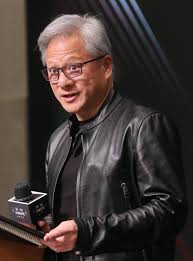
We're gonna hang out for a couple days. Oh, good. I'm gonna show him Taiwan.
It blew my mind.
Look at that.
Ladies and gentlemen, Lex Fridman.
Hello, everyone. This is the famous oyster pancake.
Amaze, amaze, amaze.
Beatles in the '60s.
Jensen, thank you. Jensen loves the night market way too much not to do it.
This smells delicious. Let's see what this is.
Let's try this thing. Doesn't make any sense. Amazing.
That's a wrap on one of the most incredible weeks of my life.
I'm visiting Taiwan, first time for me, in part to hang out with Jensen Huang, the CEO and founder of NVIDIA, which is the world's most valuable company, and also one of the most consequential companies in the history of human civilization. And I'm also here to attend Computex, which is this gigantic conference, just a sea of engineers at the heart of the land of engineers in Taipei.
Now, Taiwan is this island that's two-thirds mountains, and this one island is responsible for more than 90% of the most advanced semiconductors in the world. Basically, every computer, every smartphone, every GPU, every AI data center would not exist without this one place.
Virtually impossible to replicate anywhere in the world. You know, I often think about ancient history, human civilization, and places like Göbekli Tepe or the Egyptian pyramids, and there's a lot of mystery about how was it built. And it's humbling to know that there's places on earth like those ancient constructions that we still don't quite understand how it's built.
How is it that Taiwan comes to dominate so much of the semiconductor industry? And of course, there are answers. Some of it is culture. Some of it is the education system and how much engineering is prized within the education system. And of course, all of it has huge implications, technological and geopolitical, for the coming years, decades, centuries.
I, of course, want us to compete but remain friends, and I think a big part of that is understanding each other, understanding each other's culture, each history, and respecting it, but also working together, and the interlinked economies, technologies, supply chains. But also humans, talking to each other, marrying each other, drinking beer together, eating together, all of that.
And that's what I'm trying to do, and that's what I'm trying to do here, and it's a huge honor to be able to do that amongst so many incredible engineers that come from all across the world, and to also be able to do that with the one and only Jensen, a great human being, that after all of these years, he's able to maintain humility and to truly be able to listen and to recognize everybody around him as a human being, including me. It's a huge honor. Plus, the guy's a foodie. There's no better person to be eating some great Taiwanese food than with Jensen. All right, let's go.
Hey. - Jensen. - Lex, how's it going? - Good to see you. - Welcome to Taiwan. Hey, guys. Do you know who this is? Yes. The great Lex. Yes. I love you.
I love you, too.
You know, he's known worldwide as Lex, just like me, Jensen.
You know you made it when you're just one name.
You're just one name.
Beyoncé.
Jensen, Beyoncé. How was China?
Incredible. - Incredible. - So much kindness.
Lex.
You're a rock star.
Hey, guys. Nice to see you guys. Hello. Hello, hello. Hello. Nice to see you guys. Nice to see you guys.
Hello, everybody.
Okay, this legit is pretty insane. Jensen, I-
Mike, do you know the famous Lex Fridman?
Good to meet you.
Look at this guy. He went... He's just traveling through Asia.
Hey, guys. Good to-
Does everybody know the famous Lex Fridman?
Oh, stop it. Stop it.
Whoo. - Jensen, I love you.
Look at this. Look at this. No cables. No cables. No hoses. Yes. 100% liquid cooled. Yes. Last generation, Grace Blackwell, was only 80% liquid cooled. Now, it's 100% liquid cooled. From two hours to assemble, it's now five minutes. Things that are easy to build- Yeah... are also reliable.
Officially in full production, right?
Yeah. Yeah. Full production now. Incredible, right?
Yeah, it's incredible.
All this. Everything.
And the Vera CPU, you're full in on the CPU. I saw the-
Yeah. Yeah.
... 1.8x over x86.
Oh, it's incredible. x86 CPUs, the hyperscale CPUs were designed to be rented.
Mm-hmm.
And so you want as many CPU cores as possible-
Yes.
... because the economics of CPUs in the last generation was how, what's the dollars per core? In this new world, no, AI doesn't rent cores. Yeah. AI generates tokens, and they sell tokens. Yeah. Yes. And so your per- Correct... fundamental purpose is to go through that exchange- Yeah... go through that loop as fast as you can- Yeah... and generate tokens as fast as you can.
The more you buy, the more you make. You might be the best salesman in the world. That's a good line.
Well, Lex, it's easy. You know? It's not a complicated thing.
Yeah.
The technology is complicated- ... but the business model. Amaze, amaze, amaze. Thank you. All right, Lex, you gotta sign here. Lex was here too.
All right.
The great Lex Fridman. Yes. Yeah.
The love I'm getting right here.
Awesome. - This is incredible.
He just happened to be here? No, he just didn't happen to be here. He flew out to hang out. We're gonna hang out for a couple days. Oh, good. I'm gonna show him Taiwan.
Oh. Lex has got an awesome podcast. Very long ones.
Very, very long. - Then you learn a lot.
You learn a lot.
And learn a lot. And learn a lot.
Thank you.
AI is a five-layer cake. I think I'll have that one. Lex, have a bite.
I think I'll have that, the green one.
Did you enjoy some good food?
Yeah. - Crazy? - Yeah, street food. - Crazy? - Insane.
Crazy? It's good.
Not bad.
This is a conference cake.
Yes, let's do that.
Now let's welcome Jensen and all our Quanta QCT executives on the stage to take one last group photo.
Jensen legit is, like, the Beatles in the '60s.
Except the Beatles actually had talent.
Yeah, right. Well, I saw you dance on stage. It was all right. It was pretty good.
That wasn't quite John Travolta talent.
Remember that?
Oh my goodness. This is one of the best.
I have so many happy memories of that.
Oh, yeah. Ladies and gentlemen, welcome to SK Hynix. Trillion-dollar company. No wonder supply's so tight. Memory's so big. You want a sandwich?
SK Hynix, legendary high bandwidth memory company.
We invented this, LPDDR memory into data centers. Twice the bandwidth, half the power. Twice the bandwidth, half the power.
And now please make more.
Yeah, yeah. Please make more. Oh, look at that. That's beautiful.
You know, when I was young, I would think that that's not good. But now, I love wabi-sabi. You know, beautiful things-
Yeah. - ... imperfect.
Yeah.
Yeah. I love that.
Imperfection is beauty.
Yeah, look at that. One of a kind.
That's my favorite part, is all the different GPUs that people are-
I know. - The old school-
Isn't that amazing?
The old school 1080-
Yeah, yeah - ... the Titan RTX.
This one. Look at this one.
Nice. - This is the-
Titan.
... 1080 generation Titan.
You know, I've seen this on TV. Let me explain.
Anniversary.
We're brothers. - We're brothers.
Yeah, we're brothers.
Cheers.
There you go, man.
All right, thank you. It's pretty good.
It's nice to have just a...
I love this guy.
Hey. Oh, I love these people.
Oh, yeah.
Lex, try this. Lex.
Mechanical?
Oh, God. They're the best.
Oh, nice.
Look how delightful they feel. This is real joy.
I have bad news for you.
Oh.
In the future, it's mostly gonna be voice control.
I think so, yeah. I think better typing, don't you?
Yeah, yeah.
I have a hard time thinking when I'm just talking.
Speed is not everything. Sometimes you have to pause and think.
Look at that. Back to the '80s. Look at this. Jensen, you need this for AI. This for you. This, this, this, this, this. Thank you, brother.
Ladies and gentlemen, Lex Fridman.
Hello, everyone.
People are nice.
So much love. - People are nice.
So much love. So much kindness.
Yeah.
Were you nervous before the keynote? The whole world-
I'm always- I was super nervous, - ... the whole world watching-
... I was super nervous, but I'm always nervous. You know, every public speaking, doesn't matter what it is.
Keeps you sharp?
Yeah, well, I don't take it for granted. And, you know, I want to do a good job, and it's because everything comes together such a last moment, it's hard to practice at all, and we don't. And so, you know, so I don't know exactly all the words that I'm gonna say.
Mm-hmm.
And there's no teleprompter. If we're gonna go build and sell a few trillion dollars of computing over the next several years, this entire island has to be part of it.
Mm-hmm.
This entire ecosystem has to be part of it.
Yeah.
Every single one of these companies are gonna have to invest hundreds of billions of dollars over the next several years.
Mm-hmm.
And so they've got- they gotta, one, understand it, be inspired by it, want to be part of it, and understand how they can benefit from it.
Mm-hmm.
And so, you know, in the keynote, I tried to distill that down to as few words as possible.
Not like this guy.
By the way, Jensen shows, I mean, obviously shows humongous amount of love to me that I don't deserve, but he shows love to everybody. Everybody. And you give some love to the gamers too, with the laptops and the games.
Oh, I love the gamers. That's where we all begin. You know, don't forget your roots. You know? No matter how high you are, don't let your feet leave the ground.
Some of the most passionate humans on earth are gamers, and some of the happiest moments in my whole life is playing video games on NVIDIA hardware. Look at that. Look at that.
Look at...
Look at all these people.
It's unbelievable, man.
It's an honor of a lifetime. Thank you for this experience.
Wow. Hey, well, I really love hanging out with you. Okay, are we gonna go get it done?
Let's get it done.
Let's go get it done. Can you sign this for me?
FIRST Robotics shirt.
Oh, wow.
Thank you. Thank you.
Love this. Look at that, 2026.
Young engineers building robots. Most of them probably running on NVIDIA brain.
Love that. Now, you gotta sign it too. All right. Here, I'll hold that for you. Thanks, man.
Thank you.
Keep going. - Thank you.
There you go. So good.
Keep going, keep going. - So good.
Thank you.
Good job. Hey, Lex. There's more here.
And more here. More here. More here.
Thank you very much. - Cheers.
Yeah, cheers, guys. Cheers, cheers.
Cheers. - Cheers.
Cheers.
And also for Oliver.
Cheers. Cheers, Jerry.
Yeah. Seriously, seriously.
I love this.
Yeah, yeah, yeah.
Good?
Let me try it.
Beyond good. That guy's seen it.
Mm. - That's right.
Beyond good.
And after you finish it, please sign for us.
Amazing. - Wow.
Really good.
I really needed that.
Yeah.
This should be a long day for you. Starting from morning. Yeah.
Uh, doughy, salty-
Oh.
... with a nice beer. Taiwanese beer.
Taiwanese beer.
Yeah.
The best part of the tour right here.
Exactly.
Oh, man. Oh, my God.
Now you just have to 3D print a statue.
Please don't do that. Okay, you guys. Thank you.
Bye.
Come on, Lex. You with me. Lex. Where's Lex?
Here. - Get on the other side.
You sure? You good? - Yeah, yeah, of course.
Thank you. Thank you, sir.
I'm not gonna strand you in Taiwan. You know I'm gonna find you again.
Yeah, exactly. In a river somewhere. What an incredible, incredible experience.
It's truly amazing how much... You know, there's this outpouring of love and-
It's really inspiring to see an engineer be treated like a rock star, 'cause engineers build the world, and they don't often get the love-
... I think they deserve. Yeah, and you're, like, an inspiration to, to thousands, millions of young kids who will, like, 'Okay, I'm gonna, I'm gonna be an engineer, too.'
That's right. Exactly. Exactly. - How was your China trip?
Oh, my God, my China trip was chaos. Did you see all the stuff? I go downtown Beijing, it just turned into mayhem, complete mayhem.
Yeah, you got some food, right? You got-
I had food from every restaurant. And then I became their poster child- ... of every single restaurant. It didn't take them long. It was, like, maybe about half an hour. I was on the web with... For every restaurant. Tomorrow we have incredible lunch.
Mm-hmm.
Okay? It is, like, just utterly crazy. It's rice dumplings.
Nice.
They wrap it in tea leaves.
Nice.
And this is, this one is as good as it gets.
Yeah, Computex, thank you for this. Thank you for suggesting it. I don't think I've ever experienced anything like it. Just great engineers everywhere.
This is, this is where the world builds computers.
All right.
And people are so humble, you know?
Yeah, humility. - People are so humble.
Humility. That was one of the things I've experienced in China, 'cause I also interviewed a bunch of the AI folks, and here in Taiwan same thing. It's just humility. Nonstop humility.
Yeah.
These folks, young engineers are changing the world.
Yeah.
There's, there's no arrogance whatsoever.
In United States, we've gotta get manufacturing back. And this is, AI... During the, during the AI boom is our best chance to invest in the grid, invest in sustainable energy, invest in manufacturing again. There's so much demand. And so whether the demand is so great, whether you manufacture, you know, anywhere in y- in the world-
Mm-hmm.
... Fact is you can afford it. And so you might as well manufacture in United States as well. Take the opportunity. And now with AI in manufacturing, robotics in manufacturing, this might be the perfect time to reindustrialize the United States and move a lot of the industries that we've kinda lost over the years, you know, back into United States. That's what, that's what I'm hoping for. Really working hard to reindustrialize the US, and this is, this is just a great time to do it.
Yeah, the TSMC folks say you have to visit Arizona.
Yeah. Yeah, it's true. It's true. You know, what's, what's really great is that, that Taiwan is a strategic partner in reindustrializing United States. Look, we're trying to set up fabs in United States, and what do they do? They send a bunch of engineers. They invest a whole bunch of money. It's not easy building up a world-class semiconductor manufacturing in United States because there's just not enough talent there. So they shipped a whole bunch of people, they're training people, they're bringing, bringing... You know, Taiwan is really, really truly from a technology perspective, a real strategic partner to United States. Yeah. You know, I just really hope that people see that.
Do you have some wisdom to understand why so many of the incredible companies at every layer of the stack, especially in the hardware infrastructure, come from here?
Well, this can go back to a gentleman named K.T. Li, and as part, part of their, their Science and Industries Ministry. And he was chartered with... And he had a vision, um, in the '50s to, to bring science and technology and technology manufacturing to the island.
And it was, it was really his vision that compelled Morris to come back.
Mm-hmm.
And before all of that happened, and I forget exactly how the history went, but Philips, which is the parent company that spun off the fab that became TSMC and spun off the semiconductor manufacturing equipment that became ASML, it's amazing that it came from Philips. A consumer electronics... They were the GE of Europe.
Mm.
And GE, as you recall, was also in semiconductor manufacturing in the early days, and they were doing all of, you know, advanced manufacturing as well. But somehow he attracted Philips to come to Taiwan, and that was really the beginnings.
The implant of the seed.
Yeah, yeah. And from UMC and TSMC, which were seeking to manufacture the right type of chips, the perfect timing happened with the PC revolution. IBM, in their wisdom, opened the specifications of what is called the IBM Compatible Chipsets. Basically, all the chips that made up for the motherboard, the cache controller, memory controller, interrupt controller-
The VGA controller, the graphics controller. That, that specification was con- was specified and open. Well, all these smart engineers ended up taking that specification and designing the chipsets that were manufactured at TSMC and UMC. That is the beginning-
Mm-hmm.
... of how the PC industry really evolved. What started out as Compaq, IBM, because of Taiwan PC chipsets were available to all kinds of companies, including, you know, this little kid named Michael Dell.
Mm-hmm.
And so he was just he just bought motherboards from Taiwan, assembled them into a PC, bought an operating system, licensed an operating system from Microsoft.
Mm-hmm.
He became a PC maker. That entire loop, you know, Michael has a relationship with Taiwan that goes way back.
And he's from Austin, Texas.
Yeah.
Pride of Austin.
Yeah.
And he's doing- - What a good guy.
Yeah. Great, great.
What a nice man.
Great human being.
Yeah, really great human being.
There's something about the culture. I had this really nice woman say that she grew up in Taiwan, and said, 'As a girl, I learned how to spell CoWoS before I could spell Gucci.' I thought it was a good line. That's- ... that also says something about the-
Yeah.
... value of engineering in the culture.
That's right.
Like, what's considered cool.
CoWoS.
So thank you for, thank you for bringing cool back, Jensen.
Yeah, we brought sexy back to technology.
Bringing sexy back. All right. Thank you, brother.
Yeah.
Thank you so much.
So tomorrow night, dinner.
Yep. - Okay?
And night market.
Yeah, night market afterwards.
Okay. Stay strong.
All right.
Couldn't help it. Had to. Jensen loves the night market way too much not to do it.
It's so good.
Oh, they love Jensen.
Thank you, thank you.
Wow, so hot! Fresh out of the oven. Awesome!
No, no, no, no, no. - This looks incredible.
Eat it now. This one's the best.
Cheers.
All right, I officially can't wait to eat this.
Cheers.
This is nuts.
Don't lose, don't lose, don't lose the white kid.
I got him.
You can save one. Pineapple or watermelon?
I think watermelon.
Watermelon, right?
Watermelon.
Watermelon. It's like a hamburger.
Nice.
Take a bite. I think it's time. I think it's cool enough now.
Yes, nice and warm.
Yeah, I think it's cool enough now. You're gonna like that a lot.
Oh, this is amazing.
I know. Nice to meet you.
I'll hold our camera.
Mm.
It's really hot outside. This is nice and cold, super refreshing.
Mystery ball.
Sweet potato.
It is so good.
It is so good.
Try one.
So it's empty on the inside, crunchy on the outside. It's like a sweet potato marshmallow.
That was delicious. Orange-
Watch out.
... uh, I think so, NVIDIA.
One, two, three, four.
Original.
The one we're going with?
I think so, just simple.
Yeah. - Too salty?
No, no, perfect. Delicious, right?
That was hot. Thank you.
Oh, okay, younger brother. Come here, little man.
All right.
Looks delicious.
It's my treat. - No, no, please.
If you do this, I can't come back.
It's fine, it's fine. - It's a tip.
No tip needed. Please.
Then I can't come back.
Refused to take my money.
Look at him. Look at him. He squeezed the, he squeezed the money right back into the bag.
Okay, sure. Okay.
Cheers. Cheers.
Cheers.
So good. - Very good.
I didn't want you to impale yourself.
All right, guys.
Cheers.
Oh, nice. This is nice cold Taiwan beer.
What is it?
Oh, a little of this noodle.
That's amazing. - Amazing, right?
Spicy. It's really good noodle. It's really good noodle.
Wow.
Somebody handed this to Jensen. I'm enjoying the hell out of it. That might be the best food I've ever had.
Okay, look at this. Doesn't make any sense.
This is your vegetable.
Yeah, I think that counts.
We need to make sure we get a balanced meal. Yeah.
Some cinnamon.
I bet it's like a cinnamon... It's like a snickerdoodle meets corn.
Mm-hmm. This is good.
What could be bad? It's so good. Cooked the right amount.
For me, probably the noodle was number one.
Me noodle. - Yeah, yeah.
Yeah, that was good. That was good. And whatever that sweet potato-
Those little balls? There's still some more of those.
That was really good.
Those were delicious. Second best.
Those were really good.
Going back out there for some shaved ice.
All right, let's go. All right.
Thank you. Once more into the breach. Thank you.
Whoa, whoa. All right, guys. Excuse us. Excuse us.
Make some money. Hello, everybody. Hey, that's me. That's me.
No, it's not.
Hey, that's why we have hair.
That's not you.
That's why we have hair. You have a very limited wardrobe.
That's true. Limited suggests there's more than this.
Than more than one. So Jensen was here, I think, a day or two ago, and a lot of these folks came here because he was here a couple days ago. And now they're like, 'I did, we didn't expect you to also...' He comes with the place, basically.
Peace out. And this, it feels like a movie opportunity between, like, 11:00 and 1:00. Lex, was this your first shaved ice?
First time.
Oh, okay. Well - Can we get a selfie, me and you?
That is incredible.
So good, right?
Stupid amazing, right?
Stupid amazing is right.
Yeah, yeah.
Part of my home. I know.
You can't explain this.
No. No. People tried to explain it to me. Not even close. Not even close.
Watermelon, amazing.
Why all that?
Check it out.
This is Joy. - Mm-hmm.
Is there a lot of NVIDIA teams that's local to Taiwan?
A thousand. - A thousand.
Yeah.
Supply chain. A lot of systems engineering.
All three women.
Operations engineering. Mm-hmm.
Did you try this one?
Or fab.
You're gonna like it. It's really a mild flavor.
And fab engineers. - It's good.
Packaging engineers, test engineers.
So all those super legit hardware folks.
Yeah. They, we're gonna build a building just like the building you were in.
Mm-hmm.
Almost a replica.
Mm-hmm.
We just have to settle down here. Get a piece of land. And, that building will hold 4,000 people. So we'll hire another 3,000 people. Wow. Brain freeze.
Yeah.
Given the heat outside, it's nice.
Mm-hmm. Oh, my goodness.
Yeah. Yeah. Yeah.
This one's a gift.
Oh, wow.
This is very good.
This is good.
Pineapple with guava.
You know it now with sugar rush.
No wonder they, no wonder they gift-wrapped this to us.
They wanted you to try something new. They're sampling. Expand the market. It's tasty.
I think-
Get a photo that goes all over social media. Yeah.
Let's go. - Good stuff here, guys.
Thank you.
Sorry, guys. One more, one more.
This is the famous oyster pancake.
Thank you.
Oh.
Crazy good, right?
So good. - Yeah.
Get it all in there.
Did you oyster, did you do oyster?
Yeah.
Okay.
Wow. This is the reason I came here.
Wow.
It's amazing.
I'll go in for seconds.
Oyster. Famous Taiwanese oyster pancake.
Amazing.
That oyster pancake was-
Oh, yeah, yeah. Perfect finish.
... wow.
Perfect. - Wow.
That's the reason it's famous.
My mom and dad loved that, and we would come to the night market. And that's kinda, you know, when we go out to dinner, that's the definition of go out to... You don't go to a restaurant. You know, we didn't have money like that. And so we'd just go to night market, and you sit at these tables. And I was looking for a restroom, so I wandered off, and I walked up to this guy, this cook, and I was about to ask him, you know, if there was a restroom somewhere. And he was cleaning his knife, and my face was right next to his knife. Cut me right through, right across my face. I was five. I was almost five.
So my dad picked me up, ran me to the hospital.
Always loved the night market after that. I always had a fond memory.
Yeah, sometimes the pain solidifies the happiness, right?
Yeah. It was, you know, it was the reason why I went. The food was so good. I love the place.
You still feel like that kid-
Yeah.
... to some degree?
Yeah. I mean, you could... You know, I loved everything. I loved all the people. Everybody's working hard for a living, and they're working so hard, and they still wanna share a little something with you, you know?
Mm-hmm.
They don't have that much money. Their profit margin on that thing must be a dime each, you know?
Right.
They gave me all their profit, right?
Right.
You know, just to be kind. It's the Taiwanese way, and it's nice to watch, you know, these people, their craft.
Mm-hmm, and many of them have been doing it for years.
Yeah.
That same... I mean, you know, there's a famous documentary, Jiro Dreams of Sushi, but there's a bunch of Jiros over there.
Exactly.
They've been doing the same meal in that night market.
Dang, that pork sausage was so good. That was so good. And that bun was good.
Yeah, the bun was good.
The fried potato balls.
Mm-hmm. Amazing. I don't know how they do it.
Oh, and that fluffy-
Yeah.
... rice cake- ... with the brown sugar on top.
That somebody just handed to you-
Exactly.
... and turned out to be magic.
And that noodle.
Oh, yeah. The noodle.
Oh, come on. That noodle. The hot sauce.
Uh-huh.
That ball, that white ball.
Mm-hmm.
It's a little bit of a fish cake on the outside, and it's pork on the inside. Man, oh, man.
Yeah, the layers. You're right. It's a little bit of fish cake.
Yeah, that gives it that little QQ.
Yeah.
We ate, like, 10 things. That noodle was good. That was my first time with that noodle. Wow.
Mm-hmm.
Dang. Did you go to Shanghai?
Yeah, for some of the MiniMax, some of the AI companies that-
Okay, yeah. Boy, those companies are good.
And then went to Hangzhou for Unitree, and those... The robotics folks, full of humility. There's a lot of robotics companies, and you know what all the AI companies are saying? They're compute starved.
Yeah.
More compute.
Yeah, but somehow, somehow, you know, while they're compute starved, it forces them to come up with these-
Yeah, exactly.
... incredible architectures that are so efficient.
Yeah. Yeah, constraints is the kinda mother of invention.
Right.
Scarcity.
Yeah. And they're severely, severely constrained, and they're... Still, they're getting funded. They're still... Right?
Mm-hmm. Yeah. Any IPOs?
Yeah. Just getting it done. Like a son of a gun.
All right, Jensen. Thank you for an experience of a lifetime. That was delicious. Thank you.
Thank you. That was fun. That was incredible.
Thank you. That was awesome.
All right, we got the data model.
Let's get ready!
Still going.
It's become world-class.
Taiwan, number one whiskey.
Yeah. - Go on.
Kavalan. It's good. Welcome to Taiwan.
Welcome to Taiwan.
This is... Here, turn... Yeah, turn around. Turn around. Let's go around here. This is Taiwan. This is Taiwan.
That's the stage on which Jensen promised me personally he will dance on tonight.
We are dancing. A couple more bottles of whiskey-
We are-
... we are dancing.
So we're actually at the NVIDIA employee gathering, and it's just... It's incredible how many people, how many people are here, many of them traveling from across the world, but-
And this is a traditional five-star prepared table. It's basically a feast.
Look at this.
The party's already started. But cheers, my friend, and thank you for everything, Jensen. Thank you for meeting me here.
I want you to enjoy the Taiwanese hospitality.
Jensen is literally feeding the press.
Okay? So whatever you guys need, just speak up. Whatever you need, tell me, okay.
Okay. Okay.
Just handing out food to the press. It's awesome. It's hot out here. It's dinner time.
It's a show.
They're working around the clock.
They need love, too.
Yeah, Lex Fridman.
Oh.
Lex Fridman.
Woo!
You just met the GOAT. The OG. Lex Fridman.
Look at that. Such a sweetheart. Cheers.
What people need to realize, all that cheer is after many, many hours of doing another booth tour today.
Did you see what happened today?
I heard- - There were like-
... it had gotten nuts
... several thousand people were lined up. I came around the corner, I looked down, and my mind just went, 'I have no idea what to do.' I have no idea what to do. It blew my mind. And they were all screaming and cheering, and-
It's all love
... oh, man. It's incredible. Their capacity, their capacity for generosity and kindness and be helpful to other people, it is the reason why this island, all these companies here, are at the center of the ecosystem. It's because of that fundamental generosity and the capacity to help other people. It's the reason why they're the supply chain for the world. It comes from that.
Willingness to work very hard.
Super hard. Super hard.
Just the combination of the two.
Super hard.
Lex, I don't know what's going on here, but there's air conditioning.
This spot in Taiwan-
This exactly
... there is air conditioning.
There's a specific spot in this place and time.
Right here. Right here.
The universe just says you need a little break. How long you been working at NVIDIA?
17 years.
17 years. There we go. Look at this. He's taking selfies.
Yeah, that's right.
Something is happening right here. This, all of Taiwan, is hype-
It's true - ... for right here
It's right here. This is true. This is nice and cool in here.
Oh, yeah, there's air movement right there.
Is that-
It's the cool air from there.
Oh, from the refrigerator.
Just because of that?
Yeah.
This is literally the air conditioner.
It's a refrigerator. Was that good?
Mm-hmm. - The, the-
The sauce makes it, with a bit of pepper on top. Amazing.
Hey, thank you. Thank you. Have fun.
I love you guys. Thank you very much.
Love you, Jen.
So when we were dating in college, uh, I had no money. No, because my parents didn't give us allowance. Because, you know, when I was raised, I was raised like a Taiwanese kid. There's no allowance. If you need money, if you're dying, call home.
Is that right? Yeah.
And if you're not calling home, they're not gonna give you money. I realized right away that she had allowance.
And so I started dating her. Oh! Woo!
I started dating her for her money.
Oh! 25 cents a week- ... so we could play video games.
Well, hey there. Sorry for the quick interruption. I'm out here in nature, not AI generated, but I'll tell you what is, the videos and stories in video form that Higgsfield does. Human in the loop is important there, but AI does a lot of incredible work. Jensen and I talked a lot about how much we love video games, so asked Higgsfield to generate a quick video showing the history of video games, and the challenge is to see if I can identify all of them. Start, play. That's Pong in the Matrix. Uh, Mario with alcohol. Uh, Street Fighter. Uh, uh, Dark Souls. Heh, maybe my favorite. Uh, Arena, Daggerfall, Skyrim, the Elder Scrolls world. When is Elder Scrolls VI coming out? That was a... I think I saw a little bit of SimCity, and T- I mean, that's Grand Theft Auto. Speaking of which, when is Grand Theft Auto VI coming out? For that one, we know the answer: November something, 19th. Anyway, thank you to the people who create incredible video games. Some of the happiest hours, many hours of my life have been playing video games, and I've done a bunch of interviews. Dan Houser, Jeffrey Kaplan, Todd Howard, Carmack. The list goes on and on. I'll have many more. Anyway, this is me procrastinating while I should be running, so back to the video.
You don't mind my parents coming, right?
No. - They, they-
This is great.
... just love this place so much.
So we're having some braised pig's feet.
Hello, everyone.
Hello. Hello, hello. This is so great. You mind if I sit with you?
Yeah, sit. Good to see you.
Nice to see you too.
Have you had pig's feet before?
Yeah.
I'm guessing it's a bit of an acquired taste.
Actually, I taste fine. It's just you acquired it now.
Look.
Eggs and tofu.
And asparagus.
Get ready to eat this. This is so good.
This is another one of my favorites.
So this is pork, this is tofu, eggs-
Yep.
... and that's the pig's feet.
Pig's feet.
Wow. Awesome.
It sounds iffy, but it tastes really good.
It is so good.
My favorite is when Judson becomes cameraman.
Yeah.
He knows how to multitask.
Got it. Almost missed it.
You got it. You got it. Teamwork.
Yeah.
She's going in.
That's the toe right there.
I think it's a branding issue. It's all about the name. It probably took years for people to learn how to spell NVIDIA correctly.
Mostly they spell it NVIDIA.
No IDIA. - Yeah.
Yeah.
Look at that toe. Look at that toe. That's a good toe.
Does America do Taiwanese food good or no?
No, but it's starting to do better.
What's that going?
Everything.
Flex.
Flex. It's good to see you.
Good to meet you. We didn't get a chance to chat.
My little brother.
Tell everybody about Jensen who uses Perplexity.
Yeah. Jensen and I are just chatting how when he's learning about new things, maybe learning about new companies, he uses Perplexity Computer.
Yeah. I do. I love Perplexity Computer.
Okay. Awesome.
Beatles in the '60s.
Thank you.
Through all of that, maintaining humility. What a life, Jensen. Does that weight ever get heavy, that you have this responsibility, millions of people looking up to you?
I... It doesn't, you know, because I, I don't take it, I don't take it like that. You know, people have always been nice to me. I was-
Even when you had nothing.
Yeah. And I was always nice to other people.
Yeah.
You know, and I was always polite, and I always wanted people to succeed. I wanted them to be happy. When I was going through school, I was always hoping that all the other kids would do well in school.
Mm-hmm.
And I was, I was happy to share my homework with everybody. I like seeing other people succeed, even my colleagues in other companies.
It's a funny thing how the world works. If you just celebrate others and you want them to succeed, somehow you succeed more.
Like, for example, 43,000 employees at NVIDIA wants me to succeed, literally. You know what I'm saying?
And you want each of them to succeed.
Exactly.
And you want... I mean, I've seen you. You want people at other companies to succeed.
And they want me to succeed.
So... Mm-hmm. And that, there's a ripple effect to the whole thing.
Yeah. Exactly. There's a- You know, goodwill is not a zero-sum game. It's not limited by physics.
Can you think through, talk through your export controls view? You've been- had strong opinions that export controls is not the way America should win.
Mm-hmm.
Can you steelman the case for that and against it?
The case against it is simple. If there's something that is valuable, something that's useful, something that is a force multiplier. So for example, rare earth is a force multiplier. Computer technology is a force multiplier.
Um, you know, technology in general is a force multiplier. You could argue that knowledge is a force multiplier.
Intellectual property is a force multiplier. And so, if we have assets like that, then depriving other people of it enhances our position, deprives them of theirs.