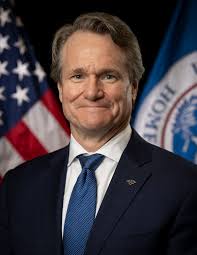
In a big company like ours, if you have to make the decisions, you're dead. So you have to manage by process. Even the strategic development has to be a process.
I want to talk a little bit about the past of Brian Moynihan. Because he goes to Christmas past year or something a little bit. I mean you've been doing this job for 17 years which is almost unheard of in CEO land. It's a pretty small group of people. The average these days is around five or six years. So what's your secret? How have you managed to survive 17 years as CEO?
Well, I think the number one thing is you have to stay fresh and current, relevant, and you have to challenge yourself because across that length of time from the post-financial crisis recovery to where we are today, the environment's changed, the technology's changed, the customers have changed behavior, the team has changed, and you always have to be thinking about what's next. At the same time, you have to create a level of consistency that people could not think you're changing the company every few years. So I think the lesson I learned looking back was we've had a consistent set of principles. The company's very different how it operates under them. But if you ask people they'd say oh you're doing the responsible growth and these types of things 10, 15 years later and you are but it's changed dramatically from what it was. So you have to change but you have to keep it consistent.
And so if you talk about the change there, there's a good book by the way written by Claudius Hildebrand on the life cycle of the CEO that showed that people who've been around for as long as you have get the best returns for their shareholders. But it's because they have mastered the art of constantly changing. What are your tactics for constantly refreshing yourself and your ideas and your view of the business?
Well, you start with a couple pieces. One is you have to have a great team and you have to be willing to reinvent that team that could help you see the outside. The second thing is we spend a lot of time thinking about from the customer in and everything we do is from the customer in, from the teammate in, from the people who we're going to provide the products and services to and from the person who's got to do it as opposed to idea out. I was raised as a strategist when in business I did all kinds of deals and everything and it's easy to have an idea. It's a lot harder to get it done. So if you start with a customer, the insight you get, the information you get, whether it's a trading client and corporate client or a consumer, and you start with your team listening to who's doing the work. So even on AI, we started with 4,000 teammates have gone through listening sessions just to say, 'What do you think this is going to do for you while we're implementing to make sure we're relevant to them?'
So it's people and problems first.
Yeah. And then you manage by process. You don't make decisions. You manage by process. You have to in a big company like ours, if you have to make the decisions, you're dead. So you have to manage by process. Even the strategic development has to be a process.
So let's go back to the very beginning. 17 years ago when you took over was right at the end of the financial crisis. Bank of America was kind of a mess. You'd taken over Countrywide. You'd taken over Merrill Lynch. What do you know today that you wish you had known when you started this task?
I think the piece that we did a good job of but just became more problematic was the realization that we are between a rock and a hard place between a government and their citizens. And so in cleaning up the mortgage crisis if you could have cleaned it up on a rational basis been one task to clean it up on a basis that society wanted to clean it up was a different task. We had one in five mortgages we service therefore we had one in five foreclosures. Therefore you were going to deal with it. And yet the rules kept changing. And I think if you would have known that was going to happen, you would have probably pushed harder on the policy side as opposed to work side. We went from 10 to 15,000 people to 50,000 people working on mortgage servicing modifications and things like that. A year and a half, two years, it was boom. And so if you and then the policy and the changes. So I think the lesson we learned from that is make sure that you have a set the way you operate the company. You'll never be dependent upon people being able to change the rules after the rules are made for the benefit of people who you can never take a counter position to.
But it also sounds like you learned through that process to pay a lot of attention not just to your customers but to public attitudes, politics.
And to do the business the way that's fairest to consumers because you know that will stand through ups and downs in the environment around you and it did through COVID or through stuff that's come up, inflation, everything because of how we drove the customer base, drove our product set to be done on a way in the consumer business it's fared out well and even on the institutional businesses to stay out the things that you we can make money doing a lot of things. You really make money for the customers that keeps you away from the principal investing and the stuff we had to write down and eat then because a lot of it was just to make money there was no customer that's always asked where was the customer. And so I think that set of principles, yeah not that you've known it took you a little while to learn them but as you learn them you could apply them but that was a lesson learned a lot of this.
Pay attention to the customer.
Well, and make sure there is customers that need you to do what you're doing. To not do things to make money in the financial services.
And what the flip side of that is what would you say the biggest mistake you've made over the last 17 years is and what did you learn from it?
You know, it's the mistakes you make are how you people selection because not all turn out to be what you thought but also moving on people. So I early on in my tenure I met with the great Jack Welch and he looked at me he said you know have you moved all the people you're going to move and I said no Jack I got to manage a company we had a constitutional crisis of leadership we had to put together a team. He said, 'Well, why don't you do it and right now get move over?' I said, 'Jack, you got to let us stabilize the place.' He said, 'Ah, that'll hold you back.' I looked at him. I said, 'Jack, did you ever do that?' He said, 'No, but you got to do it.' And so, it was one of those things.
It's a good point. It's what everyone says, but not what everyone does.
And the lesson is you probably always feel better after you've made those decisions. And so, I'd encourage CEOs here, young CEOs, people early in their tenure, you got to get your team right. Not that they all got to believe what you do. They got to beat the heck out of you in terms of intellectual content, what to do and how to do it, the right way to do it, but they've got to be with you driving towards a common outcome. And I think, you know, it took a little while to get the team settled down and once we did, off we went.
Well, you and you've had an incredible run. You've increased this stock value by the market cap by almost three times. But I have to say Jamie Dimon did a little bit better. Does that bug you?
Not really because all things come to pass.
You want to give a little more on that?
But how do you explain it?
Well, it's like one of the problems is we had a lot of dilution out of the financial crisis because and this is something to pay attention to as markets get highly activated is we did deals that caused us to end up with 12. It had nothing to do with the competition. We did deals, we made decisions that caused us to have 12 billion shares outstanding almost 11 and a half to 12 and we ended up today with seven. And that and part of that was because the capital rules changed but part of it was just dilution and restoring the capital base of Merrill when they didn't come with the capital they were supposed to come with and so the lesson learned in that is you got to be very careful doing acquisitions in the best of times in the worst of times it's easier and so you know that's one of the things that makes a difference but we just our job is we've made about $130 billion across the last 10 to 15 years. We've returned all but about 60 billion to the shareholders we keep pushing, you know, dividends and buybacks. We just keep driving the business and you got a machine going and that's what we're meant to do.
Do you feel okay about it?
How long you going to do it for another 17?
That would be other than Mr. Buffett, that would be a tall order, but no, I will do it till the board's tired of it and we got a successor. My view is you shouldn't do this unless you feel fresh about it going back to unless you feel you can motivate unless you feel you're willing to make the decisions that you have to make unless you're willing to challenge yourself that you're probably you have to start from thing what are we doing wrong not what we're doing right and because what we're doing right is obvious and good.
How would you describe your leadership style?
You know I think if you look across when I started I had smaller groups and you manage by basically driving and making decisions as you get to more and more scale of people below the size of people below you. What I learned from my predecessor Bank of America when I came into the company 23 years ago I guess is now 22 is how big the scale difference was. We were a big company. FleetBoston was a big company had 60,000 employees 70,000 employees. But you went to 200 and some thousand employees and to 300,000 employees and you're managing division which is the smallest division having 30,000 people working in you had to realize that all you could do is drive process. You can't make decisions. Now there are times when you have to step in around COVID we had to step in because there was no precedent and you go deep when that happens. We get people on the phone four times a day to talk about are we doing this, are we doing that, what are we doing because it was unprecedented to get masks in. Took like a spy novel to get the 10 million masks we need to get out of we got 20 million. We gave 10 million away to hospitals. We need and why do you need those masks? Well, to operate the branches, you needed two masks per day per person in 5,000 locations. Think about that. So, nobody had ever done that before, but they all came from a place in China that you had to get them. So thinking about how you manage by process but there are times when you have to step in but if you make the decision and a company our size if they're waiting for you to make decisions they just nothing will happen. So it has you have to have people can make the decisions and drive the business and what you have to do is process to get them on the same page process to make sure their strategies understood not only by the business unit but by the people have to make them successful.
Interesting. More about process than decision.
Because if people look to me to make a decision, we are stuck. There's 200,000 of them. There's one of me.
Did you have a coach or a mentor or you mentioned Jack Welch earlier or somebody who taught you leadership or did you learn it all on the job?
We you learn from everybody says did you have a particular person and I always think you learn from a range of people and all the CEOs I had Terry Murray was the first boss I worked for and he was more he had a very strong view of operational discipline and Chad Gifford was more an outside in customer guy but also had that Ken Lewis was a scale and each of them you learned from but also I was lucky because people like Jack reached out to me and sort of said you come in and talk to me and so you go and talk to them. So you had to and early on I was part of a lot of groups. Jack had a group called I forget exactly the name of but it was a bunch of CEOs and you just learned and talk to them because at the end of day the CEO's position is different because you really are sitting you have all the responsibility and accountability but you don't do it and so you have to learn how to manage completely different and I learned that along the way from a bunch of different people.
Yeah. And it takes and so when I talk to new CEOs coming in, you know, I say the buck stops with you, but you have nothing to do with the decision that gets the buck to your seat.
That by the way is why the Wall Street Journal Leadership Institute exists so CEOs can learn from each other. That's what we try to encourage. All right, let's look to the future of everything. But start with banking. You've spent a decade investing in your tool Erica, which is an AI tool for customers. Take us forward five years. Are we going to spend all our time talking to AI agents instead of people?
I don't know if all your time, but I think the impact of technology on financial services has been huge over the last 30, 40 years and really was the advent of the computer on the desk, centralized computers of size and scale, distribution capability and on a desk and then in the phone and etc. And it was the willingness by customers to use the stuff not just us to use it. So the reason why our mobile we have 59 million active digital customers the reason why that works is there's 59 million customers out there who want to interface to you that way and so the challenge for us is to never predict where the customers go is to watch it carefully nudge it in a direction that's helpful but also never cut off the other parts of it. So today we have 3,600 branches. About 350,000 to 400,000 times a day people come into those branches and do something. So that's important to them. At the same time we 99 something percent of all our interactions are nonhuman in the consumer business.