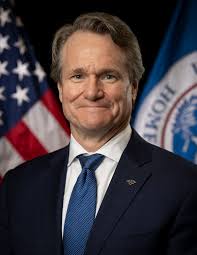
Bank of America Chairman & CEO Brian Moynihan joined Bloomberg's Dani Burger at the Forbes Iconoclast Summit 2026. Moynihan discussed the strength of the consumer in uncertain times.
See omnystudio.com/listener (https://omnystudio.com/listener) for privacy information.
Bloomberg Talks curates top interviews from around Bloomberg News. Hear conversations with the biggest names in finance, politics and entertainment. On Bloomberg Talks, we round up interviews with Fortune 500 CEOs, government officials, well-known investors and business leaders.
Listen to more Bloomberg Talks: • Bloomberg...
What Brian Moynihan said
Written from the verified transcript and checked against it. Every figure links to the moment it was said.
Brian Moynihan, CEO of Bank of America, discussed consumer strength, noting that $5 trillion in consumer spending year-to-date grew 5%, with debit card spending faster and entertainment up 13% year-over-year in May. He argued that unemployment at 4.3% and job formation of 60-70,000 jobs a month support growth, and his team projects 2.1% GDP growth this year. He acknowledged higher gas prices impact lower-income households twice as much, but said affordability is an issue, not a breaker, and housing supply is key. On shadow banking concerns, he said Bank of America doesn't do subprime, offers a $5 monthly account and $500 no-interest loans, and overdraft fees are $10 versus market $35. He noted AI spending of $325 million this year, with $13 billion annual tech spend, and said the market absorbs capital issuance smoothly. He highlighted small business loan growth in mid-double digits, and detailed AI-driven workforce changes: 14,000 people reskilled in 2025, 2,000 summer interns, 2,000 permanent hires, 8,000 community college hires over 5 years, and 10,000 veterans over 5 years. He said AI costs are not yet a concern at $70 billion expenses, with 100 projects gated for returns. He announced $2 million for Vet Tix tickets for veterans and first responders.
Key takeaways
Consumer spending grew 5% year-to-date to $5 trillion, with entertainment up 13% in May.
Bank of America projects 2.1% GDP growth this year, citing 4.3% unemployment and 60-70,000 jobs added monthly.
Bank of America will hire 8,000 community college students and 10,000 veterans over the next five years.
AI-related spending is $325 million this year, with 100 projects gated for revenue or cost savings.
Bank of America gave $2 million to Vet Tix for veterans and first responders.
I want to get to a big interview now. We've got Bloomberg's Danny Burger with Bank of America CEO Brian Moynihan. They are live from the Forbes Iconoclast Summit just a little southwest of where we are here in New York City. Danny, thank you very much.
I just want to start. One of the things you've been very consistent on so far this year, whether it be conferences or in your earnings, is just the strength of the consumer and the strength on your platform. Spending on credit and debt up 6% year-over-year, and yet gasoline prices are high, consumer confidence is at rock bottom. If those types of things can't break the consumer, then what, if anything, can at this point?
So I think just to give the stats, you know, about $2 trillion goes from our consumers in the economy every year. Excuse me, about $5 trillion year-to-date, $2 trillion plus, grown up 5% in the aggregate. Debit card, a little faster, and it's going everywhere. Now when you watch within that, you start to see your point about what consumers do. They're going to the gas station more times and spending a lower amount because they, from a budgetary basis, they don't want to spend that much. But they're still buying more on entertainment. It's up 13% year-over-year in the month of May. And so it's a little bit of a conundrum. And why is that true? Go back to your question. What would break them? Unemployment 4.3%. Job formation not as strong as theoretical numbers, but for the population growth, it's actually pretty strong at, you know, 60, 70,000 jobs a month. And so our team thinks we'll grow at 2.1% this year. And people say, 'Well, you're optimistic.' I'm saying, I'm telling you what the consumer is doing today. And what they say they're going to do will come true if job cuts really come through to lower levels of employment. Right now a lot of these job cuts are open positions and attrition and things like that. They're not necessarily huge layoffs that are actually affecting because job numbers are going up.
Well, keep an eye on it. If you sort it by low, medium, and high income earning households, it obviously has about twice the impact of a lower income, lower third of income households than it does a medium or the higher. And so that's we have to watch and make sure that they are able to carry that. And that's the people who go in the gas station more often, still spending the $40. So they don't get as much gas for it, but they go more often and they ration how they spend it. They go to the places where gas is cheaper. Let's just say that, right? And you can see people changing, micro-changing. They're going a little bit more to big box retailers, a little more secondhand stores, and all that adjustment is part of the K economy we talk about. But the reality is the incomes are growing for all those income segments. And so affordability is a real issue, but to fundamentally change affordability, we're going to have to build more housing so there's the supply pressure will bring the prices down. Affordability, gas prices at $4.50, 50 cents to or above, we've been there before. So, it is affordable. It's just not pleasant.
Someone once made the comment to me, Meredith Whitney, as a matter of fact, basically said, 'A lot of people are leaving the banking system that are especially on the lower income scale. They're turning to things like payday loans.' She brought up the term shadow banking. I wonder if there is or if you are concerned that maybe there is unseen stress in the system that has left the likes of a Bank of America.
When you look at the recent Fed data on consumer credit, the reality is that there are pockets of delinquencies that are a little higher for subprime credit. We as a company don't do that business and our credit's as good as it's been in 50 years and consumer citing is getting a little better. The flip of that though is we offer a set of products, a no overdraft account where you can't overdraft because you don't have checks, frankly, and what you do is all automated payments. We have a $5 a month account. We have a $500 loan where you pay no interest, no fees. You just have to pay it back. You can borrow it a couple times a year. So, we're always working on affordability of our products and our overdraft fees are $10 versus the market of 35 for those that choose to have overdrafts. So, we have an affordability package in banking is second to none. And if you look at our consumers from the spending side, they look like everyone else. From the borrowing side, we tend to be more of a prime lender. So you'll see some pockets, but even those pockets, if you look at some of our peer companies that are in those businesses, the delinquencies are fine right now. Everybody's worried about what happens next, but it all comes down to unemployment and people being employed and earning money.
11 more exchanges in this transcript
Sign in free to read the rest of this interview. No card required.
Moynihan, B. (2026, June 3). Bank of America Chairman & CEO Brian Moynihan Talks Consumer Strength | Bloomberg Talks [Interview transcript]. Bloomberg Podcasts. CEOInterviews.AI. https://ceointerviews.ai/interview/959991/
MLA
Brian Moynihan. "Bank of America Chairman & CEO Brian Moynihan Talks Consumer Strength | Bloomberg Talks." Bloomberg Podcasts, 3 Jun. 2026. Transcript, CEOInterviews.AI, https://ceointerviews.ai/interview/959991/.
BibTeX
@misc{moynihan2026_959991,
  author       = {Brian Moynihan},
  title        = {Bank of America Chairman \& CEO Brian Moynihan Talks Consumer Strength | Bloomberg Talks},
  howpublished = {Interview transcript, Bloomberg Podcasts. CEOInterviews.AI},
  year         = {2026},
  month        = {jun},
  url          = {https://ceointerviews.ai/interview/959991/},
  note         = {Speaker-attributed transcript with timestamps}
}