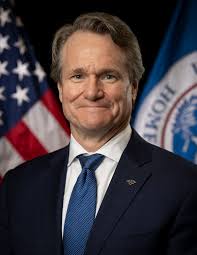
Please welcome Brian Moynihan, chair of the board and CEO of Bank of America, and interviewer Manisha Ahuja, editor at large at Forbes and founder of Iconoclast.
Thanks, guys. So, the fun continues and good afternoon. It's great to be back here and I'm especially excited for this next conversation with one of the most influential leaders of the last decade. One of the longest serving CEOs among top Wall Street banks, Brian Moynihan, Bank of America chair of the board and CEO. Thank you so much for joining us.
It's good to be here. Thank you.
So, Brian, we just heard before lunch from Sir David Beckham who announced last November as an ambassador for Bank of America's global sports program, Sports With Us. You framed this as a long-term commitment to the sports ecosystem and more than just one-off events. Why don't you talk us through Sports With Us and the global impact you have already achieved and expect to have?
Yes, so our Sports With Us program is built across multiple different types of sports, all with the common purpose which is participation, broad participation, helping charities thrive, helping kids get involved, providing opportunities. So, if you think about the two marathons we sponsor, the Chicago marathon we actually don't sponsor, we run that race, it's our race. The Boston marathon, what we're trying to do there is get more and more participation by people running but also the charities. So, we doubled the charities there and the campaign is My Marathon campaign. I'm not going to run a two-hour marathon. Most people in this crowd are not going to run a two-hour marathon but what we can do is raise money for causes we care about. So, we built that and then with the golf platform, with the various parts of Augusta National, we ended up going from the Latin America Asian amateur, women's amateur, helped them and they built that tournament and now with the Masters but it was Golf With Us, getting these kids to play golf. So, this year we'll cross 250,000 kids who can play and join a golf club. And for that, they can play any muni for $5, 3,000 municipal golf courses around the country. And we're trying to get more and more kids playing golf. And then with Tom Watson, we did a thing to get people who are retired and others who have the time to go play with these kids who are a little bit older and mentor them. And so, that's the golf part. And the soccer part, as the World Cup came and I talked to Johnny, it was about we got to build this program sort of Soccer With Us. And the thought there is think about all the aspects. So, it's the team sponsorship, it's the tournament sponsorship, the USA teams, all the different things, but also clinics in schools, putting soccer in schools, fields left behind, opening up ability for people to see this. We also did with street kids World Cup, which is a street kids from all over the world playing another World Cup, and we helped sponsor that. So, it's all about just bringing participation. And out, but we do it in the arts. This Museums on Us program, which sounds familiar to Golf With Us, is about getting people who are Bank of America customers in all 300 museums around the United States for free. Again, to get participation, get access and opportunity for people to otherwise not have it. But, it's and it lifts the brand, and that's the business purpose.
Yeah, so this really translates to helping communities and upward mobility. So, talk to us a little bit about some of the impact you've already seen since you initiated this. We spoke upstairs with Sir David Beckham about some of the impact that you've already seen since you started the program. And you also had an interesting experience with Rory McIlroy, right?
Yeah, well so this is one of those things that we did and we didn't realize it would have such precious, but for the decision to we did Golf With Us the first year of the Masters sponsorship back to on the Rory conversation. And the second year, the team came with the idea of having three kids that are the Golf With Us participants create three iconic shots. Jack Nicklaus's putt, Bubba Watson's shot from the trees, and then Rory's win. And we didn't know he's going to win it again, but what he did as part of that when we had to, you know, it's a likeness play, so we had to pay appearance fees, and when Rory saw the commercial, he was so moved, he gave his fee back to buy another 80,000 rounds of golf for these kids. So, it was just a tremendous gesture by Rory, and then he won the tournament again, which was not even in the cards. So, we've already tried to think of how that plays out. But, it's all about creating opportunity. So, when we think about these kids coming in the museum, the kids picking up a golf course and doing a tee with first clinic and two professional athletes, not golfers, but just general athletes, and seeing their reaction to it and getting that community wound up about it, we just it's just great stuff. But, you're just trying to give kids opportunity to play a sport, a life sport, a time sport in the case of that, running and golf, but also to do it in a professional manner with good coaching and good capabilities. And, you know, at the end of the day, we just keep trying to figure out ways we can help communities build, and it's a community lifting effort and an individual in that community lifting effort.
And so, your commitment to soccer though extends well beyond Sports With Us. Your FIFA sponsorship makes BofA the first ever bank in FIFA's global sponsor tier. Walk us through the decision and why that $100 million bet now?
Well, when in 2017 or 18, when it was decided it was going to be US, I had a friend of mine came and said to me, you know, you guys ought to be involved. And so, we had never thought about it. And so, I started to think about it, and really off the backs of these other programs, and if FIFA was coming to the United States, when I talked to Gianni at the outset, and what convinced us, I said, we will bring you out to all these communities. We're already in all these communities. We have been for So, Kansas City, we've probably been there 150 years. I mean, in Massachusetts, we've been there since 1784. In San Francisco for 130 years. In Charlotte for 150 years. So, we've been in these communities as we know them. We can bring in the communities and we can provide support for that local community. The clinics, the fields, and everything. But, we can make it available to everybody. So, we've had 20,000 tickets given away. Today, we just announced that we gave $2 million to give free tickets to veterans and first responders to the games through Vet Tix, which is a veteran owned enterprise. And so, we did that so that veterans could go for free. So, FIFA made the tickets available. We bought them and put them into that platform and gave them to that platform. So, we're just trying to think of ways in all those communities. And my pitch to Johnny was, if you're going to come to America, you want to be with a brand that knows how to operate grandly in all those local communities. And we can help you lift this. And so, even figure out where to think about games and demographics, populations, stuff. It's been a fun fun experience with them.
So, to your point and the point that you made to Johnny, you serve 70 million customers globally and also many small business clients and customers across the US. You've often said that the consumer has been remarkably resilient. Could that resilience turn into exhaustion? You have a lot of Bank of America research tracking consumer behavior. Are Americans spending for strength or from necessity right now?
So, if you think about we have Bank of America research, Candace Browning Platt and the team, it's top research firm. And we publish for the institute a lot of this data that we decided to do about six or seven years ago to make it available. This is sort of real-time data out of our customer set, not identified to customer A or B, but just general data. But, if you look at that data from May of '26 versus May of '25, it was about $400 billion of money moved in the economy. It grew at 5% over the last year. And then you look within the nuance of that data, you look at boomers and seniors, they're spending at a faster clip because they're in a de-accumulation mode as the industry refers to it. If you look at the lower moderate, lower middle, higher income, people are shuffling what they're spending on across all of them a little bit more in the lower income third, lower third of incomes and they're moving stuff around. So they're going to a big box retail versus a niche retailer, they might be going to second hand store to buy some stuff. But at the end of the day they're still spending a lot more money. And so what gas spending is up a lot 25-30% its overall impact is in the single digit percent to that number or less and so the rest of it is just general spending. So it's good news and the reason why people are doing this because they're employed and they work for great companies like here in the audience and unemployment has been benign. New claims are sitting at 200,000 and change haven't gone up a lot. Continuing claims 1.8 million not gone up a lot. They compare that to pre-pandemic when the population of workers was 6 years ago. So it's been pretty strong. What happens next we'll see but right now they've been extremely resilient. By the way, this was true last year, the year before and everybody said the consumer was going to quit spending after COVID, after the payments during COVID, after the tax law change. They're always going to quit spending and American consumers are a wonderful thing. Now, there are affordability issues that are serious and that's where we got to make sure that the policy makers are saying how can I create more housing to bring the supply up and the cost down. There are those types of issues that are real that the war has to resolve so gas prices get to a natural balance. And those are real issues but from a general population and general activity it's really strong and then when you go to small medium size businesses they're in very good shape credit wise. They have access to credit, to cash flows, they're making money. They want everything to be resolved because they want to be able to do their business plans without worrying about tariffs and immigration policy and all that stuff but at the end of the day they just are going about their business.
So, if I'm hearing you correctly, it sounds like what you're seeing in your data is showing us is that the consumer is resilient and that you're cautiously optimistic.
Yeah, our team has the US growing at 2% 2.1% for '26, a little faster in '27. They have the world growing about 3%. That's aligned with a lot of people, but the interesting thing is last year at this time that dropped about 1 and 1/2%. Then it went up to 2.8% and back down to 2%. So, what's causing that? That's the external factors of the war, gas prices are slowing down spending on other stuff. And then you have this big phenomena that many of your panels have talked about AI spending, which is driving a whole different element in the deregulation and which is benefiting businesses, too. So, you put that all soup together at 2%, which if you think about the last 15 or 20 years is actually pretty solid growth number.