The human brain is the only existence proof we have that general intelligence is even possible.
What breakthroughs do we need on this path of solving all diseases? If we had unlimited compute, could we predict the future? So, if you and I time travel to 2050, what does it look like?
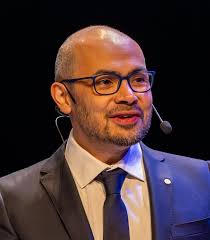
This is Demis Habasis. He is leading the race to invent superintelligence. Demis committed his life to this 30 years ago when most people thought creating true AI was impossible. But Demis isn't most people. He's a childhood chess champion, a neuroscientist, and as of last year, a Nobel Prize winner. Every chapter of his life has prepared him to create true artificial intelligence. And now we're closer than ever before. So, in today's episode, I'm going to ask Demis questions he's never been asked before. And here are his vision for the future so you can build the next big thing.
Thanks so much for coming on the show.
Thanks for doing this. It was great.
Yeah. To prepare for this one, I watched every single interview you've ever done. Gosh, which is awesome. And in a lot of them you mentioned like your scientific heroes and your mind. So I just wanted to say thank you.
Thank you. That's very kind of you.
I mean it. I want to start in your autobiography. There are so many different moments that kind of lead to this thread line of your life thinking about intelligence. And I feel like when you started DeepMind, or even further back studying AI, a lot of people didn't believe in it. What were your unconventional beliefs about the world that gave you so much conviction?
Well, actually, to be honest with you, I just thought it was one of the most fascinating problems you could spend your life working on. But really it was my expression of doing science. So when I was a kid, I wanted to understand. I was fascinated by all the big questions: nature of reality, nature of consciousness, these things. I felt like they were kind of staring us in the face, and even the best scientists hadn't made that much progress in answering these questions. And I felt that we maybe needed some help, like this amazing tool. And for me it was obvious that that should be computers and then in the form of AI. And that's what set me off on this whole path really: to build AI to help us advance scientific discovery.
One of the things that you've talked about is that if you can make an AGI system then we can understand the differences between the human brain and an AI brain. What are the main differences you've noticed so far?
Well, it's interesting. That's exactly right. I think things like consciousness and even intelligence, like what are these things, creativity, you know, what are the processes involved in that? One of the difficulties is that we've made some progress by doing neuroscience and doing fMRI and studying our own brains and animal brains – that's why I did my PhD as well – but we sort of lack a reference comparator that can say, 'Oh, this system, this thing, this entity is intelligent but it's not conscious, so then what are the differences?' And I think AI could also be used for studying neuroscience as a comparator. So building AGI and then analyzing it will be one of the best ways to understand our own minds and the deep mysteries of our own minds.
Yesterday you talked about how solving all disease is actually not that far away for us, that we're closer than we think. My cousin's getting a PhD right now and uses AlphaFold every day. Amazing. I feel like you guys have had so many AlphaFold moments. What breakthroughs do we need on this path of solving all diseases?
I think this is what we're working on at Isomorphic Labs really, which is AlphaFold obviously was really helpful with protein structure prediction, which is critical for one of the things you need for drug discovery, but it's only one piece. So you can think of Isomorphic Labs: we're extending that – we're improving AlphaFold but we're also extending it into biochemistry and chemistry to understand what compounds should you make, where do they bind on the protein, and also checking how your body reacts to those proteins, how does it absorb them, are there any toxic side effects? So you're trying to minimize all those things and predict them, to make cleaner compounds and cleaner drugs. So there are about half a dozen really big challenges there that we're working on. And you can kind of think of it as we're going to try and put them all together and then you have your drug discovery platform.
What do you do for the proteins that are unstable? Like AlphaFold works amazing for proteins that have stable structures. What do you do for the ones that are unable?
Well, actually, the hypothesis is that those intrinsically disordered regions of those proteins actually do form some sort of structure if you know what it binds to or what the context is. So you can think of AlphaFold 3 and the newer versions of AlphaFold and the things we're doing at Isomorphic is to try to understand more the dynamic picture of these proteins. So how are they going to look if something binds to them? Will their little pocket open up that wasn't there before? That's very important in drug discovery. So we've got to be able to predict the dynamics of a protein, including sometimes disordered regions, in order to design the right type of drug or the right type of antibody, whichever disease profile we're looking at. So we're trying to extend our model to be able to deal with that type of complexity. It's one of the big challenges of biology. There's so much complexity.
Interesting. And so is it like we would use AlphaFold or some other technology to understand the proteins and then that would cut down clinical trial time?
Yes. So the idea is that what we're focusing on at the moment is just the drug discovery phase, which could still take many years, even a decade, to go from the target of interest, the biology understanding of that, to having a candidate compound to take into clinical trials. So we're focusing on shortening that from years down to months, maybe even one day weeks, which would be incredible. I mean, it seems unthinkable right now, but I do think that's the same as thinking about protein structures 10 years ago – everyone thought that was impossible, and now here we are with all the structures folded. And I think that's going to happen again with drug discovery. Then there's the second question of can we also speed up the clinical trials part? And that's hard – there's regulations, lots of things involved that aren't necessarily to do with the technology. But I do think AI can help there too in terms of stratifying patients, making sure they get the right test compounds, analyzing that data. If you're more accurate at predicting side effects, then maybe you can jump more quickly through the dosage steps. So there's a lot of things in clinical trials that could probably be compressed once we had a better idea of the design of the drug compound in the first place.
Something else that people also thought was impossible was the models understanding physics. And then yesterday you guys have Gemini on. The coolest thing ever to me about this was that you didn't actually train it on physics, right? It just learned from videos. How did that work?
Yeah, it's pretty mind-blowing really. The more videos you give it, with Gemini under the hood it has understanding about the world and can label things. Gemini has been multimodal from the beginning, so it's really good at understanding scenes. Then we had to make it dynamic with Omni, and it's kind of mind-blowing that it does seem to pick up pretty accurate versions of intuitive physics. We're starting to create physics benchmarks where future versions of Omni – Omni Pro and so on – are going to be tested on marble runs, things falling down, gravity. But right now it's amazing what it can do in an emergent way, understanding these different things. It opens up loads of possibilities for creators, where it's incredibly easy to edit things because it understands what parts of the scene are.
Yeah. I remember in a previous interview when you were asked about AGI, you said that Not a Banana and Veo were actually the closest thing we had to it because of this deep understanding. AGI has become this term with a lot of discussion around it. I think your predictions on when we get to it are more conservative, but what you think it will do is a lot more ambitious than other people. Can you bring me to your mind: how do you think about AGI and why does it matter in that sense?
Yeah, for me it's a little bit of a neuroscience analogy. The human brain is the only existence proof we have that general intelligence is even possible. So that's why we know it's possible – because the human mind has invented all this amazing modern civilization around us, including science. It's incredibly general, and that's why we're so adaptive. We can adapt to new technologies. We invent all these technologies. Even our brains will evolve for hunter gathering, you know, so that's kind of amazing. I think we won't know we have a true general intelligence unless it has the capabilities that the brain has, because that's the only existence proof we have. So that's a pretty high bar, and it means it's probably higher than just being able to do some useful economic work, which others have talked about. I've been pretty consistent that the type of test I would have is an Einstein test: train one of these systems with a 1901 knowledge cutoff. Can it invent special relativity like Einstein did in 1905? If it could, then you could apply it to today's physics – come up with extensions of string theory, or answer what's going on with dark matter. We could investigate what it came up with. Even though that's impressive already, coming up with some problem worthy of study is even harder; asking the right question is the hardest thing in science.
And is that like the true creativity of the AI system?
Yeah, it's very related to what I would call true creativity. Can it come up with something truly novel and a leap forward, rather than something incremental?
So one of the ways to test that is an Einstein test, but are there other ways to test it?
Yeah, another example I often give is with AlphaGo. Of course AlphaGo famously came up with move 37 in game two of the match. That was a novel strategy in Go for sure, and it changed the way Go is played. It was amazing because humans have played Go for a couple of thousand years – it's the oldest game ever invented, most complex game ever – and yet AlphaGo was able to invent new strategies. But the thing I say is that's not enough. What you'd actually want is a future version of AlphaGo to be able to invent Go itself – a game as deep, complex, elegant, and beautiful as Go – not just come up with a strategy within the game. I don't think today's systems are yet capable of doing that, but I think they will be in the future.