I want to ask you a series of questions. We're calling this the leadership test.
You didn't tell me I had to take a test today.
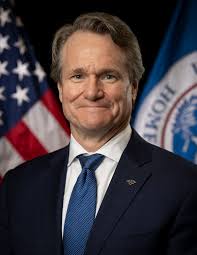
You got a big test today. It's graduation season. Hopefully, people understand a little bit better what type of leader, boss, manager you are. Brian Moynihan, CEO of Bank of America. Thank you for hosting us here at the top of Bank of America, the Tower in Midtown Manhattan. From where you sit inside this company, you have a tremendous view of what's happening in the American economy and the global economy. What are you seeing today that's surprising you?
When you look at the economy, our teammates—we have the best research team in the world—has 2026 in the United States growing at 2.2% and the whole world growing around 3%. And part of that's important, that it's a number that's, you know, 2.2% is a pretty sizable growth economy. But what's interesting about it is it was predicted to grow faster until the war caused more disruption and it slowed down. And so if the war in the Middle East were to end, you'd expect it might kick back in because they were 2.8% before that 2.2. Last year with Liberation Day and all the tariffs, they went from 2.5% down to 1.5% and then back up to 2.8%. So one of the things, everybody looks at the point in time, but the question is sort of what's the travel? The travel is the economy has been strengthening. The travel is the businesses and consumers are strong. The travel is there's uncertainty out there and there always is. But the question, if that uncertainty doesn't get worse, we should see a pretty good year in the US and a decent year in the world.
US voters are saying that affordability is their top issue. Are consumers still spending?
There's no question that people are concerned about affordability. Housing costs, meaning rental payments typically, gas prices are up. Inflation that came from 2019 in the pandemic went up and even though it's flattened out in terms of rate increases, people remember when milk was less a gallon than it is today. So that lingering in the consumer thought is not new. That happens all the time. But the interesting question is I always say don't listen to what they say they're going to do because that's important, but really listen to what they do. And what they're doing right now in the month of May here, they're spending about 5% more than they spent last May. And for the first quarter it was the same and the month of April was the same. So they're continuing to spend money. They had to shift a little bit more to gas. And then when you look at across different cohorts of income-earning households, obviously we do a third, a third, a third. The lower third is more impacted by the gas prices and it's more of a burden on them and that's an affordability question. But the other two-thirds are less because they have bigger incomes and gas is not as big as part of their spending pattern. They're spending strong. So we see the consumer continuing to spend and so they are concerned about prices. There's a concern about affordability, but they're still spending money. And that really comes down to the unemployment rate in this country is a very low level and it isn't getting worse. In other words, employment is very stable. People are getting paid more money. And you know, that's a good thing.
I want to drill in a few things you mentioned there. The first is housing. What can a first-time homebuyer expect today when it comes to rates? I think for so long the expectation was rates would come down meaningfully and return to where they were just a few years ago. Is that expectation wrong?
Well, part of this is that the rate structure in United States after the financial crisis really through to a couple years ago was very low and it went up a little bit in '18 and '19 and then came back down in COVID then went up a little bit but it was fundamentally very low. So one of the basic problems we have in the United States is there's a lot of housing mobility slow down because people are sitting on 3% mortgages and they're not too enthusiastic about going to a 6% mortgage. That means the inventory doesn't turn out. And then if you're trying to buy into that, you heard about all these people with 3% mortgages, but what you see is 6% or etc. And so that there's an expectation gap. Now, meanwhile, what you're actually starting to see as we speak in the last few months and you're starting to see housing prices mitigate reflecting that if the buyers can't afford the prices, they'll come down till they can afford them. If interest rates are going to stay higher, that means affordability, the monthly payment affordability is not the same. So housing isn't a good. The biggest problem with housing when you look at this great city and other places, they got to build more units, period, end of story, because despite the fact that the population growth is not that high, the amount of units short in the major cities—New York or Charlotte where our headquarters is or Boston or Washington—is where they haven't built a lot of housing. They're short and they got to just build more housing. And if you look where they built more housing, housing prices have gotten more.
Whose fault is that that we haven't been able to create housing policy that creates the environment you're asking for?
Personal real estate is one of the toughest things to get through in the world. One of the inherent values of America is you can own your land and you can control your land, you can do what you want. And so it's hard from the top down to drive the policy.
You mentioned housing, you mentioned the Iran war. What impact has that war had on consumers?
Well, gas prices being up, you know, from $60, $70 a barrel of oil to $100 raise the price at the pump. Customers are spending about the same money at the pump, but they're filling up more often because they're getting less fuel out of that dollar amount. The gasoline expenditures in the aggregate are 3 or 4% of the spending of a consumer on their debit and credit card. The impact is higher among the lower third of earners. It's doubled in cost to them on a relative basis. That causes them to fill up to go more often and earn less gas. That's one impact. The other impact is inflation and underlying goods prices that is still coming through the system because a lot of that oil that has been bought since the prices went up is just now making it through the manufacturing process for plastics or different types of materials that end up in manufactured goods. So there'll be a longer-term inflation.
How long is that term? How long is it going to take for that to work its way through the system?
If you stopped it today, they'd say 6 and 12 months to work through and then you got to restore some of the capacity to produce to get it up. But once you say it's stopped, humans are amazingly adaptable. So once they know there's an end, then they'll start planning that as if the end occurred even though it may take some months. What the business community doesn't like is, I say I don't know my goods, price of goods. If I know it's going to end in 6 to 9 or 12 months, even I'm fine. If I don't know it's going to end, I'm going to have to price through this. That question then is what's the final demand impact on consumers of higher price goods across many different industries in 2027? And that's going to come down to how fast the resolution of this conflict, the opening of the straits takes place.
Where that uncertainty seems to have the biggest impact is not on the big businesses, but the small businesses. And Bank of America has a unique perspective on what is happening with small businesses today. So what is the state of the American small business?
They're pretty enthusiastic honestly. But they'd be more enthusiastic I think if you had basically two issues resolved for them again. The trade and tariff situation, which just that it won't keep changing on them. And then secondly, those that have oil content in their goods sold or in their delivery or whatever they do, they'd like to see prices stop being uncertain. Right now, they're worried it's going to go to $150 a barrel or something like that. So, they have a worry board they're working at. I think that's probably overworried, but until this solves, they'll have that as a question mark. But meanwhile, credit quality is good. They're borrowing. They're growing. They're employing more people because we can see the payrolls they pay. They're paying their people more. So, in the aggregate, they're in pretty good shape.
The World Cup is here now in the United States. The bank is sponsoring it. Is something like the World Cup good for small businesses or only for the big businesses?
In the end of the day, a lot of people come and spend a lot of money in the United States from foreign countries with any activities, even in a market like Kansas City is hosting games. People come from other parts of America to see this and spend money. Hundreds of thousands of people coming to these communities. So, you know, we know it has a big impact because it's a four-week, five-week, six-week tournament. They actually stay longer than they might stay if they just came in and saw a game. Let's say it was an NFL game. They came for that game and left. They'll stay around. The teams practice in other communities. Think of this as now 10 Super Bowls in terms of viewership and attendance. Who benefits by that? The people sell sandwiches and pizzas and restaurants and things like that because spectators flood those places. So, I think you'll see a lot of economic activity and it's a lot of fun.
Among the people who have been championing the World Cup are President Trump. I'm curious, how has the president been for small businesses in America?
I think if the economy grows and it's growing 2% this year, then small businesses do well. If I go talk to small businesses across the country, they focus on the deregulation and they focus on the tax rates. What they do really want is also immigration straight. Now, a lot of them depend on workers that are here and have been here for a long time. It's not that new people coming in. They're really saying that their teammates have been with them for 20 years that have citizenship status and they want to make sure that those workers feel safe and confident and that's what they're communicating to the administration. We're communicating on behalf and that's one of the things we got to be careful because America was unique. It had a growing economy and a growing population and that meant the workers for all the different things we need them for came in. That's a tricky execution against, you know, border crossings and other issues that are countervailing to. We'll see this play out, but that's probably the most concern they have of recent times.
The president has repeatedly called out Bank of America for refusing him as a customer. How do you deal with a sitting president shining the spotlight on you and your bank like that?
It's part of the job. It's part of what we do. We run the business the way you run it. So, this company's been around since 1784. Our job is to work with every administration, make them successful because if America's successful, we're successful. As we think about the 250, start to think about our intertwining with America. So 1783 in Massachusetts, the oldest bank started. People formed a bank to help America grow because it needed its own sources of capital. It couldn't rely on England and Rhode Island. 1791 happened in Philadelphia. Happened in New York City. We funded the Erie Canal bill. We funded the White House in 1813, 1814 when it got destroyed. We were the bank and they had to borrow money. The federal government had to borrow money from banks to be able to rebuild the White House. So we've helped these communities grow. Our job is to work with anybody and make America successful. And by the way, in other countries around the world, the same thing.
The bank has this perspective from basically 1776 to 2026. Someone called 2026 the year of the bank—decreased regulation from Washington, you mentioned that bank stocks are performing very well. Anyone who lived through the financial crisis could start to worry about banks being so successful. What would you tell them?
If you think through the financial crisis, the issues with companies were actually outside the core banking system by and large. Lehman or Bear Stearns and the difficulty at Merrill and others that we bought Merrill that was in stress and etc. If you think about the Countrywide and even WaMu which is, quote, a bank but regulated wholly differently and then Goldman Sachs more, everybody got shoved in the tent. So the one good thing is everybody has a common set of rules that's driving a lot of the economic activity. Then we stress test ourselves and we have liquidity rules and so the industry is in very good shape. As you've seen subsequent crises happen, we were able to lend more money out and grow as COVID hit and help a lot and waive fees and help our clients through this thing. Then you had a couple regional banks who failed and we helped bail them out as opposed to being part of the problem, part of the solution. So I think the industry is in very good shape—capital, liquidity, etc. At the end of the day the industry is going to reflect a lot of what's going around us in the economy. So if you think the economy is going to grow, the bank industry will be fine. If you think the economy is going to go into recession, we're better positioned for that as an industry than ever, and Bank of America is better positioned than ever. But it still will be a little different. But right now, everybody thinks the economy is going to grow this year. And after the first quarter of a strong quarter year-over-year EPS growth at 25%, we see that continuing.
Speaking of things that are happening outside the bank, you chair the Sustainable Markets Initiative. Two years ago, every CEO wanted to talk about ESG. Today, pretty quiet. What happened?
Well, I think the question is the law changed in some cases literally—the Supreme Court interpretations of how hiring practices and admission practices in schools and interpretations that changed. But also, I think people just trying to get the balance back. So, we've always believed capitalism done right is the way to work. Capitalism done right looks at making sure our clients are well taken care of, our teammates are well taken care of, our communities are supported, go back to 1784 and beyond. And also, we earn a great return for our shareholders. You have to do all those. It's not profits or purpose. It's profits and purpose. That's the genius of it. So we believe in that to our core. I think what happened is as all pendulums swing, you know, it swings back to middle. We did as much environmental financing on the green stuff as we did on fossil fuels or more. It is because the demand for energy is so high. We got to have all energy sources financed. And you know we did it like that before. So the companies run well. The way we run it, that's capitalism done right. We believe that to our core.
One of the things driving that demand for energy is artificial intelligence. And I think it would be criminal if we didn't have a conversation where we talked about your views on AI. Bank of America economists remain bullish on AI. Investor surveys show persistent fear of an AI bubble. Who's right?
They're probably both right. It has a huge potential impact. We know that because we've seen something like Erica that we put out in 2018. We put out an AI agent on a small language model, deterministic model. You and I wouldn't, even if I described those words, you'd have said what are you talking about? So we put that in 18, 20 million customers use it 100 times and we can see it works. Can it work at the way all this implies? Maybe, maybe not, but you have to make sure it works perfectly, right. If I ask you the answer of, you know, is A better than B and it gets it wrong, you'd say ah, it's a screw up, right? If I ask what your balance is, you want to know we're right. But the technology itself is not new. It just continues to be improved to where it can do more. It can help us write, you know, offering member and therefore a credit decision. This now helps the people do the work.
So should AI be able to decide who gets a loan?
In the consumer space, we do underwriting by models and then there's exceptions kick out. In the commercial space, we'll always have humans at least in the near term. If you just let the agent run itself and it runs unconstrained, that's the worry. It'll make the determination, but it's all subject to testing, review, and a set of rules, frankly, that ensure it doesn't have those impacts. So, the worries about AI is will it discriminate? We don't let that happen. We're 100% responsible for the loans we make both on the credit risk and on discrimination. We don't need any regulation, whatever tool we use, but we're responsible for the outcome. So when you take that approach, when a customer or regulatory agent comes in and says, 'Hey, looks like you're doing something and turning down people for loans that looks like it's done this way.' The answer can't be, 'Oh, the model maybe did it.' That's not going to work.
Let's talk about AI and jobs. Last year, you told your employees they didn't need to worry about AI, that it wasn't a threat to their jobs. There was a recent announcement that the bank cut a thousand positions for applying technology. Is AI now a threat to your employees' jobs?
No. The answer is so what do we do in AI? So our job is to invest for growth and grow and then use these tools to make our teammates more effective. So we've gone out to thousands and thousands of teammates and say give us your ideas, make this work, make this work for us. We want employees to own it and make it work. It's a tool like spreadsheets were. It's a tool like, you know, email was. It's a tool that they've got to harness and make beneficial.
I'm curious a little bit about your sense of history, what you've taken from history and brought to your job today. You became CEO shortly after the financial crisis. When you reflect back on that period, what are the lessons that we should be thinking about as we think about our uncertain future today?
The simple way to think about is we shouldn't be dependent on what the regulators think about our company, what they're rating it. We have to be able to run our company no matter if they love us and don't like us. And you know, the idea is run the right way and they'll always like it, right? And that's so that's capital, liquidity, the range of activities we have, keeping it narrow, staying out of certain business which are inconsistent with the biggest consumer brand and financial services in the country.
Can you give an example of that?
We don't do subprime lending and it's not because other people can't do it. It's just it's inconsistent with us being able to maintain the customer relationships at the level we have to maintain them. We're driven by core checking accounts and we got to make sure that takes precedent and our brand has to be top shelf. Just we made a choice and by doing all that our volatility around our stress tests and things is lowest in industry and that shows you that we're—when you give this information to somebody who doesn't really have any interest in making you look good. The Federal Reserve when they run the stress test, they're tough tests. They want to make you look bad. So it's what you do, how you do it, how you have to make sure the brand stays intact, how you have to have businesses which offset each other and can play off each other. How you have to have strong capital, liquidity, but I also say how you have to have a team that in times of stress actually outperforms and that's what we showed in the stresses since and there has been times where it's been a little interesting out there since the financial crisis. People forget that our teams actually accelerated and outperformed and done more for our clients than others.
You've led through interesting times. You mentioned there probably five or six other crises whether it be COVID or Silicon Valley Bank or other examples. What do you think you are like in a crisis?
You got to be like a duck on a pond, right? You're going along smooth. You may be swimming like heck underneath it, but it doesn't do any good to sit there and lament the situation. You got to go in and figure out how to fix it. Whatever it is.
I don't have to tell you. You are 66 years old. You've been CEO for 17 years. When will you know when it's time to step down?
If you don't thrill at this job every day, you don't really try to be curious and drive it, you don't try to maintain your ability to let people move and prosper and drive it. If you're blocking, that's when you got to go. I've got a wonderful team and a lot of teammates. So, they don't let you become stale because they're pushing you every day that we could do this or that or other things. But the number one issue I have also is to develop talent. We've got lots of great talent who could run the company not only for next year if I got hit by the proverbial truck but also for decades ahead because somewhere in this company are the people going to run it in the years 2035 and beyond and we got to make sure they're grounded and can make it happen.
On the talent front, you have two co-presidents. You have a strong CFO. Analysts say that it's a three-way race to replace you. Is that the right way to think about it?
I don't think if I were outside, I'd speculate on anything inside the company. The job is for us to have a group of people who could work together and drive the company and someone who will lead it. And you know, you can't go through—I went through where it was just a process that it was too out in the open and too many decisions. You know, CNBC was running who's going to get it for six for three months. My job is to make sure that we have a seamless transition, but they have choices and then drive it.
You recently announced a new hire of recent college grads. Why is that a priority for you?
I think what you might think is community college kids. So, think of this as the debate about a degree requirement required or not required. And so, we've gone from about 25% of the people coming in in a year do not have a college degree to like 40%. And so, what we're doing is working with community colleges saying come into Bank of America, you can then learn on the job, you can keep taking courses, we will give you skills. So, the idea is we're going to community colleges so that an undergraduate degree isn't the defining thing. It's the skills.