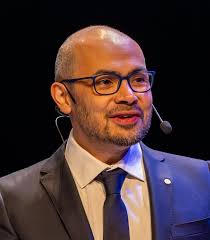
Demis Hassabis, CEO of Google DeepMind, and Master Lee Sedol, who astonished the world with their match against AlphaGo 10 years ago, have sat down together again.
Discover the vision and insights that solve humanity's difficult problems and turn vast possibilities into reality through AI.
#Google #GoogleAI #GoogleDeepMind #GoogleforKorea
What Demis Hassabis said
Written from the verified transcript and checked against it. Every figure links to the moment it was said.
Demis Hassabis, Chief Scientist of Alphabet and Chair of Google DeepMind, returned to Seoul 10 years after the AlphaGo match with Lee Sedol, calling it the beginning of the modern AI era. He discussed AlphaFold, which folded all 200 million known proteins in a year, a task that would have taken a billion years of PhD time, and open-sourced it. Hassabis said Korea has the right ingredients to be a world leader in AI, citing its manufacturing, chips, robotics, universities like Seoul University and KAIST, and his meetings with the president and businesses. He advised leaders to integrate AI agents into workflows to free time for creative tasks. He predicted AI could solve all disease in 10 to 20 years and usher in a new renaissance. For children, he recommended traditional STEM studies plus hands-on experimentation with AI tools. He praised Lee Sedol's move 78, noting Lee remains the only person to have beaten AlphaGo in a match.
Key takeaways
AlphaFold folded all 200 million known proteins in a year, a task that would have taken a billion years of PhD time, and was open-sourced.
Hassabis predicted AI could solve all disease in the next 10 to 20 years, with breakthroughs in fusion, materials, and batteries.
Korea has all the ingredients to be a world leader in AI, including manufacturing, chips, robotics, and universities like Seoul University and KAIST.
Lee Sedol remains the only person to have ever beaten AlphaGo in a match, with his move 78 symbolizing human intuition.
Hassabis advised children to study STEM subjects and experiment with AI tools, which he said have untapped capabilities even the leading labs don't know about.
0:29So, you want to say hello to the city that's been waiting for you to come back for the last 10 years?
0:44So what does it feel like to be back here after all that time?
2:48And you folded what, 200 million proteins in a space of a year?
2:55How did you come to that decision and what's making you stay that course?
5:11What could a country like Korea do to use AI or AGI even, that's coming pretty soon according to you, to help us face down some of these challenges and really unlock the next level of growth and prosperity?
7:02What's your advice to them on how to be a better leader in the age of AI so they can really elevate their value both within their organization and to society at large?
8:45And in 50 to 100 years what will we be looking at that seems impossible to us now?
11:09And many parents are wondering, how do I raise my kid to be AI ready?
19:13... Lee Sedol's legendary move 78, which has since become the symbol of human intuition and creativity, what did you think at that moment in terms of how human beings and AI intelligence is different and how we can build a future together?
Good morning everyone. My name is Sununyan. It's an honor and privilege for me to be a part of this historic conversation and be the one to welcome a true architect of the future, Demis Hassabis, back to Seoul. Welcome back to Seoul, Demis.
So exactly 10 years ago, just a few blocks down the street, you were at the center of a Go match that was to change the history of technology and therefore the history of humankind. And a lot has happened in those 10 years, not least of which is you getting a Nobel Prize, which we'll get to later. But just as importantly, AI has gone from being a lab experiment to part of pretty much everyone in this room's life. So what does it feel like to be back here after all that time?
Well, Seoul and this place will always have a special place in my heart. For me it was the kind of beginning of the modern AI era. I think when we look back now 10 years ago, the AlphaGo match with Master Lee signaled the beginning of these incredible advances that have happened in the last decade. So in many ways it feels like I was here just yesterday. We were playing the match just down the street. But on the other hand it also feels like a hundred years has gone in terms of the amount of advances that have happened since then. So we're very proud of the legacy that this match has had in the technology world, and it's great to be back here kind of at the center of where it all started.
And now we are going to get to your Nobel Prize. Your Nobel Prize winning achievement was called AlphaFold, as I understand it, and I'm not very scientifically inclined. Protein folding is one of the most difficult scientific problems in modern biology. And you told me in our previous conversation that one PhD student might spend a lifetime folding one protein. And I remember that scene from the documentary featuring you, which I advise everybody to watch, that there was a point when you realized that using AI you could potentially fold every protein known to humankind.
Hassabis, D. (2026, May 20). 2026 Google for KOREA with Google DeepMind | AI Vision Fireside Chat [Interview transcript]. Google Korea. CEOInterviews.AI. https://ceointerviews.ai/interview/1042431/
MLA
Demis Hassabis. "2026 Google for KOREA with Google DeepMind | AI Vision Fireside Chat." Google Korea, 20 May. 2026. Transcript, CEOInterviews.AI, https://ceointerviews.ai/interview/1042431/.
BibTeX
@misc{hassabis2026_1042431,
  author       = {Demis Hassabis},
  title        = {2026 Google for KOREA with Google DeepMind | AI Vision Fireside Chat},
  howpublished = {Interview transcript, Google Korea. CEOInterviews.AI},
  year         = {2026},
  month        = {may},
  url          = {https://ceointerviews.ai/interview/1042431/},
  note         = {Speaker-attributed transcript with timestamps}
}