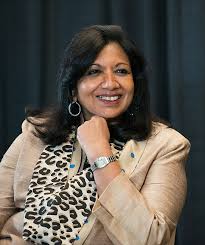
Hello and welcome to the show. I'm Nisha Poddar. I'm here at Biocon campus in the city of Bengaluru here to catch up with Kiran Mazumdar Shaw. Now, when we talk about Biocon, Kiran Mazumdar Shaw has really built it from scratch over the years as a first generation entrepreneur. And it's very critical to really take a look at this particular company at this juncture as it's at an inflection point with the years of R&D development as well as investments and the restructuring behind the company, it's time to reap the benefits for the shareholders. Let's find out more from the founder herself on the road map ahead. Hi Kiran. How are you? It's always a pleasure to meet you. Kiran, what an important juncture that I am meeting you at this particular time. You know, for several years you had been talking about how India's vision should be to become a top leader globally to innovate something, to have breakthroughs. Today you stand vindicated.
Thank you, Nisha. Always a pleasure to meet you. And you're right. I think, you know, finally people, I hope, are beginning to understand what I have tried to do for the last two decades.
Biosimilars business amongst the top companies in the world. So, that's an achievement not just for you, Kiran, but it's an honor for the country as well. And that was your vision. But from now on, what's your next dream and vision? Because you are a dreamer, I know.
Well, I think, you know, we are at a very important inflection point. You know, we've just, you know, undertaken a huge merger between our two businesses. I think the future is very, very exciting because, you know, we have a growing portfolio of biosimilars. We're beginning to really start making a mark in biosimilars globally.
And of course, we have a lot of synergistic portfolio plays.
You know, obviously the insulins and GLP-1s,
the cancer chemotherapy drugs, and of course, the cancer immunotherapy drugs.
And of course, in general,
the synergy between generics and biosimilars in every disease segment.
So, I think, you know, having now a global footprint with a global presence is allowing us to really grow the business very robustly and predictably.
All right. So, we'll have to talk about each of these businesses and what you're going to do. And you have a lovely campus. Why don't you show me around? Let's go.
So, Kiran, now there is a roadmap that the market also expects to know, the world as well as the pharma industry also is looking at. When we talk about Biocon, what is required to now make it a $20 billion company?
So, I think we have all that it takes to get there.
First and foremost, we are now on a high growth trajectory.
We expect to double our business over the next five fiscals.
We believe that we have a very well-differentiated portfolio of products because as you just rightly said, we are the only biosimilars company out of India.
But in that, we also have, you know, the very unique combination of insulins and GLP-1s,
of the cancer drugs, both generics and biosimilars. And of course, we have many new launches
and many new products under development in both generics and biosimilars.
And then of course, when you talk about Syngene, I think we are really doubling down on the CDMO business.
So, I think we have high-growth opportunities in every one of our businesses.
And now of course, I don't even want to talk about generics and biosimilars as a separate business. This is a combined business. So, if you look at it, it's a products and services company
which both have got very exciting growth opportunities. So, the way I look at it is that our EBITDA is growing.
Our profitability is growing because you know, we've retired a lot of the structured debt.
We raised almost a billion dollars through our Q2 QIPs.
And that has actually taken away the overhang
of the huge interest provisioning that used to go on.
And the overhang of the debt that was payable
at any given point in time.
So, finance charges, yes, reduction of that, but what the expectation is also that you are in a phase of deleveraging momentum. What is your road map and vision towards that? What is the timeline that we are looking at in terms of debt reduction?
I think debt reduction has already started, Nisha. So, it's not like we have to wait for anything to happen.
The beauty of our business, you know, inflection point right now is the fact that CAPEX is behind us,
R&D spends are reduced because of the new regulatory pathways.
And of course, the deleveraging that has already happened.
Okay. And we continue to retire debt every quarter.
But I think that actually now makes for a very profitable business, a growing EBITDA,
and obviously free cash flow is going to start showing up from this fiscal.
All right. When we talk about the GLP-1 opportunity, Kiran, everybody in the pharma space is now really looking at that particular pie and share in that pie. What's your vision? Of course, your company has been at the top of the line when it comes to GLP-1 opportunity. What's in store and what is the outlook towards that, even globally? That's a big opportunity for Biocon coming in for GLP-1.
So, for us GLP-1s have always been about a global opportunity.
And I think we already have the foot in the door because we have a liraglutide,
which is both in the US and in Europe,
and a very interesting aspect of even liraglutide
fact that the other competitors who were in the US have indicated certain manufacturing difficulties.
Okay. So, I think Biocon's capability in peptides and insulins
have made them very strong when it comes to GLP-1s as well.
Okay. And I think that we see ourselves as a fully end-to-end company
very much on key starting materials from China.
So, I think that kind of sets us apart. And ultimately, I think the true competitive advantage that we look at is the ability to make many of these through recombinant DNA technology.
All right, so that's one challenge in the GLP-1 journey of Indian Pharma that you really pointed out where you have created the end-to-end bouquet in-house. But when we talk about the peptide opportunity and the commercialization of that, you've always passionately spoken about that chemistry and that formulation, but how do you reap benefits when it comes to the commercial aspect even at a greater pace?
Well, you know, the fact is we now have a global presence. We have a global field force because of our biosimilars, and we can now leverage that capability to drive every part of our business. And that's what makes us very excited and aspirational and very confident that we can actually drive that kind of growth because of the fact that we made a big success of our biosimilars, and the same workforce can be leveraged in many parts of the world for these other products.
Right. And when we talk about insulin, again, Kiran, you have been very focused and optimistic about the insulin business. And you've doubled down on this particular aspect. It is a low-margin business.
All right, so there is competitiveness in the market. There are new products which have come in. Of course, but supply is much lower than the global demand is. So putting both these aspects together, how do you see the 300 million plus business now that you've created scaling up to $1 billion now?
So first and foremost, you know that we've just recently doubled our manufacturing, yes, right? And if you were just to double the 300 million because of that, you can see where the business is heading in the near term.
But I think we will get to that billion-dollar mark
in a fairly predictable way because of two reasons. One is that the insulin companies have decided to focus their resources and their capacities
Okay? And there are very few insulin companies at scale
to take on the responsibility of supplying insulins.
And insulins will never go away.
So, I believe that we have a very exciting opportunity.