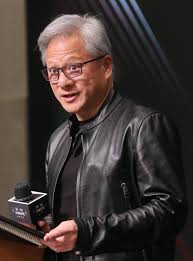
Nvidia Corp. will invest $1 billion in Naver Corp. to help finance an AI data center under construction in South Korea, adding to a frenzy of deals by the world’s most valuable company.
“This is the golden ages for Korea,” Nvidia Chief Executive Officer Jensen Huang said in an interview with Bloomberg Television. “Their semiconductor business is booming. Their industrial business is booming. You know, this is a country that has the ability to help the world build out the AI infrastructure.”
--------
Watch Bloomberg Radio LIVE on YouTube
Weekdays 7am-6pm ET
Saturday & Sunday 7am-10am ET
WATCH...
What Jensen Huang said
Written from the verified transcript and checked against it. Every figure links to the moment it was said.
Jensen Huang announced a $500 billion business partnership with SK Group, covering memory purchases and supercomputer sales as SK scales to gigawatts of AI factories. He also revealed a $1 billion investment in Naver, Korea's leading cloud, to support its 200MW expansion in Korea and global growth. Huang said the semiconductor industry must grow ten times larger over the next decade to support AI agents and robots, and that the industry is constrained across the supply chain, including HBM, LPDDR, land, power, and construction workers. He argued both China and the US will advance AI, noting China produces more AI researchers annually than the rest of the world. On open models, Huang said they are essential for safety, security, innovation, and sovereignty, and that closed models are often cheaper but open models provide necessary control. He cited Hugging Face's use of GLM 5.2 to defend against an attack as a canonical example of why open models matter.
Key takeaways
Nvidia and SK Group will do over $500 billion in business together, including memory purchases and supercomputer sales.
Nvidia is investing $1 billion in Naver to help scale its cloud to 200MW in Korea and expand globally.
The industry is constrained in HBM, LPDDR, land, power, and construction workers, limiting growth to doubling each year.
China produces more AI researchers annually than the rest of the world, and both countries will continue advancing AI.
3:19I've had the opportunity to ask you about this more than once this year, but how much do you need the Korean economy to kind of get going to increase the supply of HBM bits for Nvidia based systems, wherever they are?
4:13Is that Nvidia's spending in the Korean economy or is it SK fronting capital expenditures?
7:22Why did you and Satya Nadella and others need to do that in this moment?
I think we just start with the basics. Like career is incredibly important to the AI build out globally. We'll get into high bandwidth memory. But just from this summit, from the president being here, what is the takeaway? What is it you're trying to achieve?
Well, we're announcing a whole bunch of partnerships with them. This is the golden ages for Korea. As you know, their semiconductor business is booming. Their industrial business is booming. You know, this is a country that has the ability to help the world build out the AI infrastructure that they're incredibly adept at adopting new technologies and is a really technologically forward leaning society. And they love using AI. AI has really diffused throughout their society and their industry. And so this is a great time for them. We're announcing several things.
We announced a big partnership with SK Group, where our companies are going to enter into a business partnership where we do over $500 billion of business with each other. Whether it's consumption of and purchasing of memories or selling supercomputers to them as they scale out to gigawatts of factories. There's a whole bunch of other announcements. We're investing $1 billion in Naver to help. They're Korea's leading cloud. They're going to scale up in Korea up to two. They're going to scale up 200MW, I think it is. And they're going to expand across the world. And so we have a whole bunch of announcements that we're making today with the expanded relationship. There's also sort of more direct involvement with Nvidia on the roadmap for HBM, future generations of HBM.
Talk about that. You know, I remember being on stage earlier this year saying five years ago, we told our supply chain what was going to happen and it did happen. And you gave some credit to the memory makers in going with you on that journey. But clearly, you want to be involved in the direction of travel for future generations of HBM.
Yeah, we're working together on, of course. We started with HBM2 and worked on HBM3, HBM3E, HBM4, and then beyond. And so we've got a whole roadmap of memories that we're working on together.
It is also the case that the semiconductor industry has really changed. And the reason for that is because we used to build computers for people to use and we're going to still continue to build incredible computers. These are now AI processing for humans to collaborate with. But in the future, we also have AI agents and robots, and they're going to be using computers. So instead of just a billion people using computers, we're going to have 100 billion agents and billions of robots all using computers. The computer industry, the chip that's built on top of the chip industry, surely is not big enough. And so this is one of the realizations of the semiconductor industry that now computers are built not just for people to use, but computers are being built for computers to use. My guess is that the semiconductor industry is probably going to have to be ten times larger than it is today over the next decade or so. And so working with our partners in Korea and around the world to scale up the supply chain of semiconductors so that we're prepared for this AI future is really important.
I've had the opportunity to ask you about this more than once this year, but how much do you need the Korean economy to kind of get going to increase the supply of HBM bits for Nvidia based systems, wherever they are?
Well, we don't have enough bits. We're constrained in HBM memories, LPDDR memories. We're constrained in just about every part of the supply chain. We're even constrained now with land and power and construction workers to set up the data centers. I think this is one of the areas that is going to make sure that we continue to build out in a throttled way for a decade. And the reason for that is because these infrastructure, unlike electronics, electronic devices like PCs and phones and things like that, it's really hard to scale up land, power and shell. And so all of the supply chain just really needs to get built out over the years. I think we have the ability as an industry to double each year, but we're going to have a hard time going much faster than that.
The $500 billion number is large. Would you just talk a little bit more about what it encompasses? We've gone over a lot on your commitment to the US in terms of spending. Is that Nvidia's spending in the Korean economy or is it SK fronting capital expenditures? Just a little bit more detail.
7 more exchanges in this transcript
Sign in free to read the rest of this interview. No card required.
Huang, J. (2026, July 25). Nvidia CEO Jensen Huang Talks AI Golden Age in South Korea, New Naver Investment (Full Interview) [Interview transcript]. Bloomberg Podcasts. CEOInterviews.AI. https://ceointerviews.ai/interview/1128583/
MLA
Jensen Huang. "Nvidia CEO Jensen Huang Talks AI Golden Age in South Korea, New Naver Investment (Full Interview)." Bloomberg Podcasts, 25 Jul. 2026. Transcript, CEOInterviews.AI, https://ceointerviews.ai/interview/1128583/.
BibTeX
@misc{huang2026_1128583,
  author       = {Jensen Huang},
  title        = {Nvidia CEO Jensen Huang Talks AI Golden Age in South Korea, New Naver Investment (Full Interview)},
  howpublished = {Interview transcript, Bloomberg Podcasts. CEOInterviews.AI},
  year         = {2026},
  month        = {jul},
  url          = {https://ceointerviews.ai/interview/1128583/},
  note         = {Speaker-attributed transcript with timestamps}
}