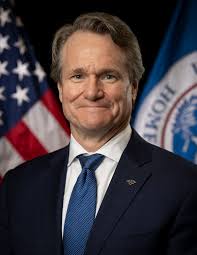
These days, there's so much speculation about the state of the consumer. I don't like to speculate; I prefer to go straight to the source. And nobody takes the pulse of the consumer and the broader economy better than Bank of America, the nation's second-largest bank by assets, which, by the way, has put up a nice 14% gain year-to-date. Earlier today, I had a chance to sit down with Brian Moynihan, Chairman and CEO of Bank of America, right here at the New York Stock Exchange. Our conversation comes as we approach the 25th anniversary of September 11th, with Bank of America making new commitments to organizations dedicated to honoring the victims, first responders, and their families. Take a look.
I want to talk about 9/11. We're on the eve of it. I think your bank, both charitably and as a commercial enterprise, is responsible for a lot of the rebirth here. Why don't you talk to me about Bank of America and your role in an amazing turnaround that is downtown?
So if you think about Bank of America, this building is an important part of the tragic legacy around 9/11 because, you know, this is where America's epicenter of the financial markets happened, and the job was to get this back up and operating. That was the job because we had to get the securities markets started. But if you think about the legacy we had—Merrill Lynch is now part of the company, we had FleetBoston, which was the Quick & Reilly specialist business, and then we had Bank of America, we had U.S. Trust—and so all those companies are now part of one company.
So as we look back, the stories from my teammates about going through that day are amazing. And the story is immediate: we're not going to let them get us down, we're going to beat this back, we're going to reopen, we're going to put America back in. And all of us who worked in this industry, who are fierce competitors, worked together to say, how can we get the securities markets back up? A lot of corporate issuers, remember, said, we're going to buy back a bunch of stock on Monday, we've got to go, and then recovered. And there was a lot of work, and there was a lot more work. But it was a story of resiliency, unity among the country, and just fabulous personal stories of recovery and resiliency, horrible stories of loss and grief. And, you know, I think back about it a lot because I was literally on my way down here when that plane hit. And you just wonder—that was terrorism at its worst because they took something as ordinary as flying and turned it into a terrorist act, and America felt unsafe.
And President Bush, the city, the stock exchange, all the financial services companies, all Lower Manhattan recovered. And then since then, you've seen this: this is a vibrant place now. My daughter lived down here for a bunch of years. Kids are back down here running around. It's just a whole different place than it was in the aftermath. It was like it's never coming back. And then even we built our building at Bryant Park in a place that was not well built back then, off in Times Square. We built that building with Liberty Bonds, as they were called, to help rebuild Manhattan because nobody was investing in Manhattan. And we put the building out, and we ended up occupying by 2007 or '08 or whatever it was. So think about how fast for a 51-floor skyscraper to go up. And we're not alone. But our company supported veterans, first responders, and we just recently announced another grant to Tunnel to Towers. And we've been doing a lot of work across the last 15 years—probably $100 million for veterans and first responders.
You're always, I felt, a soft touch.
Well, we're hard business people, but we have a heart.
You do, you do. Now let's talk about present day. We're in a remarkable moment. You have the best data, and the data show that things are pretty darn good in the country. Yeah.
So think about what would be the indices—take the opposite. What would be the indices of problems? Consumers wouldn't be spending. Consumers spent in the month of August about 4% more than they spent last August, which is a pretty good month because that's after Liberation Day and the recovery. Last quarter, it was 5%. So it's ticking along; that's consistent with a strong, growing economy. The second issue would be credit. Our credit statistics are as good as they've been for years—the charge-offs and consumer delinquencies and credit cards. You hear about record outstanding balances of credit cards, but the economy is 40% bigger, whatever it is, since '19. Everybody compares it. So what you've seen is the recovery back to trend.
And then if you look at businesses, business credit is very strong. People are using the lines of credit, investing. That's been a little slower to come back after the pandemic just because of the uncertainty of trade tariffs—you pick the issue of the moment—but they're strong, their credit is strong, they have the ability. It's more costly, and the place that higher rates affect is small or medium-sized businesses who borrow on lines of credit. That's the big place. It affects mortgage rates, but where it really affects the short-term rate structure is there. So, but they're borrowing, they're using the lines of credit, quality is good, and they've figured out in a world where a lot of things are changing, they've figured out a path forward pretty much. They still worry about gas prices and how it affects product prices, but everything we see is fine. The capital markets had a gangbuster second quarter.
Every year, numbers are great growth stock numbers.
Yeah, our earnings were up 30% and things like that. We had a great quarter. What's interesting is that level will be hard to sustain, the growth rate at that level. But the aggregate level, the S&P and stuff has stayed, and that's good for the wealth management business. Investment banking fees are a little bit bounced around, but there's just a lot of activity last year in comparison. It was a good quarter. But we feel very good about deposit growth, loan growth—the stuff that makes the American economy visualized. And consumers are spending, consumers are employed, and wage growth—we see wage growth in the lower-income group because we see their paychecks coming through.
The lower income—we had that K-structure converge a little. The most recent numbers you have are very encouraging for the people who are less well-off in the country.