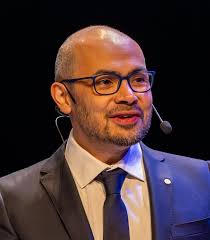
Quick and easy questions. Please try to answer in one sentence, sometimes one word.
Oh, wow. That's even harder.
Demis, I don't know if I told you, but my mother recently got some health scan results. It was a massive video file, and we had to wait for weeks for the evaluation, and we were really anxious. And then I thought, wait, Gemini, long context, you know, why not give it a look? And it analyzed the scan and said don't worry, it's fine. And later the doctor verified that it nailed it. And I am really grateful for that. And I was about to say thank you. But in the meantime you also released Gemma 4, free local AI that can likely do the same with a little compassion. Just wanted to say these are a gift to humanity and thank you so much for doing this for the little man.
Fantastic. Well, I'm glad to hear that. And I'm glad to hear your mom's fine, but we've had a lot of anecdotes like that of people using Gemini for health reasons and actually in some cases life-saving advice. So I think it's an incredible use case. So I'm glad it helped.
Yeah. Thank you very much. Now, Jensen Huang of Nvidia says that he uses LLMs as a confidant for decision-making. What about you? Do you use Gemini for things beyond research?
Yes. I don't use it quite as a confidant yet, although maybe at some point I will. I use it a lot for brainstorming. So, you know, project ideas, project names, creative ideas. I quite like it as a kind of sparring partner for that. And that's probably the main use. And then I also use it to look at and summarize some new area of research, some new body of research I'm not so expert in but I want to get a quick take on the main key points.
Do you use it to get your ideas criticized? Like fire up Deep Think, you know, Mathematical Olympiad, and now criticize my idea?
Yes. I mostly use it for helping me kind of think through some of the steps I've been thinking of as well. I mean, I guess you could call it critiquing it, but I try it in a more collaborative frame rather than maybe I should try it with more like be harsher, come up with the flaws in this. But I definitely use it as a kind of sparring partner.
Amazing. Now, when I heard you got the Nobel Prize, I thought finally some proper recognition for the theme park AI.
Exactly. Exactly. Took a while.
Yes. And then I heard John Jumper say something that really stuck with me. He said that he's looking forward to seeing someone use your Alpha technique to invent something to win the prize. I thought, let's call it the second-order Nobel. So, do you expect that to happen?
Second-order Nobel. That's a really interesting idea. I think it's possible given the number of researchers who are using AlphaFold, you know, over 3 million at this point, and they're all doing incredibly important and impactful work. So, yeah, I guess that John's right, that may happen at some point. That would be an amazing moment.
Amazing. Now, you have a system called Co-Scientist that can invent new things. Can you tell me about it?
Yeah, you can think of Co-Scientist as a sort of fine-tuned version of Gemini that's specifically with extra tools and extra harnesses on top that is specific for helping with hypothesis generation, helping you analyze data, helping you summarize literature as well. So, it's the beginnings of a kind of almost like having a great research assistant that's helping you in your daily work.
It's incredible. By the way, the new hypothesis generator, they also tried it. Gave it some ideas. And then it was interesting because it wants you to narrow down the idea because you just say something and then the result was absolutely amazing. I waited eight hours and then I was like, this is incredible. And I tried it on my original area, ray tracing, global illumination, very little training data, very few people do that. So I think it's pretty cool to see it perform on that, not just on...
And it came back with some interesting, sensible ideas that helped you?
Okay. I wish I had more time.
Me too. Me too. This is the problem, is actually finding the time now to do that. We almost need, I feel like we almost need really good AI assistants to help deal with our admin work. We have to do all of that stuff. So we have more time for using Co-Scientist.
Right. This is my dream too. On April 20th, 2025, you said, 'I think one day maybe we can cure all disease with the help of AI, maybe within the next decade. I don't see why not.' When I saw that, I got so excited. I made a website for that. curealldisease.com. And I have some data in there and I wrote, 'Check back often because I will update it with new data.' And never updated.
Yeah. Well, we're working hard. No, yeah, but it won't be a gradual thing. It'll be more like AlphaFold is the way I'm thinking about it. We're building Isomorphic Labs and also our spin-out, and also at DeepMind as well in our science group, more and more tools. You can think of it as building a platform. You know, AlphaFold is one of the components of that, the advanced versions of AlphaFold. But as you know, protein structure is only one component. It's an important component but it's only one step in the drug discovery process. So we're building, you can think, another half dozen to a dozen AlphaFold-level models that are on different parts of the drug discovery process. And then we've got to put that all together and of course test it on some disease profiles, which is what we're doing now in pre-clinical stage. And then once we've proven that out, which I think will take a few more years, then we may have an engine that can be applied to, you know, a platform that can be applied to almost any disease area. That's the hope. So a bit like with AlphaFold 2, you know, you get it accurate enough and then suddenly you can fold all 200 million proteins in one year. So it's going to be more like that. So you may not have any updates on your website for a few years and then suddenly I hope there will be some big breakthroughs where then you'll have, you know, you won't be able to, you'll have to update it every day.
Okay. I think I've heard something similar from Watson's talk. He said that the process is going to be exponential. And then at year five they said that well you're only at, I don't know, 8%. What are you doing? And he said no, that's fantastic. I mean if it's doubling every year we are way ahead.
Yes. He may have been talking about the Human Genome Project probably. That's exactly right. And we've already seen this once with AlphaFold. So, we need to replicate that success. Obviously, it's much, much more complex. And I also meant by that as well that we would potentially have a platform that could come up with those potential cures. You still would need to test them in the clinic and go through that process. That could still take more time.
I think actually AI could also help with that, too. Like stratify patients, maybe predict dosages better, all of those things. So I actually think AI could probably speed that up too. So there's two parts, you know, to drug discovery. You've got to do the drug discovery process and then you've got to do the clinical trials. And right now we're focusing on the first part but I think AI could also help with the second part. That's when we would then have a step change in human health.
So with that I think we are on track, right? So cure all disease in 9 years.
You know, I won't say specifically, roughly that kind of time frame, but I think in the next 10 to 20 years, there's, I don't see any laws of physics that prevent that, right?
And when I read drug discovery papers, it's not my area, but I get really excited and then I ask an expert and they say, 'Yes, exactly what you said, that's just one step and there's a thousand other steps.' So I'm wondering what can we now do with AI that we couldn't before in drug development?
Well, I think what the kind of things we're working on is, so there's obviously there's advanced versions of AlphaFold. You can imagine we can predict lots of interactions now. So not just a static picture of a protein, proteins interacting with other proteins, proteins interacting with molecules. And then the hard parts are then predicting what is it going to do in the body. So when you know where does it bind to, are there, you know, what's the ADME properties, absorption and toxicity, all of these things which ends up being side effects. So we've got to build models that predict all of these different things and then put that all together. As well as like kind of biochemistry models of like what exact compound would you design and how is it going to be made and how and where will it bind to the particular pocket or whatever it is that you're targeting in the protein.
My impression is that there's a lot of things in drug discovery that we cannot do at the moment and we will be able to do with AI. What are the things that we cannot do at the moment and you see that that's maybe not changing? I don't know, maybe something about regulations that evades physics basically.
Regulations obviously that's a bit outside the scope of AI to help with, but what I hope with there, you know, if you think about regulations, FDA, these types of things, obviously they're an incredibly important part of the process but they could be sped up like we were saying earlier with more evidence that once a few AI-designed drugs I think get through the whole regulatory process then you might have enough data, say there's 10 AI-designed drugs and nine of them worked, right, then you would be able to back-test how accurate really were your models in their predictions? Which ones can you trust, which ones can't you? And then that would be evidence to the regulator. I think that some of those processes could be sped up and maybe some of the steps could be skipped or replaced with something more efficient. But I think it's going to require evidence first of all that a few of these AI-assisted or AI-designed drugs get all the way through to actually help the patient in the probably traditional way and then we can change, you know, maybe think about changing the way that's done.
Maybe similarly as what we had with the mRNA vaccines, right?
Yes, potentially, right. So, you know, there was a new technique, there was this emergency need obviously with COVID and then that accelerated the tests and the trials on those things. You know, that's one potential way it could go. But I don't think there's, I mean, this is something about human health for the next, you know, next 10 centuries, right? We don't need to rush it in the next 5 to 10 years. But I just think what I see is such exciting technology coming down the road. I just think anything may be possible.
That's incredible. Now, as a former player, can you tell me a bit about your new partnership with the EVE Online game?
Oh yes. Oh, you're a former player. Oh yeah. Okay. Fantastic. Yeah. Well, it's an awesome game and I think its community is very special actually. You know, very rare. The community sort of builds the game too really with the way they build their alliances and factions. It's an incredibly deep game, you know, massive multiplayer. It's a whole universe really that's created not just by the game designers but also by the players. And it has a functioning economy and really interesting kind of dynamic storylines. So, we think that we've admired their work for a long time. I know Hilmar, the CEO of the company very well. We're good friends going way back to when I was still doing games and we think it's a fantastic sort of sandbox if you like for testing out some interesting AI ideas that will help the gameplay and, you know, be interesting kind of to test out how it interacts with economies and the storylines and player alliances and things like that. So it's going to be an interesting proving ground. I think fascinating for the game and the community and also like they've always been at the cutting edge really. So this is continuing that tradition and then for us it's also continues in the tradition of DeepMind of using games as a safe kind of proving ground.
Would the concept work in a way that some AI agents would be embedded playing with the players?