Back
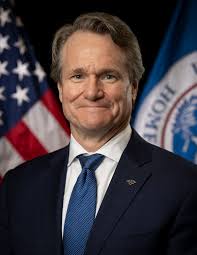
Brian Moynihan
Chairman & CEO, Bank of America

Full interview: Bank of America CEO Brian Moynihan

🎥 Jul 16, 2026 📺 Face the Nation ⏱ 20m 👁 15938 views
Watch Margaret Brennan's full interview with Bank of America CEO Brian Moynihan, a portion of which aired on July 19, 2026. Editor's note: This interview was taped on July 16, 2026. "Face the Nation" is America's premier Sunday morning public affairs program. The broadcast is one of the longest-running news programs in the history of television, having debuted Nov. 7, 1954, on CBS. Every Sunday, "Face the Nation" moderator and CBS News senior foreign affairs correspondent Margaret Brennan welcomes leaders, newsmakers, and experts to a lively round table discussion of current events and the la...
Watch on YouTube

About Brian Moynihan

In media appearances in mid-2026, Brian Moynihan discussed the U.S. economy and consumer behavior, describing what he called a "say-do paradox" in which consumer sentiment surveys show worry about affordability while Bank of America's internal data shows spending growth of about 5-6% year-over-year. He said that the bank's 70 million customers moved about 6% more money out of their accounts in early July 2026 compared to the same period in 2025, and that income growth was occurring across all income cohorts. Moynihan stated that Bank of America's research team had raised its 2026 U.S. GDP growth forecast to 2.2% and expected global growth to remain steady at 3.2%. He also said the bank's economists believed inflation would remain elevated into 2027 and 2028, and that the Federal Reserve might raise rates rather than cut them. Moynihan addressed artificial intelligence, stating that the bank was spending about $350 million on AI-related initiatives in 2026 as part of a $13 billion technology budget. He said the bank had about 100 implemented AI projects and that 200,000 employees had access to AI tools on their daily platforms. He expressed "serious concern" about AI models such as Anthropic's Mythos, saying they represented "a big change in the amount of work that will have to go on" regarding system vulnerabilities. Moynihan also discussed the bank's sponsorship of the FIFA World Cup and its "Sports With Us" program, and announced a $2 million donation to provide tickets for veterans and first responders through the organization Vet Tix.

Source: AI-verified profile updated from Brian Moynihan's recent appearances. Browse all interviews →

Transcript (28 segments)
M
Margaret Brennan0:00
We're joined now by the president and CEO of Bank of America, Brian Moynihan. Welcome back to Face the Nation.
B
Brian Moynihan0:06
It's great to be here again, Margaret. How are you doing?
M
Margaret Brennan0:09
Doing well. I want to ask you about though how Americans seem to be feeling these days. You've got some unique insight. Our polling shows 22% of Americans say economic affordability will be America's biggest challenge over the next 50 years. They seem to really be doubting that their living standards are going to be improving. What are you seeing in terms of how consumers are actually behaving?
B
Brian Moynihan0:35
Well, affordability is a challenge, a talked-about challenge that we see in our customer base. But as you look at what's really going on, we see a couple things. One is the consumers at our 70 million consumers who spend about $400 billion plus a month are spending about five or six percent more money this month, month of June of '26 versus '25, and likewise in the first part of July here. So they're spending money, and you know, while the consumers reflect on higher gas prices or higher food prices and inflation and things like that and they're worried about it, what you see is especially of the middle third of households and the top third of households by income, their spending is growing faster. What's been interesting frankly in the more recent past in the last couple months is we're seeing the wage growth of all income cohorts kind of coalesce together around three to four percent, which is good. So at the end of the day, how consumers feel is critically important to their future desires to purchase and demand. And we watch that, but we also watch what they're doing today, and today they're spending at a pretty good clip and faster than they did last quarter or last year.
M
Margaret Brennan1:42
So they're holding in there even though we're seeing gas prices have raised the cost for drivers by 31% since this war with Iran began. I know fuel inventories remain low. How are you thinking about how this geopolitical uncertainty factors into planning?
B
Brian Moynihan2:01
So the price of oil and gas affects not only the gas at the pump, which is what you're first reflecting on, and that is up. It actually started coming down, and if as the oil prices rise, it might rise back up, but it basically when we were running around $100 barrel equivalent oil, you were running about a $4 and change gas price. It actually came down from the month of May to June because that's when the oil started flowing more. But I think if you talk to businesses, it's different what consumer sees and in a concerning nature of that is out there. But when business see it, they worry about the cost of goods that's coming through the pipeline. So the goods are being manufactured now have imported that oil and gas to go into the plastics production or the material production or the whatever it was during the time when gas prices were high. That's why our team has inflation staying higher all the way into '27 and '28 and why the Federal Reserve will probably, you know, our belief was we'll raise rates, whereas six months ago they thought the Fed would be cutting rates. They're actually believing they'll raise rates to fight off this inflation and it will take them a while to get through it.
M
Margaret Brennan3:04
So raise rates. You think the Fed will act as soon as next week to do that, or excuse me, end of the month to do that?
B
Brian Moynihan3:10
I don't think so, more towards the end of the year. Our team has them raising rates, and you know, I think based on the recent data that came out, they had three rate rises. Whether they hold that with some of the inflation numbers, but the reality is it's sort of the tail end of this year into next year, and it really will depend a lot on the path of other price cohorts other than just oil and gas at the pump. And that's a question of what's going on in housing and food and other places where you're seeing some progress being made, it's drifting down, and it's drifting down slower than people would like it, but the reality is this type of inflation takes a long time to squeeze out of the system. When you go back to the post-pandemic infusion of cash and infusion of activity, that just takes a while to squeeze out.
M
Margaret Brennan3:54
You say the consumers holding in, but I was looking at some of your research and it says credit card delinquencies are elevated. They are rising and that seems to be from younger consumers. So are individuals just choosing to live beyond their means with a statistic like that, or does it imply that people are unable to keep up with their cost of living?
B
Brian Moynihan4:15
Yeah, there's some confusion out there. Our credit card delinquencies and frankly mostly industry delinquency came down, and so what there's been a report out there from the Federal Reserve that actually keeps on the file seven years of charged-off data. So without getting too technical here, that way overinflates what's really going on in the current year. And the reality is credit quality for prime credit cards has gotten better quarter to quarter for the industry and for our company. So that's good news. At the end of the day, it's coming back to whether consumers are employed or not. The unemployment rate of 4.2%, wages grow, excuse me, jobs growing somewhat, claims for employment were 28,000 this week, you know, which is low. That's all pretty good and stable. And if you listen to the teammates we have, you know, the fact that that's going on means wages, employment stability is there. Now they got to get to inflation and that's the part of wages. So I think consumers have a lot of borrowing capacity. The line usage of our home equity lines is still way below where it was in 2019. The value of homes is up a lot. People aren't moving as much. They're capturing that value. They could, they aren't selling to get it, but it's sitting there. And so their household carry as a percentage of their income is in line with normal times. It's the inflation that gets on their mind and affordability because that's a sticker shock question and it takes a while to get that to flatten out and through the system, and I think that's what you're seeing in the dialogue. But credit card, what you're reading about has a little bit of confusion there. People using points to pay everyday things. That's what our team said. But that happens. It's a little, that's what they do with it because our rewards program is a lot about the cash back on the card.
M
Margaret Brennan5:50
Got it. So when you're talking about factors in driving up inflation, one of the things that the Fed chair Kevin Worsh was asked about was whether AI investments are also, you know, inflating things. He told lawmakers there's a supply shock, but he doesn't view a one-time change in prices as inflationary. How do you think about AI and how it's factoring in here?
B
Brian Moynihan6:14
Well, I think you know Kevin being a well-versed economist, they talk about supply shocks and once it's in the baseline, it goes out of the growth rate a year later and things like that. And that's important, but the question is what's the nominal price is what human beings pay. And so when they see prices go up, they're concerned. And that's the general issue about oil $3 or four or gas price of three or four hits them. When you think about on the institutional side, the corporate side, the real question is if inflation in goods and services or inflation in chips and things like that goes up, you have to be able to price them through. And that tug-of-war is going on and our ability as a consumer of that activity of AI technology, whether it's the data centers to support the AI models, the models themselves, etc., is going to be geared by what we can get out of them. And so when we look at Bank of America, how we apply AI, we look at a business case. Does the amount we spend for the capacity, the capability, whatever, is it offset by more revenue or less expense and more productivity? And we look at that in every case, and I think that will be a little bit of a gating factor of the implementation as people try to find that business case. But it's true that it's inflationary short term, it's true that goes out of the base, that becomes goes out of the math over the course if it sits and it goes up and then stays there and doesn't go further up. But the reality is when people who are actually paying for all this look at it, we have to think about does it make economic sense, and we're looking at nominal price versus what we can get out of it.
M
Margaret Brennan7:41
Well, I want to ask you about what's happening with those companies because when we looked at Bank of America's earnings recently, you had record sales and trading revenue in the quarter past. A lot of that, some of it churn from energy price swings, but some of it seems from the tech boom of these massive AI companies and the public listings. How do you think about that what looks like a tech boom?
B
Brian Moynihan8:09
It's absolutely a strong market for technology and other IPOs. There's biotech, there's biology, there's drugs going out getting IPOed and things like that. There's M&A activity. And so when you're talking about the investment banking activity of Bank of America, it was up 70% year-over-year or something like that, and our peers were up like amounts, at 50%. Actually, that has a lot to do with the amount of activity our corporate clients are doing, in part also comparing to last year which was liberation day quarter. The good news is at our company, the nominal dollars we earned in the first quarter and second quarter went up in investment banking, and that's reflecting the environment around us. We held our market share, gained a little bit here and there, but it's really around debt issuance, equity issuance, IPOs, and M&A activity, all of which are very strong, and the pipelines are very full, which is good for the American economy because that activity is always generating something. Premiums that people get to spend when they sell their company and invest, it's creating debt proceeds that can be invested in the growth of the company or buying equipment or employing more people. So that economic activity is good for the country, and Bank of America is benefiting as are our peers.

M
Margaret Brennan9:19
Yeah. Jamie Dimon said it's getting close to as good as it gets. We just don't know how long it's going to last. I guess you're in that same camp. You don't know how long this is going to last.
B
Brian Moynihan9:30
That's always the pipeline. We measure what we call pipeline. So what's the forward activity that hasn't yet been booked? In other words, the deal is in process, and that activity is as strong as it's ever been. The nominal amounts strong as ever been. And it all depends on the markets staying stable and the windows staying open so stuff can get through it. But it's pretty good. Now, by the way, our consumer business made $3 billion after tax, and the team did a great job there. The returns on every business grew. The revenue growth was strong, and the profit margins increased. And that's good news, and frankly our employees benefit by it as do our customers. But you know, everybody talks about Wall Street, it's a much broader economic backdrop which is pretty strong with the US economy growing 2% plus.
M
Margaret Brennan10:17
Well, it's fascinating because Wall Street is benefiting from this IPO boom around AI, but it is the state of New York where you are sitting right now that has now become the first state to bar the construction of large-scale data centers. There's just so much political heat around this idea of not in my backyard, and the president argues this is all a driving force for jobs and a good thing. Do you see more states following suit?
B
Brian Moynihan10:43
Well, you can read the articles on a day or week basis of the tug-of-war. Look, America's been around for 250 years. And one of the great principles of America's private landholders, ownership of your land and a right to control your land and a right for community to control its land and states' rights and city rights and town rights. And so this is a classic struggle of land use, and everybody's working it through, and everybody will work it through differently. Whether it's the stories about New York putting a pause on further development while they try to figure out the dynamics of electricity pricing, water pricing, and things like that. There's other states saying build, Louisiana has a major facility going in. So I think we see it handled differently, but it really comes down to America being America. My community, my town hall, my town meeting, my mayor, my council deciding what they want to do, or my governor. And I think that's where the population is trying to figure it out. And so there's a pretty good tug-of-war going on. But I think the facts ought to get on the table, the decisions ought to follow what people want for their community, and then frankly, the data center builders will go to the communities that want them.
M
Margaret Brennan11:48
Mhm. You mentioned earlier the liberation day quarter. I think that was a reference to the surprise tariff regime a year ago from the president which has changed dramatically in the time since. One of the things you talked about as a big uncertainty for small businesses when we spoke back in December was labor availability due to changing immigration policies. We got a little more clarity from the Supreme Court at least on one part of that. But I wonder what you think about how small businesses are dealing with those labor strains and how much of this is also a factor in the housing situation we see right now.
B
Brian Moynihan12:30
Well, I'd make it a broader statement in terms of the construction industry which had 0% unemployment and obviously benefited by the immigration in the country for worker supply. And you know, whether it's commercial construction or residential construction and housing industry to your question, all of them are facing demands and shortages not only for general labor but also technical labor, welders and things like that. And so you know, there's work going on to develop those skill sets more deeply in the United States, but the slowdown in people coming into the country creates a deficit of workers in those areas. And the principle is that we will then retrain people to do those jobs, but that takes time. And so you know, it's got to work through the system. I think it's been pretty stable now, in other words, the restrictions have been pretty stable for a series of months now, but it's still on the minds of small business. Getting labor is one of their tough jobs, and we make that clear that that's one of the constraints that they face. And so, you know, there's a belief AI productivity and stuff will help companies like ours in the service business, but in the construction business, a lot of it's going to be done by good solid work, and that work is not going to get done as fast if we don't have the people to do it.
M
Margaret Brennan13:41
Well, you are in of course the mortgage business as well. And when we talk about housing, there was this recent law, the Road to Housing Act, that's trying to help make housing more affordable for everyday people. It does a lot of things, unlocks more federal funding for factory-built homes. It also limits the purchase of single family homes by institutional investors. Do you think this is going to make much of a difference for people who are looking to buy?
B
Brian Moynihan14:09
All these things help with the margin, but the number one thing when I talk to in cities across America to mayors or whatever the governing authority is, is you have to if you want your housing prices to flatten and come down, you're going to have to build more supply because usually that's the problem. It's a supply problem. And that goes back to the land use question we talked about earlier: will you permit projects faster? Will you help them get through the system so they can get in the ground faster and get to production faster, therefore lowering the financing costs and the carry costs and just be a cooperative thing for housing development? That's the number one issue. That is a local question. And what the federal law passed is it's hard for them to affect that, but they put a lot of other things to help around the edges. But the reality is it's down to the cities and towns saying if I've got a shortage of housing, I've got to get developers in to build it. Now, we have a great practice in helping developers. We do about $5 billion a year in tax equity, low and moderate income housing, and that's been pretty constant. Our mortgages this quarter, our production of mortgages was up 30%. You know, and that means people are moving a little bit more, which in our customer base, and we see that elsewhere, that's good news. But I think, at the end of the day, when you take a city like Charlotte that's 20, 30,000 housing units short, you got to build them, and the mayor and the town council and the surrounding towns know that, and they've got to get that permitted and get it up. And the faster you do that, the faster you start to ease pricing. The good news is in the aggregate statistics, and it's different in every market, you're starting to see these prices mitigate and flatten out. And that's good news. And then the other question is mortgage rates. I don't think they're going to move much in the near term, and you know, but we've had higher rates now for three or four or five years, three years I guess it is, and people are getting used to it. And that's what it'll take. The wage growth will catch up. People's appetites, people who are older will move, and even if they have a lower mortgage, you know, the decision is different than just pure mortgage pricing and things like that. So you're starting to see that move a little bit, but it takes some time getting used to the newer higher rates that have been in place for three years now.
M
Margaret Brennan16:15
So, I know you've got a FIFA sign next to you. And the FIFA World Cup finals are this weekend. The world's going to be watching. You're a sponsor. Given how high ticket prices are to these matches, have you been surprised at the turnout at the tournaments and the spending?
B
Brian Moynihan16:32
Absolutely not. What we, our team did a research piece, Margaret, that said the total amount that is economically generated on FIFA is about $40 billion. $20 billion to be in the US, and even we look in the host cities like Kansas City, we can see the growth rate in spending faster than other cities. So it's having this on-the-ground economic impact, and that spending is going into what we call bricks and mortar. It's going to bars and restaurants and things like that, not necessarily only the people in the stadium. All the tickets, there's 500 million ticket requests. So a lot of the dialogue that I guess I'm told happens between before every World Cup that all the seats are going to be sold. They're all sold. The people are showing up. They're having a great time. If you go to a game, you know, they keep the stadium open two or three hours after. I was in the quarterfinals in Boston, and the place was full, and three hours later I went out after having dinner at one of the places nearby, and the parking lots were full of people still enjoying it. And so it's an unbelievable phenomenon. I think the United States hadn't seen for a while, seeing again. And to put it in context, they're estimated two billion people watched the finals on Sunday, which is just an amazing amount. And that's what the brand strategy for us was. We had a great quarter internationally. We have a great international business. It's a very important part of what we do. This in the rest of the world is a statement of Bank of America support of what's important in the United States. It's a statement that too. We sponsor USA soccer. We're putting fields in locations. We did $2 million worth of tickets for veterans and first responders that we gave to them to get them in the games. We're doing soccer in schools with street soccer, street kids soccer. We helped sponsor the Street Child's World Cup soccer, which is a different organization outside the United States. We have a wonderful commercial featuring David Beckham and a new song. It's been a fabulous amount of work, but at the end of the day, it's a worldwide phenomenon of which we've been a part of, including the fan bands, and I saw some colleagues or some customers that were standing in line since 4:30 this morning to get in at 10:00 to get their fan bands up in Rockefeller Center. So it's been wonderful to be a part of this. The stadiums are sold out. It'll be a fascinating final on Sunday, and we look to be a part of it, and then we'll continue to promote soccer, and in fact the accessibility of soccer in the schools is one of the major tenants here, in fields and places otherwise not have, is another major tenant of what we're doing that will last way beyond the phenomenon of the World Cup that will come to a close here in the US on Sunday.
M
Margaret Brennan19:10
Yeah, I've read ESPN called it the largest sports investment Bank of America has made in its history, a global sponsorship. Why are you just a huge soccer fan or is it the two billion viewers?
B
Brian Moynihan19:24
Look, we grew up with our kids playing soccer. I never played the game. This is a business decision to help generate support for our communities that were hosting the games and support for our brand and our sales. And so, you've seen this new Bank of America rewards program we have out there. It's gone up tenfold in terms of daily signups. Our credit card, our FIFA credit card. These are things we're promoting. So that's the economics, that's the classic sort of brand analysis. But the reality is we also believe strongly that broadly participating in things, whether it's the Golf with Us program, the Soccer with Us program, the Museums on Us program we have, provide access to museums, the running programs we do, the My Marathon campaigns or the Boston Chicago marathons and the other races around that all to raise money for charity. These are all things that get broad participation that we can help support and help our communities grow and prosper. It's just a part of what we've done. So yes, it's a major investment, and we're very happy with it.
M
Margaret Brennan20:20
All right, Brian Moynihan, thank you for your time today.
B
Brian Moynihan20:22
Thank you, Margaret.